Open Access Publisher and Free Library
CRIMINAL JUSTICE.jpeg

CRIMINAL JUSTICE

CRIMINAL JUSTICE-CRIMINAL LAW-PROCDEDURE-SENTENCING-COURTS

Posts in rule of law
Miscarriages of justice : exception to the rule?

Michael Naughton.

This thesis explores the ways in which miscarriages of England and Wales' criminal justice system (CJS) are currently defined, quantified, constructed and deployed. Presented in two parts, the first identifies and argues against the pervasive but problematical tendency to conceive miscarriages of justice as exceptional occurrences, that are small in number, and that result from post-appeal procedures once existing appeal opportunities have been exhausted. In fact, the evidence is that a successful appeal against criminal conviction forms a routine and mundane procedure of criminal justice in England and Wales. This indicates a need both to re-orientate definitions and understandings of miscarriages of justice and to re-calculate the likely scale of the phenomenon, an attempt at which is then offered. The second part of the thesis involves a broader plane of analysis, examining a range of discourses which articulate challenges to, or reforms of, the CJS, with respect to miscarriages. In so doing, a critique is developed to show that counter-discourses against miscarriages of justice are hindered by their problematic definition and the consequential calculation of miscarriages as a small-scale statistical phenomenon. They also labour under a misconception of the relations of power in the sphere of criminal justice. This severely diminishes the potential force of critical counter-discourse in the existing terrain. As a possible way out of this malaise, a Foucauldian-inspired understanding of the inter-relations of power, knowledge and `governmentality' is brought into dialogue with the emerging zemiological perspective, which seeks a more holistic appraisal of the harmful consequences of social and political decisions in the interests of social justice. The critical and reconstructive moves that I recommend enable miscarriages of justice to be thought about in new ways and to help assess what is to count as effective counter-discourse. The thesis, then, represents a determined effort to re-orientate our understanding of miscarriages of justice by moving away from `exceptional ism'. This encourages new ways of defining and quantifying miscarriages of justice and new ways of developing theoretical resources. The ultimate point of the thesis is to contribute towards the production of more effective counter discourses that might achieve lasting practical change in this area of social regulation.

Brighton, UK: University of Bristol, 2003. 313p.
download
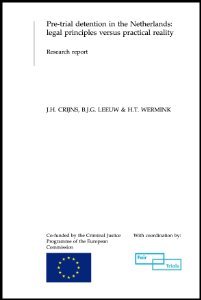
Pre-trial detention in the Netherlands. Legal principles versus practical reality: research report

By Crijns, J.H. ; B.J.G. Leeuw, and H.T. Wermink.

The goal of this report is to provide an overview of the use of pre-trial detention in practice in the Netherlands. In recent years there has been a lot of discussion and criticism of the (extensive) use of pre-trial detention in Dutch criminal procedures. In this report we will assess whether this criticism is justified, and if so, what steps need to be taken to alleviate the concerns that exist regarding pre-trial detention. The overarching conclusion of our research is that Dutch legislation on pre-trial detention meets the relevant standards of the European Court of Human Rights (ECtHR). This leads us to the conclusion that legislative changes are not strictly necessary. However, our research shows that the way in which the legal rules on pre-trial detention are applied in practice is rightly criticised by defence lawyers, academics and even judges themselves.

The Hague: Eleven International Publishing Co., 64p.

download
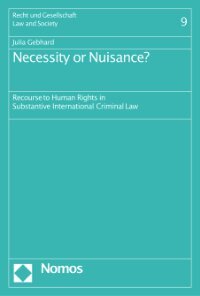
Necessity or Nuisance?

By Julia Gebhard.

Recourse to Human Rights in Substantive International Criminal Law. What are chances and challenges of referring to human rights law in defining crimes under international law? Under what circumstances is a reference to human rights law dogmatically appropriate and practically likely? The answers to these questions are explored through a look at the theoretical framework, practical application in jurisprudence as well as empirically through interviews with judges. By highlighting the common roots and the differences between both areas of law, the existing inconsistencies in the application of the law, as well as approaches which could contribute to their solution, the book presents a crucial contribution to the debate on legal certainty and innovation in international criminal law.

Baden-Baden, Germany Nomos Verlagsgesellschaft mbH & Co. KG, 2018. 296p.

download
Court reform

By Adriaan Bedner.

At present, virtually everyone working in the field of development agrees that reform of mal-functioning court systems is central in promoting good governance and rule of law. Unfortunately, however, the record of court reform attempts is not very heartening. Those who intend to reform must take into account a complex set of courts' relations with other state agencies, dispute resolvers, and actors in the state legal system, but they also depend heavily on the quality of legislation and legal education. In reaction to this complexity, three types of strategies have been common for court reform programmes: the 'holistic', the 'tactical', and the 'strategic' approach. This Research and Policy Note discusses strategic court reform and its underlying ideas. Its main intention is to alert those involved in judicial reform to some of the pitfalls and choices connected to particular types of interventions. The concluding remarks will comment on the political nature of judicial reform and on a model to design a proper sequence of interventions for judicial reform.

Leiden: Leiden University Press, 1008. 33p

download
Law, Privacy and Surveillance in Canada in the Post-Snowden Era

By Michael Geist.

Years of surveillance-related leaks from US whistleblower Edward Snowden have fuelled an international debate over privacy, spying, and Internet surveillance. Much of the focus has centered on the role of the US National Security Agency, yet there is an important Canadian side to the story. The Communications Security Establishment, the Canadian counterpart to the NSA, has played an active role in surveillance activities both at home and abroad, raising a host of challenging legal and policy questions. With contributions by leading experts in the field, Law, Privacy and Surveillance in Canada in the Post-Snowden Era is the right book at the right time: From the effectiveness of accountability and oversight programs to the legal issues raised by metadata collection to the privacy challenges surrounding new technologies, this book explores current issues torn from the headlines with a uniquely Canadian perspective.

Ottawa: University of Ottawa Press, 2015. 298p.

download
Criminal procedures and cross-border cooperation in the EU area of criminal justice: together but apart?

Edited by Élodie Sellier and Anne Weyembergh.

This book examines to what extent differences between national and procedural criminal laws hinder the negotiations and the operation of cross-border cooperation instruments. It is based on a comparative analysis of a representative sample of Member States.

Brussels: Editions de l'Université de Bruxelles, 2020. 463p.

download
Approximation of substantive criminal law in the EU: The Way Forward

Edited by Francesca Galli and Anne Weyemberg.

This book dedicated to the substantive criminal law in the EU put the Libson Treaty under scrutiny. It evaluates the changes introduced by this new Treaty and their impact, before reflecting on future prospects.

Bruxelles: Editions de l'Université de Bruxelles, 2013. 250p.

download
The Evaluation of European Criminal Law

Edited by Anne Weyembergh and Veronica Santamaria.

The example of the Framework Decision on combating trafficking in human beings. The role of evaluation has become increasingly important in the context of EU policies in the field of judicial cooperation in criminal matters. This evolution is the result of an increasing number of legally binding instruments adopted in the framework of the third pillar of the European Union and of their growing impact on national legal systems. “Trafficking in human beings in the Republic of Lithuania still remains rather a relevant problem – according to the data of the Police Department of Lithuania, 96 persons have suffered from trafficking in human beings in 2006 and the common depersonalised database on the victims of trafficking in human beings, where information is submitted by all NGOs working with persons of this category, had 101 persons recorded in 2006.” (French and English).

Bruxelles: Editions de l'Université de Bruxelles, 2009. 406p.

download
Power and Prosecution

Edited by Kai Ambos, and Ottilia A. Maunganidze.

Challenges and Opportunities for International Criminal Justice in Sub-Saharan Africa. This book contains some of the papers that were presented at the first meeting of the newly formed African Expert Study Group on International Criminal Law / Groupe des Experts Africaines en Droit Pénal International held in September 2011 in Brussels, Belgium. The group was established under the auspices of the Multinational Development Policy Dialogue (hereinafter ‘MDPD’) and the Rule of Law programme of the German Konrad-Adenauer-Stiftung (‘KAS’) in 2010 modeled on the successful sister group in Latin America. This latter group was originally founded as an expert group to monitor the implementation of the Rome Statute of the International Criminal Court (‘ICC’) in Latin America within the framework of cooperation between KAS’ regional Rule of Law Programme and the Department for Foreign and International Law of the Institute for Criminal Law and Criminal Justice of the Georg-August-Universität Göttingen in 2002. The newly formed African group consists of judicial experts with both academic and practical background from various parts of Sub-Saharan Africa. The importance of such a group for the African continent cannot be overestimated. Africa plays a vital role in international criminal law and justice, both as an active player at the ICC and at the regional and national level. As for the group’s composition and outreach, the aim is to broaden regional representation and further consolidate membership. In 2012, the group will meet in Nairobi, Kenya to deal with topics surrounding the ‘Potential for the domestic prosecution of international crimes in Africa.’ Topics for future meetings abound given the multi-faceted African legal and political practice regarding international criminal justice in general and the ICC in particular. The group should in particular monitor the recent international or transnational criminal justice developments at the regional African level as well as relevant national developments.

Göttingen Studies in Criminal Law and Justice Volume 24. 2012. 209p.

download
Do Exclusionary Rules Ensure a Fair Trial?

Edited by Sabine Gless and Thomas Richter.

A Comparative Perspective on Evidentiary Rules. This open access publication discusses exclusionary rules in different criminal justice systems. It is based on the findings of a research project in comparative law with a focus on the question of whether or not a fair trial can be secured through evidence exclusion. Part I explains the legal framework in which exclusionary rules function in six legal systems: Germany, Switzerland, People’s Republic of China, Taiwan, Singapore, and the United States. Part II is dedicated to selected issues identified as crucial for the assessment of exclusionary rules. These chapters highlight the delicate balance of interests required in the exclusion of potentially relevant information from a criminal trial and discusses possible approaches to alleviate the legal hurdles involved.

Cham: Springer, 2019. 387p.

download
On The Witness Stand

By Hugo Munsterberg.

A pioneering treatise of applied psychology that examines the mind of the witness on the witness stand, noting that the field was (at that time) “absurdly neglected.” Topics ranged from the memory of the witness, detection of crime, untrue confessions, hypnotism and prevention of crime.

Harrow and Heston Classic Reprint. (1908) 269 pages.

download part 1
download part 2
The Plea of Insanity in Criminal Cases

By Forbes Winslow.

“This treatise was one of the first attempts to outline criteria through which to determine the legitimacy of an insanity plea. This issue would be resolved later that year with the establishment of the McNaghten Rules, which this work undoubtedly influenced, and which are still applied in England today.”

London : H. Renshaw, 1843. 78p.

download
Public Justice and the Criminal Trial in Late Medieval Italy

By Joanna Carraway Vitiello.

Reggio Emilia in the Visconti Age. “Medieval public justice was characterized by its inherent tensions: tensions between a system designed for crime control and a society accustomed to self-help, and tensions between an ideal of public justice and a culture of private retribution. Criminal jurisdiction served as a primary marker of political authority, and the late medieval criminal court became a nexus of power at many levels—signorial, communal, and judicial. It was also a place where the lives of people from all walks of life came into direct contact with the results of the high medieval legal revolution, which yielded inquisition procedure. In the late middle ages, the dynamic created by these fundamental tensions would transform the history of criminal justice.”

Brill (2016) 232p.

download
Manifest Madness

By Arlie Loughnan.

Mental Incapacity in Criminal Law. Whether it is a question of the age below which a child cannot be held liable for their actions, or the attribution of responsibility to defendants with mental illnesses, mental incapacity is a central concern for legal actors, policy makers, and legislators when it comes to crime and justice. Understanding mental incapacity in criminal law is notoriously difficult; it involves tracing overlapping and interlocking legal doctrines, current and past practices of evidence and proof, and also medical and social understandings of mental illness and incapacity. With its focus on the complex interaction of legal doctrines and practices relating to mental incapacity and knowledge - both expert and non-expert - of it, this book offers a fresh perspective on this topic.

Oxford (2012) 307 pages.

download
The Forgotten Army

By Charity Organization Society of the City.

Six Years' Work of the Committee on Criminal Courts of the Charity Organization Society of the City of New York, 1911-1917: A story of its work for the clean, intelligent and kindly administration of our Inferior Criminal Courts.

Harrow and Heston Classic Reprint. (1918) 58 pages.

download
Contested Justice

By Christian De Vos, Sara Kendall and Carsten Stahn.

The Politics and Practice of International Criminal Court Interventions.“This timely, perceptive book brings together leading scholars and practitioners to reflect on the field of international criminal justice through focusing on a singular institution: the International Criminal Court (ICC). Drawing on a range of experience, empirical work, and normative theory, it seeks to come to grips with a remarkable development – the creation of a permanent, international court meant to adjudicate mass crimes – through assessing the ICC’s work in practice, given now more than a decade of experience to explore. The ICC is a clear innovation in global governance. A relatively new legal institution, it was intended as an evident departure from past exceptional tribunals associated with particular conflicts. “

Cambridge University Press. (2015) 526 pages.

download
Constitutional Challenges in the Algorithmic Society

Edited by Hans-W. Micklitz, Oreste Pollicino , Amnon Reichman, Andrea Simoncini , Giovanni Sartor, and Giovanni de Gregorio.

“ the rise of the bureaucratic state, the technologies for infringing liberty or equality were thought to be containable by the exercise of concrete judicial review… . In recent years, however, the rise of the algorithmic society has led to a paradigmatic change where the public power is no longer the only source of concern for the respect of fundamental rights and the protection of democracy, where jurisdictional boundaries are in flux, and where doctrines and procedures developed in the pre-cybernetic age do not necessarily capture rights violations in a relevant time frame.”

Cambridge University Press. (2021) 300 pages.

download
Justice and the Child

By Douglas Pepler.

“But these enactments are Of little value unless supported by public opinion and executed according to the spirit rather than the letter of the law. There are a few towns where it is determined that no effort Shall be spared to give a lad a new chance, where it is realised that the first Offence will not be the last unless there is skilled intervention by the right sort of person. Where the effort is made it can always be traced to the interest of one person in the fate of one child. The work cannot develop except on that foundation, it cannot exist except there be this personal desire among men to seek and save that which appears to be lost.”

London: Constable, 1915. 163p.

download
Children's courts in the United States their origin, development, and results.

International Penal and Prison Commission

“If the question be asked, What is the most notable development in judicial principles and methods in the United States within the last five years? 'the answer may unhesitatingly be, The introduction and establishment of juvenile courts. Never perhaps has any judicial reform made such rapid progress. Beginning in Chicago in 1899, this institution has sprung up in city after city and State after State until it is now established in eight States and eleven large cities.”

A Read-Me.Org Classic Reprint. Washington, DC: Government Printing Office, 1904. 203p.

download
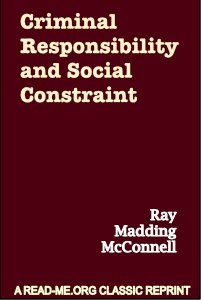
Criminal Responsibility and Social Constraint

By Ray Madding McConnell.

“Among the most expensive functions of government is that which is concerned with the detection, arrest, trial, and punishment of criminals. The expenditures in connection with police, courts, and prisons exceed in amount the outlay for the conservation and improvement of health, the necessities and conveniences of travel and intercourse, highways, parks, and playgrounds, and about equal the costs of education/ When any one begins to philosophize about the raison d^etre of this enormously expensive arrangement for dealing with crime and criminals, he naturally asks first for its purpose —What is the object of it all? What kind of return does this investment bring in? Society has schools for the ignorant. It has accident stations, ambulance corps, dispensaries, and hospitals for the injured and diseased. It has special educational institutions for the feebleminded, the blind, the deaf, and the dumb. It has homes for the aged, the infirm, and the incapacitated. It has asylums and hospitals for the epileptic and the insane. But for the criminals, society has detectives, bureaus of criminal identification, police, judges, jailers, and executioners —houses of correction, penal colonies, jails, penitentiaries^ the gallows, and the electric chair. What is the ground for the difference in treatment that is accorded to this last class? "

New York: Scribner, 1912. 356p.

download