

Denouncing Into the Void: The Dismantling of Internal Oversight and Accountability at DHS
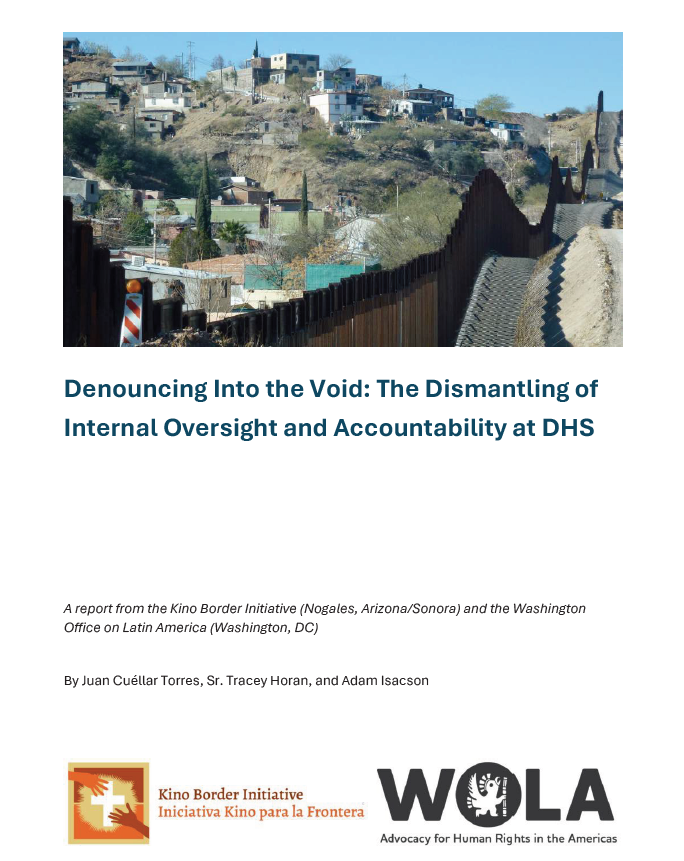
By Juan Cuéllar Torres, Sr. , Tracey Horan, and Adam Isacson
One year ago, on March 21, 2025, hundreds of experienced employees overseeing the Department of Homeland Security (DHS) abruptly learned that the Trump administration was firing them. The Department’s Office of Civil Rights and Civil Liberties (CRCL), Office of the Immigration Detention Ombudsman (OIDO), and Office of the Citizenship and Immigration Services Ombudsman (CISOMB), if not abolished, were to be shrunk to their “absolutely irreducible minimum.” The “Reductions in Force” came at the same time that the new administration was launching a “mass deportation” campaign, supercharging often aggressive arrests, detentions, and repatriations while dramatically increasing the capacities of the Department’s border and migration law enforcement agencies, Customs and Border Protection (CBP), Border Patrol, and Immigration and Customs Enforcement (ICE). This report focuses mainly on the Civil Rights and Civil Liberties office and the Detention Ombudsman’s office, which most frequently oversaw the law enforcement agencies. A year later, including contract personnel, the first has seen its staff cut by 80 percent and the second by 96 percent. Litigation to undo the cuts continues in federal court.
Even before the Trump administration took an axe to them, these offices were far too small and under-resourced to oversee a Department with about 240,000 employees. They lacked the authority to initiate investigations and to make their recommendations stick. As the Kino Border Initiative found during years of submitting abuse complaints on behalf of migrants arriving at its Nogales, Sonora shelter, a lack of transparency was a chronic problem. But since the agencies’ near-total dismantling on March 21, the experience has been far worse. Many complaint investigations have been halted. No new recommendations have been issued. The ability to submit new complaints—through web forms in English—has been truncated. Investigations now stop if the complainant is no longer in ICE custody. Case updates are almost impossible to obtain after receiving a sparse form email. In Nogales, over the past year, the Kino Border Initiative has experienced months of radio silence from offices that were more communicative in the past, followed by a wave of case-closure notices offering no indication that complaints were meaningfully investigated or that any recommendations resulted.
This deep reduction in oversight could not come at a worse time, as regular front-page revelations of abuse and rights violations committed by DHS agencies, from the streets of Minneapolis to the cells of the U.S. detention network, make urgently clear. These times call for more oversight, more accountability, more transparency, and more embedding of democratic, rights-respecting values throughout the Department. This report, from two organizations with decades of combined experience monitoring human rights at the U.S.-Mexico border, contains a series of recommendations to guide a restoration of internal oversight capacity at DHS. While the March 2025 reductions in force must be reversed immediately, the Department can go further. Assisted by new authorities and appropriations from Congress, it can take a series of common-sense steps to uphold the dignity of victims, make repeated abuses less likely, and instill a culture that recognizes that respect for civil rights, civil liberties, privacy, and detainees’ rights is a necessary element of success in securing the homeland—never an obstacle.
Kino Border Initiative (Nogales, Arizona/Sonora) and the Washington Office on Latin America (Washington, DC)
2026. 30p.