Open Access Publisher and Free Library
HUMAN RIGHTS.jpeg

HUMAN RIGHTS

Human Rights-Migration-Trafficking-Slavery-History-Memoirs-Philosophy

Posts in Civil Liberties
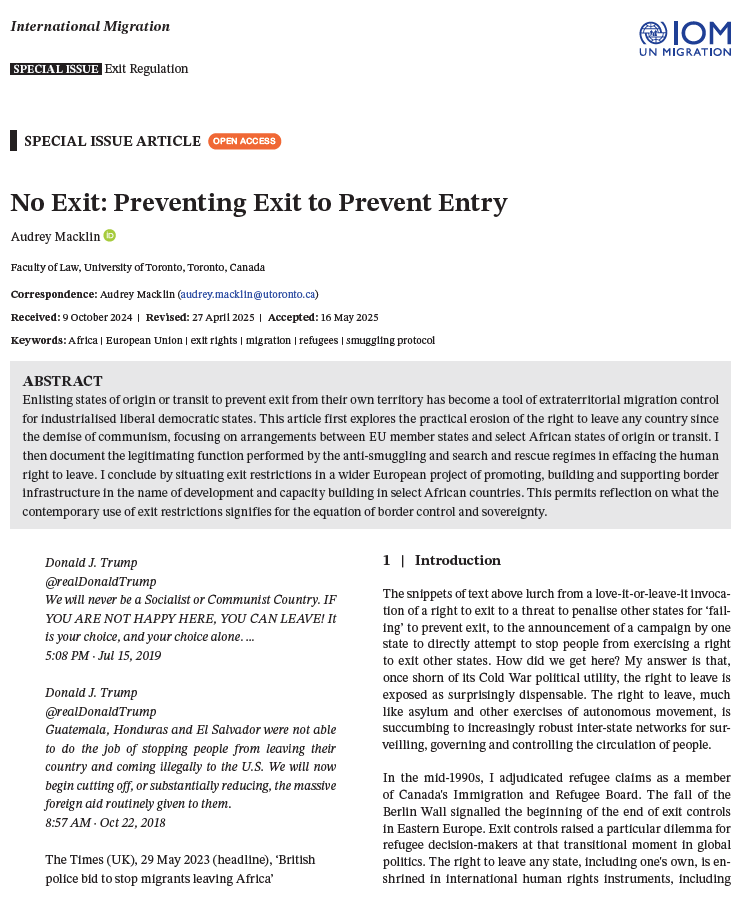
No Exit: Preventing Exit to Prevent Entry

By Audrey Macklin

Enlisting states of origin or transit to prevent exit from their own territory has become a tool of extraterritorial migration control for industrialised liberal democratic states. This article first explores the practical erosion of the right to leave any country since the demise of communism, focusing on arrangements between EU member states and select African states of origin or transit. I then document the legitimating function performed by the anti-smuggling and search and rescue regimes in effacing the human right to leave. I conclude by situating exit restrictions in a wider European project of promoting, building and supporting border infrastructure in the name of development and capacity building in select African countries. This permits reflection on what the contemporary use of exit restrictions signifies for the equation of border control and sovereignty.

International Migration, June 2025

Strengthening Frontex's mandate in border and migration management

By RADJENOVIC, Anja

Issues at stake: • Frontex, the European Border and Coast Guard Agency, is mandated to support EU Member States in managing external borders, combating cross-border crime, and managing migration, through joint operations, surveillance and data analysis. The agency also cooperates with non-EU countries through status agreements and working arrangements, and plays a key role in organising and executing migrants' returns. • The European Commission is considering a revised mandate in 2026 for Frontex to address growing geopolitical, security and migration challenges. Reforms are driven by hybrid threats, the implementation of the new pact on migration and asylum, and demands for swifter returns of individuals ineligible for asylum. • There is broad support among Member States for more flexible, informal arrangements with third countries. While Member States oppose a radical overhaul of Frontex's mandate, they prioritise operational efficiency, particularly in returns and border management, and stress maximising the current mandate's potential before considering major changes. Member States also back a new legal basis for Frontex to support returns from non-EU countries to other non-EU countries. • The European Parliament's discharge procedure has been a critical tool in scrutinising Frontex, particularly amid allegations of fundamental rights violations and pushbacks at the EU's external borders. Parliament has repeatedly warned that oversight has not kept pace with the expansion of Frontex's mandate.

Brussels: EPRS | European Parliamentary Research Service,   2026. 8p.

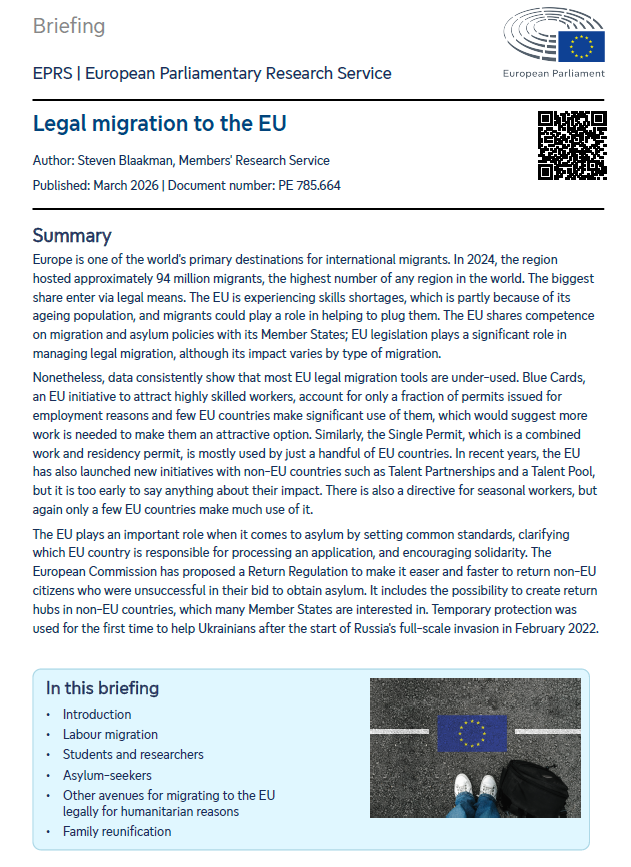
Legal migration to the EU

By BLAAKMAN , Steven

Europe is one of the world's primary destinations for international migrants. In 2024, the region hosted approximately 94 million migrants, the highest number of any region in the world. The biggest share enter via legal means. The EU is experiencing skills shortages, which is partly because of its ageing population, and migrants could play a role in helping to plug them. The EU shares competence on migration and asylum policies with its Member States; EU legislation plays a significant role in managing legal migration, although its impact varies by type of migration. Nonetheless, data consistently show that most EU legal migration tools are under-used. Blue Cards, an EU initiative to attract highly skilled workers, account for only a fraction of permits issued for employment reasons and few EU countries make significant use of them, which would suggest more work is needed to make them an attractive option. Similarly, the Single Permit, which is a combined work and residency permit, is mostly used by just a handful of EU countries. In recent years, the EU has also launched new initiatives with non-EU countries such as Talent Partnerships and a Talent Pool, but it is too early to say anything about their impact. There is also a directive for seasonal workers, but again only a few EU countries make much use of it. The EU plays an important role when it comes to asylum by setting common standards, clarifying which EU country is responsible for processing an application, and encouraging solidarity. The European Commission has proposed a Return Regulation to make it easer and faster to return non-EU citizens who were unsuccessful in their bid to obtain asylum. It includes the possibility to create return hubs in non-EU countries, which many Member States are interested in. Temporary protection was used for the first time to help Ukrainians after the start of Russia's full-scale invasion in February 2022.

Brussels: EPRS | European Parliamentary Research Service, 2026. 12p.

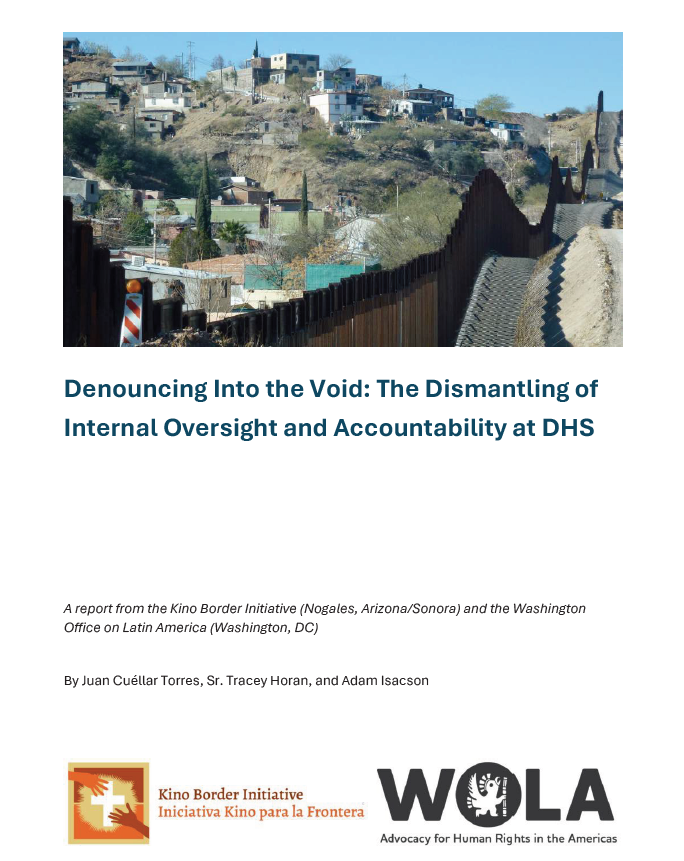
Denouncing Into the Void: The Dismantling of Internal Oversight and Accountability at DHS

By Juan Cuéllar Torres, Sr. , Tracey Horan, and Adam Isacson

One year ago, on March 21, 2025, hundreds of experienced employees overseeing the Department of Homeland Security (DHS) abruptly learned that the Trump administration was firing them. The Department’s Office of Civil Rights and Civil Liberties (CRCL), Office of the Immigration Detention Ombudsman (OIDO), and Office of the Citizenship and Immigration Services Ombudsman (CISOMB), if not abolished, were to be shrunk to their “absolutely irreducible minimum.” The “Reductions in Force” came at the same time that the new administration was launching a “mass deportation” campaign, supercharging often aggressive arrests, detentions, and repatriations while dramatically increasing the capacities of the Department’s border and migration law enforcement agencies, Customs and Border Protection (CBP), Border Patrol, and Immigration and Customs Enforcement (ICE). This report focuses mainly on the Civil Rights and Civil Liberties office and the Detention Ombudsman’s office, which most frequently oversaw the law enforcement agencies. A year later, including contract personnel, the first has seen its staff cut by 80 percent and the second by 96 percent. Litigation to undo the cuts continues in federal court. 

Even before the Trump administration took an axe to them, these offices were far too small and under-resourced to oversee a Department with about 240,000 employees. They lacked the authority to initiate investigations and to make their recommendations stick. As the Kino Border Initiative found during years of submitting abuse complaints on behalf of migrants arriving at its Nogales, Sonora shelter, a lack of transparency was a chronic problem. But since the agencies’ near-total dismantling on March 21, the experience has been far worse. Many complaint investigations have been halted. No new recommendations have been issued. The ability to submit new complaints—through web forms in English—has been truncated. Investigations now stop if the complainant is no longer in ICE custody. Case updates are almost impossible to obtain after receiving a sparse form email. In Nogales, over the past year, the Kino Border Initiative has experienced months of radio silence from offices that were more communicative in the past, followed by a wave of case-closure notices offering no indication that complaints were meaningfully investigated or that any recommendations resulted. 

This deep reduction in oversight could not come at a worse time, as regular front-page revelations of abuse and rights violations committed by DHS agencies, from the streets of Minneapolis to the cells of the U.S. detention network, make urgently clear. These times call for more oversight, more accountability, more transparency, and more embedding of democratic, rights-respecting values throughout the Department. This report, from two organizations with decades of combined experience monitoring human rights at the U.S.-Mexico border, contains a series of recommendations to guide a restoration of internal oversight capacity at DHS. While the March 2025 reductions in force must be reversed immediately, the Department can go further. Assisted by new authorities and appropriations from Congress, it can take a series of common-sense steps to uphold the dignity of victims, make repeated abuses less likely, and instill a culture that recognizes that respect for civil rights, civil liberties, privacy, and detainees’ rights is a necessary element of success in securing the homeland—never an obstacle. 

Kino Border Initiative (Nogales, Arizona/Sonora) and the Washington Office on Latin America (Washington, DC) 

2026. 30p.

An Examination of Public Benefit Enrollment Data in Minnesota Immigrant Households as Evidence of Public Charge Chilling Effect

By Ana Pottratz Acosta

A hallmark of the first Trump Administration was its pervasive attacks against immigrant communities. While President Trump often touts his efforts to ramp up immigration enforcement to secure the southern border, other policies aimed at limiting legal immigration to the U.S. through administrative action had a far greater impact on U.S. immigration policy during his first term. One such action, the promulgation of regulations setting forth more subjective standards to determine if an immigrant was subject to the public charge grounds of inadmissibility, led to the denial of many family-based permanent residence applications that were otherwise approvable under existing law.

In this Article, the Author will examine means tested benefit enrollment data for Minnesota immigrant households to see if this data supports existence of a chilling effect through decreased immigrant household enrollment in these programs following publication of the public charge regulations. Additionally, while several previous studies using survey data support existence of a public charge chilling effect, this Article will build on this previous work by analyzing primary enrollment data provided directly by the Minnesota Department of Human Services (MN-DHS), the agency administering these programs.

 (September 01, 2024).

Policing after Slavery: Race, Crime, and Resistance in Atlanta

By Jonathon J. Booth

This Article places the birth and growth of the Atlanta police in context by exploring the full scope of Atlanta’s criminal legal system during the four decades after the end of slavery. To do so, it analyzes the connections Atlantans made between race and crime, the adjudication and punishment of minor offenses, and the variety of Black protests against the criminal legal system. This Article is based, in part, on a variety of archival sources, including decades of arrest and prosecution data that, for the first time, allow for a quantitative assessment of the impact of the new system of policing on Atlanta’s residents.

This Article breaks new ground in four ways. First, it demonstrates that rather than simply maintaining the social relations of slavery, Atlanta’s police force responded to the challenges of freedom: it was designed to maintain White supremacy in an urban space in which residents, theoretically, had equal rights. Second, it shows that White citizens’ beliefs about the causes of crime and the connections between race and crime, which I call “lay criminology,” influenced policing strategies. Third, it adds a new layer to our understanding of the history of order-maintenance policing by showing that mass criminalization for minor offenses such as disorderly conduct began soon after emancipation. This type of policing caused a variety of harms to the city’s Black residents, forcing thousands each year to pay fines or labor for weeks on the chain gang. Fourth, it shows that the complaints of biased and brutal policing that animate contemporary police reform activism have been present for a century and a half. In the decades after emancipation, Atlanta’s Black residents, across class lines, protested the racist criminal legal system and police abuses, while envisioning a more equitable city where improved social conditions would reduce crime.

University of Colorado Law Review Volume 96 Issue 1 Article 1 2025

Rethinking Preventive Detention

By Ahilan Arulanantham

When can the government imprison people without trial?  That question lurks beneath many important civil rights issues of our time, from the federal government’s plans to jail and deport millions of non-citizens under the immigration laws, to the indefinite detention of people convicted of sex offenses, to the confinement of unhoused people in major American cities, and, most recently, the plan to summarily jail and deport “alien enemies” on national security grounds.  All of these involve forms of preventive detention—that is, imprisonment without trial to protect the public.

Under current doctrine, the legality of preventive detention schemes is governed by a substantive due process framework that requires courts to balance society’s interest in safety against the detained individual’s interest in liberty.  Although litigators, judges, and scholars often disagree about how to apply that framework, they have all generally assumed that it does apply.

But that framework is a modern invention.  Prior to World War II, the law took a very different approach to evaluating imprisonment without trial: the state could not preventively detain to stop conduct that could be punished under criminal law.  That framework reflected a basic normative constraint—that preventive detention should not be used to circumvent the criminal legal system.  If the conduct the state wanted to stop could be punished, the state was required to use the criminal law, rather than displacing it with a bespoke regime lacking the criminal law’s procedural and substantive protections.

That bedrock constraint began to erode during the Japanese American mass incarceration of World War II, and then disappeared over the next several decades as the Supreme Court upheld the preventive detention of non-citizen Communist Party members and then the pretrial preventive detention of people charged with federal crimes.  Since then, state power to imprison people outside the criminal legal system has grown rapidly in new ways, as the due process balancing framework has proven malleable enough to legitimate nearly every preventive detention scheme that governments have created.  As the federal government’s recent invocation of the “Alien Enemies” Act illustrates, more may soon be on the way.

In this Article, I uncover the origins of the common law doctrinal framework governing preventive detention, and then tell the story of its downfall, describing how today’s due process balancing framework took its place.  I then draw lessons from that doctrinal history for our present moment, as scholars, policymakers, litigators, and courts seek to chart the limits of preventive detention authority in the face of new demands for expanded state power.

73 UCLA L. Rev. ___ (forthcoming), UCLA School of Law, Public Law Research Paper No. 26-07

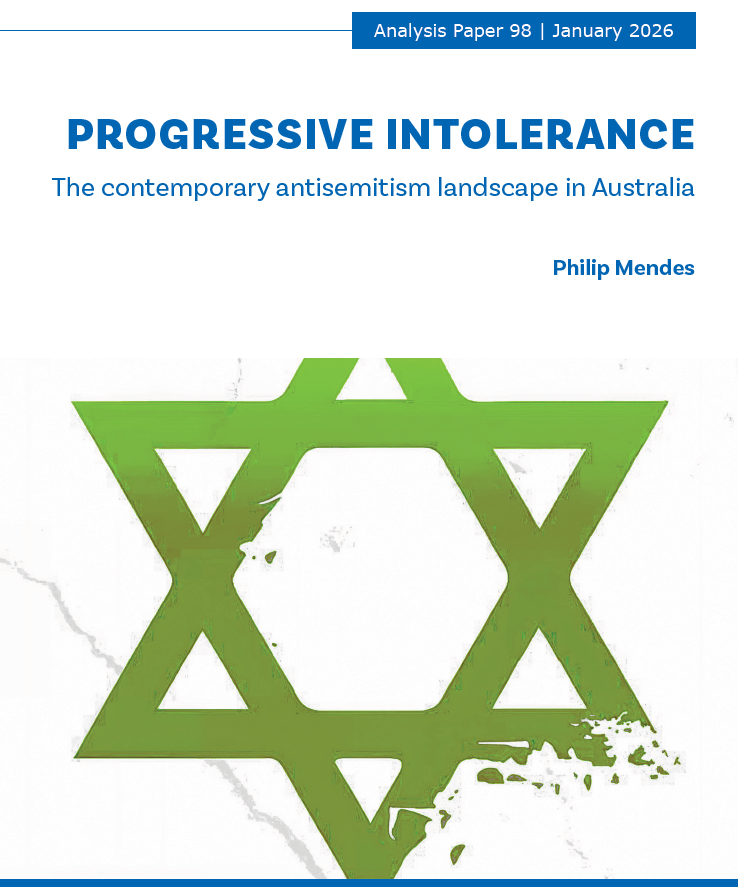
Progressive intolerance: the contemporary antisemitism landscape in Australia

By Philip Mendes

The paper describes the emergence of antisemitism as a defining characteristic of significant sectors of Australia’s self-described ‘progressive’ institutions. It argues that antisemitism is rife in institutions such as universities, schools, the arts, trade unions, human rights and civil liberties bodies and the media – and predominant among younger Australians.

The paper documents a systematic pattern of hostility toward Jews going far beyond legitimate criticism of Israeli government policy. It presents case studies of pro-racist groups and activities, and of a bystander approach. The paper outlines three steps towards a best practice anti-racist response of zero tolerance.

A combination of universal and targeted education among other strategies are needed to prevent antisemitism becoming embedded longer-term within key sections of Australian society. The paper identifies mandatory education is badly needed both within all secondary schools – public, private and faith-based – and universities to directly counter antisemitic arguments that are prevalent and currently uncontested.

Australian policymakers attempting to combat manifestations of antisemitic intolerance will need to take a long-term approach given the ingrained nature of the racist and illiberal views within sections of academia and the wider community.

Key findings

The levels of antisemitic incidents in Australia are unprecedented, reaching a high in 2024 rising sharply after the October 7 massacre of innocent Jews in southern Israel in 2023.

Incidents range from systemic vilification in universities and trade unions, to extreme acts of violence.

There is a major generational divide between older Australians who are less likely to hold antisemitic views, and younger Australians aged 18 to 24 years who are more likely to hold negative views concerning Zionism, Israel and Jews generally.

Key recommendations

Exclude antisemites from Australia's immigration admission processes.

Prevent hate speech.

Interventions within educational institutions to stop young Australians absorbing racist ideas.

Centre for Independent Studies, 2026. 30p.


Bail Reform at Five Years: Pretrial Decision-Making in New York State

By Michael Rempel, Olive Lu, & Sarah Monaghan

In January 2020, New York’s landmark bail reform law went into effect. This report provides a definitive examination of how bail reform reshaped the pretrial landscape after five full years of implementation. Covering all regions of the state, and drawing on court data from 2018 to 2024 (spanning pre- and post-reform timeframes), the report examines bail reform’s impact on:

  • Pretrial Decision-Making at Arraignment: Rates of release on recognizance, supervised release, bail, and pretrial detention; and estimated numbers of cases not resulting in pretrial detention due to changing practices under bail reform.

  • Affordability of Bail: For cases that continue to be assigned bail, median bail amounts, bail posting rates, and judges’ use of “alternative” payment methods (partially secured bonds and unsecured bonds) that legislators intended to ease people’s ability to pay.

  • Racial and Ethnic Disparities: Disparities among Black, Hispanic, and white people in judges’ rates of continuing to set bail or remand people directly to jail.

  • Three Rounds of Bail Amendments: Effects of amendments respectively put into effect in July 2020, May 2022, and June 2023 (entailing a first-ever analysis of the 2022 and 2023 amendments).

New York: Data Collaborative for Justice, 2026. 47p.

Christianity Versus Slavery

by Lord Hugh Charles Clifford. (Author), Graeme R. Newman (Introduction)

In a world still grappling with the echoes of systemic inequality, Christianity Versus Slavery (1841) emerges not merely as a historical relic, but as a prescient manifesto on human dignity and the moral imperatives of justice. This collection—comprising the fiery oratory of George Thompson, the strategic appeals of Lord Clifford to the Catholics of Ireland, and the authoritative weight of centuries of Papal Briefs—challenges the modern reader to confront the persistent "complicated interests" and "rotten politics" that continue to shape global structures of exploitation. At its heart, the work champions the "Scriptural doctrine of equality," asserting that the "innate dignity of man" is an immutable truth that transcends "complexion" or state borders. This 19th-century insistence that "God has made of one blood the varied tribes of man" serves as a foundational precursor to our modern concept of universal human rights.
The book’s relevance to the modern era is perhaps most striking in its sophisticated analysis of the intersection between global exploitation and domestic economic health. Lord Clifford’s address highlights how the "ruinous, than unchristian and inhuman traffic" of slavery in the colonies was inextricably linked to the "general distress" and "awful distress" of the manufacturing interests and the "starving workman" at home. This early critique of an "equally wicked and foolish policy" that prioritized "sordid lucre" over justice prefigures modern debates regarding ethical supply chains, globalized labor rights, and the hidden human costs of consumer goods. By linking the oppression of India and Ireland to the struggle for abolition, the text invites a contemporary audience to view justice as an indivisible, global pursuit.
Furthermore, the work offers a timeless strategy for social change through the "regeneration of public sentiment". In an age often dominated by digital echo chambers and a "venal press," the book’s emphasis on the "power of truth" and "moral power" as weapons "mightier than armies" remains a potent call to action. It warns that the struggle for justice is "slow and progressive," requiring a "struggle continued through a series of years" against "deep-seated prejudices" and "long-cherished pride". Ultimately, Christianity Versus Slavery serves as a rigorous moral compass, reminding the modern era that the "spiritual nature and affinity of the races" is the only legitimate basis for a sane and just civilization.

Read-Me.Org Inc. New York-Philadelphia-Australia. 2026. 101p.

CHRISTIANITY VERSUS SLAVERY

BY HUGH CHARLES, LORD CLIFFORD.

In a world still grappling with the echoes of systemic inequality, Christianity Versus Slavery (1841) emerges not merely as a historical relic, but as a prescient manifesto on human dignity and the moral imperatives of justice. This collection—comprising the fiery oratory of George Thompson, the strategic appeals of Lord Clifford to the Catholics of Ireland, and the authoritative weight of centuries of Papal Briefs—challenges the modern reader to confront the persistent "complicated interests" and "rotten politics" that continue to shape global structures of exploitation. At its heart, the work champions the "Scriptural doctrine of equality," asserting that the "innate dignity of man" is an immutable truth that transcends "complexion" or state borders. This 19th-century insistence that "God has made of one blood the varied tribes of man" serves as a foundational precursor to our modern concept of universal human rights.

The book’s relevance to the modern era is perhaps most striking in its sophisticated analysis of the intersection between global exploitation and domestic economic health. Lord Clifford’s address highlights how the "ruinous, than unchristian and inhuman traffic" of slavery in the colonies was inextricably linked to the "general distress" and "awful distress" of the manufacturing interests and the "starving workman" at home. This early critique of an "equally wicked and foolish policy" that prioritized "sordid lucre" over justice prefigures modern debates regarding ethical supply chains, globalized labor rights, and the hidden human costs of consumer goods. By linking the oppression of India and Ireland to the struggle for abolition, the text invites a contemporary audience to view justice as an indivisible, global pursuit.

Furthermore, the work offers a timeless strategy for social change through the "regeneration of public sentiment". In an age often dominated by digital echo chambers and a "venal press," the book’s emphasis on the "power of truth" and "moral power" as weapons "mightier than armies" remains a potent call to action. It warns that the struggle for justice is "slow and progressive," requiring a "struggle continued through a series of years" against "deep-seated prejudices" and "long-cherished pride". Ultimately, Christianity Versus Slavery serves as a rigorous moral compass, reminding the modern era that the "spiritual nature and affinity of the races" is the only legitimate basis for a sane and just civilization.

Read-Me.Org Inc. New York-Philadelphia-Australia. 2026. 100p.

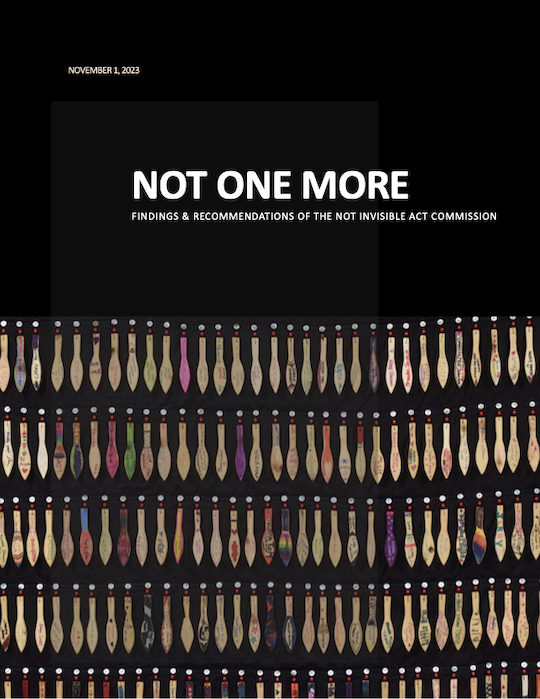
Not One More: Findings and Recommendations of the Not Invisible Act Commission

By The Not Invisible Act Commission

There is a crisis in Tribal communities. A crisis of violence, a crisis of abuse, and a crisis of abject neglect affecting Indian Women & Men, Indian Children, and Indian Elders. The federal government must act now; not tomorrow; not next week; not next month; and not next year. Once and for all, the federal government must end its systematic failure to address this crisis and react, redress, and resolve this. We call on the federal government to declare a Decade of Action & Healing to address the crisis of missing, murdered, and trafficked Indian people. -- The Not Invisible Act Commissioners _____________________________________________________________________________ With each passing day, more and more American Indian and Alaska Native (AI/AN) persons are victimized due to inadequate prevention and response to the MMIP and HT crisis. Our recommendations encompass actions that must be undertaken without delay to provide AI/AN people and communities with the same sense of safety and security that other communities in the United States take for granted. The United States government’s failure to fulfill its trust responsibilities to Tribal nations, coupled with historic policies that sought to disconnect AI/AN people from their land, language, and culture, have given rise to a public health, public safety, and justice crisis in Tribal communities. The crisis is most notably reflected in the federal government’s failure to effectively prevent and respond to the violence against AI/AN people, particularly in the context of missing, murdered, and trafficked AI/AN people. Despite the best efforts of many individuals across law enforcement (LE), the judiciary, and social services, long-standing institutional failures must be acknowledged and addressed. Calls for action and funding to address these issues have been made repeatedly.1 Although there has been a growing awareness of the high rates of missing, murdered, and trafficked AI/AN people in recent years, and several federal initiatives have been launched,2 addressing the needs in Tribal communities continues to generally be underprioritized by the federal government. Until this changes, violence against AI/AN individuals and on Indian and Alaska Village lands will persist. The Commission believes that the circumstances that have created the crisis of MMIP and HT are not intractable. In fact, to see them so is to continue the unjust past. With resolve and an appropriate investment of resources, these issues can, and must, be effectively addressed. While it is imperative that the federal government take immediate and concerted action, thescale and severity of this issue, and the need for long-term healing and justice, also demand a comprehensive and sustained response. Therefore, we call upon the federal government to declare a Decade of Action and Healing dedicated to addressing this crisis effectively for future generations. Such a declaration would underscore the urgency of the matter and signify a long-term commitment to combatting the deeply rooted issues that perpetuate continued violence against AI/AN individuals and supporting individuals and communities in their healing as they seek justice. This Decade of Action and Healing must involve partnership with Tribal communities, Tribal governments, and relevant organizations, focusing on improving safety, prevention, justice, support services, and healing for AI/AN communities through increased funding, policy reform, action-oriented programs, and training and technical assistance.

Washington, DC: U.S. Department of the Interior and the Department of Justice, 2025. 212p.

THE LEAGUE OF NATIONS: The Principle and the Practice

Edited by Stephen Pierce Duggan. Introduction by Graeme R. Newman

A Landmark Vision of International Order at the Dawn of the Modern World

Published in 1919 at the very moment when the post–First World War settlement was taking shape, The League of Nations: The Principle and the Practice, edited by Stephen Pierce Duggan, is one of the most authoritative and illuminating contemporary statements of the ideas that sought to prevent another global catastrophe. Written as the Covenant of the League of Nations moved toward ratification, this volume captures the urgency, optimism, and hard-headed realism of thinkers grappling with the central political question of the twentieth century: how can peace be made durable in a world of sovereign states?

Bringing together leading scholars, jurists, historians, and policy practitioners, the book moves beyond slogans to examine how an international organization must actually function. It explains not only the moral and historical foundations of the League idea, but also its practical machinery—arbitration, sanctions, international administration, and continuous cooperation across borders. Readers are guided through the institutional logic of collective security, the limits of national sovereignty, and the challenges posed by armaments, small nations, and postwar reconstruction.

Distinctive for its clarity and documentary richness, the volume includes key historical texts and the full Covenant of the League itself, allowing readers to engage directly with the constitutional framework of early international governance. Written in accessible but rigorous prose, it was intended for educated citizens as well as specialists—an informed guide for public debate at a decisive historical moment.

Today, The League of Nations: The Principle and the Practice stands as an indispensable primary source for understanding the intellectual foundations of modern global governance. It reveals how the ambitions and anxieties of 1919 shaped later institutions, including the United Nations, and it remains strikingly relevant in an era once again marked by questions of collective security, international law, and global cooperation. For historians, political scientists, legal scholars, and readers interested in the origins of the contemporary international order, this book is both a historical document and a continuing challenge to think seriously about how peace is organized.

The Atlantic Monthly Press. BOSTON. 1919. Read-Me.Org Inc. New York-Philadelphia-Australia. 2025. p.253.

Civilisation: Its Cause And Cure

By Edward Carpenter

“Civilisation” is a word that evokes triumph — of human ingenuity, collective organisation, rising standards of living, the unfolding of arts and sciences, the building of cities, bridges, empires. And yet, as Edward Carpenter’s 1889 work Civilisation: Its Cause and Cure; and Other Essays demonstrates, civilisation can also be approached as a problem: as a state of society marked by dis-ease, alienation, and unsustainability. Carpenter, a socialist, poet, philosopher and social reformer, treats civilisation not simply as the progress of humankind but as a complex and ambivalent phenomenon — one that may require “cure” as much as celebration.

In this volume Carpenter brings together his earlier lectures and essays — including the eponymous essay “Civilisation: Its Cause and Cure,” along with essays on science, morality, custom, and society.The book thus serves as both a diagnosis of modern Western society and an expression of an alternative vision for humanity’s social and moral development.

In the following pages we will consider: first, the intellectual and historical context of the work; second, the major themes and arguments set out by Carpenter; third, the structure of the essays and the particular significance of the titular essay; fourth, an evaluation of the work’s place in the history of social thought; and fifth, pointers for contemporary reading, criticism and further research.

Read-Me.Org Inc. New York-Philadelphia-Australia. 2025. 164p.

Sentencing and Human Rights: The Limits on Punishment

By Sarah J Summers.

From the introduction:

Sentencing law and theory is closely bound up with the justification of punishment. 1 It is thus unsurprising that sentencing theory is generally perceived as falling squarely within the domain of moral philosophy. 2 Much of the debate has focused on whether retribution or consequentialist notions of deterrence or rehabilitation should serve as the principal aim on which the sentencing system is based. There are numerous articles by proponents of the various theories explaining why their theory should provide the primary basis for the determination of the sentence. 3 The importance of the moral philosophical discussion transcends national boundaries. Despite considerable diversity in the legal cultures and traditions of the various legal systems, ‘[p]rinciples of uniformity and retributive proportionality are now recognised to some extent in almost all systems, but sentences in these systems are also designed to prevent crime by means of deterrence, incapacitation and rehabilitation’.4 Whereas broadly ‘correctionalist’ accounts of punishment underpinned the penal welfare model of punishment for much of the twentieth century, 5 the ‘just deserts’ movement 6 of the 1980s was in line with a transfer of focus away from the individualized treatment of offenders and towards a vision of punishment which not only favoured a more standardized approach to the treatment of offenders, but which also expressly legitimized retributivist penalties and practices…..

London Oxford. 2022. 280p.

Slavery in Germanic Society During The Middle Ages

By Agnes Mathilde Wergeland (Author), Colin Heston (Introduction)

Slavery in Germanic Society sets out to trace the evolution of slavery from the late Roman world through the early and high medieval periods. Wergeland’s analysis begins by distinguishing classical slavery—predicated on the total alienation of the enslaved person from kinship, community, and legal personhood—from the systems of servitude that emerged in Germanic societies. As Germanic tribes moved into former Roman territories, they both absorbed and modified existing practices of unfree labor. Captives taken in war, debtors who had fallen into bondage, and the descendants of slaves formed a stratum of society that was neither fully outside nor fully within the emerging frameworks of medieval law.

Wergeland is especially attentive to the role of law codes in shaping and regulating these relationships. The Salic Law, the Lex Saxonum, and other Germanic legal compilations provide glimpses into a world where freedom and unfreedom were not binary categories but existed along a continuum. The distinction between a servus (slave), a colonus (tenant bound to the land), and a liber homo (freeman) was fluid and often contested. Her work suggests that these categories were not only legal but also deeply embedded in cultural ideas about honor, lineage, and the obligations of lordship.

Wergeland’s historiographical legacy is also tied to the broader cultural currents of her time. Writing in the aftermath of the American Civil War and during the height of European colonial expansion, she was acutely aware of slavery’s moral and political resonance. While she does not draw explicit parallels between medieval and modern forms of servitude, her decision to study the topic reflects a world in which questions of liberty, labor, and human rights were urgently contested.
In returning to Slavery in Germanic Society During the Middle Ages today, readers encounter a work that is both a product of its era and strikingly relevant to our own. It invites us to consider how deeply embedded systems of inequality are in the fabric of society, and how they can endure even as their outward forms change. Wergeland’s careful scholarship provides a foundation for ongoing conversations about freedom, coercion, and the ways in which human societies organize power and labor.
This edition reintroduces Wergeland’s study to a new generation of readers at a moment when the legacies of slavery and unfreedom are once again at the center of global debates. It offers not only an invaluable historical resource but also a reminder of the intellectual courage of a scholar who, against the odds, claimed her place in the academy and in the long conversation about justice and humanity.

Read-Me.Org Inc. New York-Philadelphia-Australia. 2025. 93p.

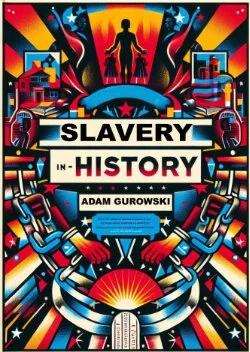
Slavery in History

By Adam Gurowski (Author), Colin Heston (Preface)

Adam Gurowski’s Slavery in History is a sweeping and impassioned historical treatise that challenges the reader to reconsider the institution of slavery not as a fixed or inevitable component of human civilization, but as a corrosive anomaly that has repeatedly undermined the moral and structural integrity of societies throughout history. Written in the mid-19th century, a time when the question of slavery was at the forefront of political and ethical discourse—particularly in the United States—Gurowski’s work stands as both a scholarly inquiry and a moral indictment. His approach is not merely descriptive; it is analytical and polemical, seeking to dismantle the notion that slavery is a natural or historically justified institution.
From the outset, Gurowski frames slavery as a “general disease” rather than a social norm, arguing that its presence in any civilization is symptomatic of deeper political and moral decay. He rejects the deterministic view that slavery is a universal or necessary stage in societal development, instead positing that it is an aberration that has consistently led to the decline of the cultures that embraced it. This thesis is developed through a methodical examination of a wide array of civilizations—from the Egyptians and Phoenicians to the Greeks, Romans, and beyond. In each case, Gurowski explores how slavery was integrated into the social fabric, how it was justified or resisted, and ultimately, how it contributed to the weakening or collapse of those societies.
Adam Gurowski’s view on modern slavery, particularly as it existed in the 19th century, is deeply critical and morally charged. In Slavery in History, he argues that for the first time in human civilization, slavery had been elevated into a comprehensive ideological system—a “religious, social, and political creed” . This modern form of slavery, especially as practiced in the United States, was not merely a continuation of ancient customs but a deliberate and systemic institution, defended by theology, law, and public discourse. He is especially scathing in his critique of how slavery in the modern era had been rationalized and sanctified by political leaders, religious figures, and intellectuals. He describes this as a “new faith” with its own “temples,” “altars,” and “fanatical devotees,” suggesting that slavery had become a kind of state religion in parts of the American Republic. This metaphor underscores his belief that modern slavery was not just a social or economic system but a deeply entrenched ideology that corrupted every aspect of public life.
Finally, his introduction to Slavery in History serves as both a roadmap and a manifesto. It outlines the historical scope of the book—spanning ancient to modern civilizations—and sets the tone for a critical, morally engaged exploration of one of humanity’s oldest and most pernicious institutions. Gurowski’s work is not merely a catalog of historical facts; it is a call to conscience, urging readers to recognize the enduring consequences of slavery and to commit to the principles of justice and equality. In doing so, he positions his book as a vital contribution to the intellectual and ethical debates of his era—debates that, in many ways, continue to resonate today.
Read-Me.Org Inc. New York-Philadelphia-Australia. 2025. 172p.

Natural Rights

By David G. Ritchie

David G. Ritchie’s Natural Rights: A Criticism of Some Political and Ethical Conceptions is a critical examination of the philosophical and political theories surrounding natural rights. Published in the late 19th century, Ritchie’s work challenges the assumptions held by classical liberals and natural law theorists, particularly those who argue for the inherent and immutable nature of rights. Instead, Ritchie approaches the concept of rights from a historical and evolutionary perspective, arguing that rights are not absolute but are instead shaped by social, political, and moral developments over time.

Ritchie’s work remains highly relevant and modern in its rejection of fixed, universal rights and in its emphasis on social evolution, institutions, and collective well-being. However, contemporary discourse has gone further by incorporating intersectionality, global human rights frameworks, and moral imperatives that sometimes challenge his purely historical and pragmatic approach. His work is valuable for its emphasis on the social and historical evolution of rights, but some critics argue that his relativism could justify oppression, that he underestimates moral absolutes, and that he places too much emphasis on legal institutions rather than individual freedoms. Nevertheless, this is a pioneering work that aligns with modern human rights discourse in its recognition of change over time,

NATIONALISM and SĀDHANĀ: Introductions by Colin Heston

By Rabindranath Tagor

Rabindranath Tagore’s Nationalism is a profound and prophetic critique of the nationalist fervor that swept across the world in the early 20th century. First published in 1917, the book is a collection of essays based on Tagore’s lectures in Japan and the United States, where he examined the rise of nationalism and its impact on societies, particularly in the West and in colonial India. As a poet, philosopher, and humanist, Tagore viewed nationalism not merely as a political movement but as a force with the potential to both unite and divide humanity.
Tagore’s Sādhanā is not just a philosophical text—it is a guide for living with awareness, compassion, and harmony. In today’s fast-paced, often disconnected world, his message of spiritual realization, unity, and love remains as vital as ever. Whether through mindfulness, environmental consciousness, or a deeper appreciation of human relationships, *Sādhanā* offers timeless wisdom for navigating the complexities of modern life. Tagore’s vision challenges us to look beyond material success and societal divisions, urging us to embrace a life of inner fulfillment, interconnectedness, and profound respect for all forms of life. By revisiting *Sādhanā* in the context of contemporary challenges, we find a powerful and enduring message that calls us to rediscover the deeper truths of existence and live with greater purpose and harmony.

Read-Me.Org Inc. NY. Phila. Australia. 2025.