Open Access Publisher and Free Library
HUMAN RIGHTS.jpeg

HUMAN RIGHTS

Human Rights-Migration-Trafficking-Slavery-History-Memoirs-Philosophy

Posts in Human Rights Migration
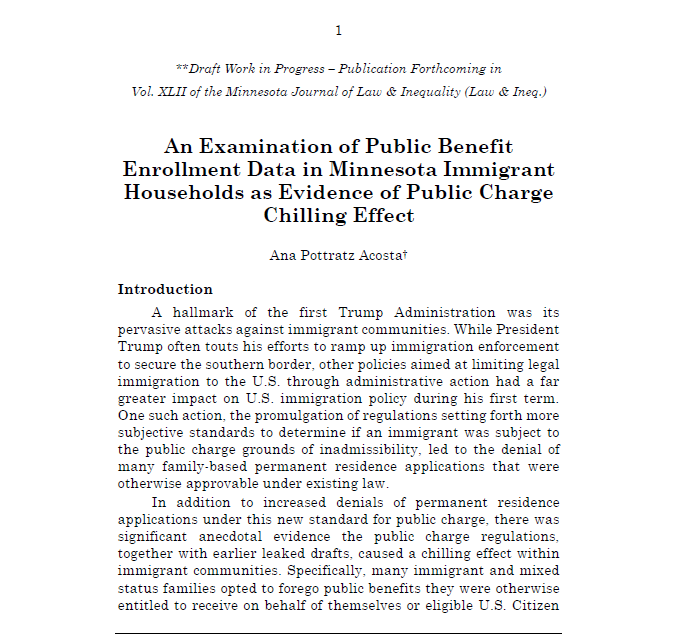
An Examination of Public Benefit Enrollment Data in Minnesota Immigrant Households as Evidence of Public Charge Chilling Effect

By Ana Pottratz Acosta

A hallmark of the first Trump Administration was its pervasive attacks against immigrant communities. While President Trump often touts his efforts to ramp up immigration enforcement to secure the southern border, other policies aimed at limiting legal immigration to the U.S. through administrative action had a far greater impact on U.S. immigration policy during his first term. One such action, the promulgation of regulations setting forth more subjective standards to determine if an immigrant was subject to the public charge grounds of inadmissibility, led to the denial of many family-based permanent residence applications that were otherwise approvable under existing law.

In this Article, the Author will examine means tested benefit enrollment data for Minnesota immigrant households to see if this data supports existence of a chilling effect through decreased immigrant household enrollment in these programs following publication of the public charge regulations. Additionally, while several previous studies using survey data support existence of a public charge chilling effect, this Article will build on this previous work by analyzing primary enrollment data provided directly by the Minnesota Department of Human Services (MN-DHS), the agency administering these programs.

 (September 01, 2024).

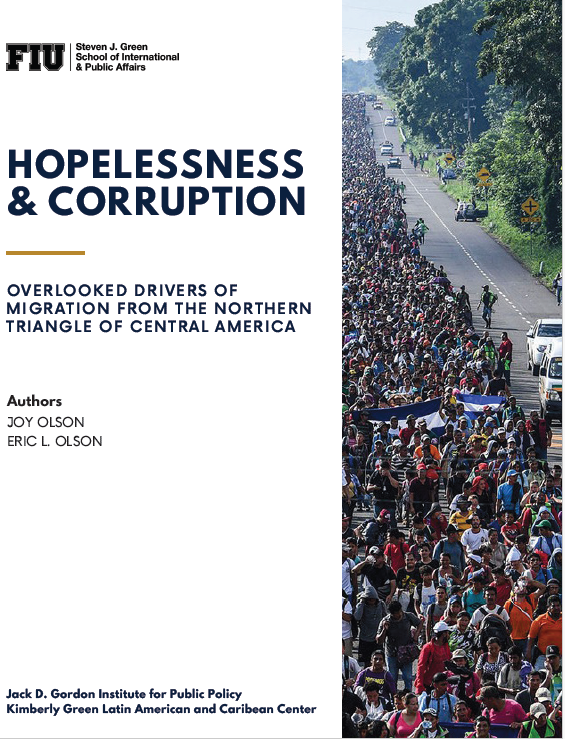
HOPELESSNESS & CORRUPTION OVERLOOKED DRIVERS OF MIGRATION FROM THE NORTHERN TRIANGLE OF CENTRAL AMERICA 

By JOY OLSON and ERIC L. OLSON

This paper analyzes the drivers of migration hypothesizing that persistent government failure driven in large part by corruption produces a sense of hopelessness among Central Americans that contributes to and propels their decision to migrate. Traditionally, corruption and its contribution to hopelessness have not been studied as drivers of migration. The authors conclude that addressing weak governance and corruption helps create a national context in which individuals can see a future in their own country. Central Americans from the Northern Triangle countries have a complex set of motivations for migration. Traditionally studied push factors include poverty, violence and natural disasters. Pull factors include economic opportunity/upward mobility, protection, and family reunification. The weight given to each factor is as varied as the number of people migrating. The intention to migrate is often based on one’s calculation of personal challenges and opportunities. Decisions are also influenced bylarger social, political, and economic factors. While it is an individual that migrates, it is their experience within their community and nation that informs their decision. Contextual factors contributing to migration include respect for human rights, governance and corruption. The State Department’s human rights reports paint a clear picture of the deplorable human rights situation in each Northern Triangle country and highlights the high level of impunity and, conversely, low expectations for justice that the majority can expect from their governments and justice systems. According to surveys of both experts and individuals, government corruption and/or the perception of corruption is widespread and endemic across the Northern Triangle. Weak governance can be the result of poor planning, lack of resources, and limited workforce capacity, but in many instances, it is also the result of corruption. While more research is needed, the thrust of the studies cited suggest that corruption can be both a direct and indirect driver of migration. The authors identify hopelessness as contributing to migration from the Northern Triangle. Since little research has been done in this area, proxies like Subjective Wellbeing (SWB) are considered. Hope, optimism, and SWB are concepts based not only on personal experience, but on one’s interaction with and perceptions of broader society. One’s experience with endemic corruption can contribute to a sense hopelessness. The authors argue that endemic corruption in Central America, and the destruction of mechanisms to control corruption, undermine peoples’ confidence in government and contribute to a lack of hope that their lives will improve. While the work done to date is insufficient to establish direct correlations. If the citizens of Central America believe that good governance and anti-corruption measures can be successful and see the results of such efforts reflected in improved healthcare, education, access to education, and justice, it could improve theirlives will improve. While the work done to date is insufficient to establish direct correlations. If the citizens of Central America believe that good governance and anti-corruption measures can be successful and see the results of such efforts reflected in improved healthcare, education, access to education, and justice, it could improve their sense of hope for the future and improve feelings of SWB thus lessening an underlying push factor from Central America. More must be done to address government corruption in the region and to learn about the relationship of hopelessness to migration.

Miami: jack D. Gordon Institute for Public Policy. Florida International University,  2021.

Are Trump Judges Different? Evidence from Immigration Cases

By Daniel M. Klerman

Judges appointed by President Trump are more likely to vote in favor of the government in cases challenging the second Trump administration's immigration policies. While Trump's Supreme Court nominees behave like other Republican nominees on the Court, Trump's lower court nominees are twice as likely to vote in favor of the government as nominees of other Republican presidents; in contrast, other Republican nominees to the lower courts are statistically indistinguishable from Democratic nominees. The difference between Trump nominees and other judges is driven almost entirely by judges 55 years old or younger, who may be influenced by the prospect of promotion to the Supreme Court.

 USC CLASS Research Paper No. 2522, 2025, 

Towards the Abolition of the Immigration Detention of Children in the United States

By Lauren E. Bartlett

For over a decade, international human rights mechanisms have been calling for the prohibition of the detention of children based solely on immigration status. Human rights experts agree that the detention of children for immigration purposes is never in the best interests of the child, it leads to long-term harm, and it is a clear human rights violation. Yet, the United States continues to detain hundreds of thousands of migrant children each year the U.S. government still tries to justify its inhumane practices. This article argues that engaging with international human rights mechanisms on this topic, including during the upcoming Universal Periodic Review of the United States by the U.N. Human Rights Council in November 2025, is a small and relatively low stakes step to help forge a path towards the abolition of the immigration detention of children in the United States.

UNIVERSITY OF SAN FRANCISCO LAW REVIEW, VOL. 59, NO. 3 , 2025.

“This Hell Was My Only Option” Abuses Against Migrants and Asylum Seekers Pushed to Cross the Darién Gap

By Human Rights Watch

  Over the last year, over half a million people have crossed the Darién Gap, a swampy jungle between Colombia and Panama, on their journey north, often to the United States. Venezuelans, Haitians, and Ecuadorians, but also people from other regions like Asia and Africa, risk their lives in this difficult terrain. “This Hell Was My Only Option”: Abuses Against Migrants and Asylum Seekers Pushed to Cross the Darién Gap, the first in a series of Human Rights Watch reports on migration via the Darién Gap, documents how a lack of safe and legal pathways has pushed migrants and asylum seekers fleeing human rights crises in Latin America to cross the Darién Gap. Data analyzed in the report suggests restrictions on movement to Mexico and Central America, often promoted by the US government, have contributed to sharp increases in the number of people crossing the Darién Gap, exposing them to abuses, including rape, and empowering organized crime in the area. Whether seeking international protection or economic opportunities, asylum seekers and migrants deserve safe, orderly, and dignified paths to make their claims or to offer their skills. In all cases, they are entitled to safety and respect for their human rights during their journey.   

New York: Human Rights Watch, 2023. 68p.