Open Access Publisher and Free Library
HUMAN RIGHTS.jpeg

HUMAN RIGHTS

Human Rights-Migration-Trafficking-Slavery-History-Memoirs-Philosophy

Posts tagged Nigeria
The impact of cyber-crime and violent extremism on socio-economic development in Nigeria

By Chukwudi Kingsley Onyeachu, Ikechukwu Clement Okoro & Martina Mgbosolu Ugwuoke 

Cybercrime and violent extremism have not only become mutually reinforcing, in recent times, but also fast growing, multidimensional and easily joined by the youth for lack of socio-economic opportunities to break out of poverty and overcome family and peer pressures. Research findings have proven that to ‘get-rich-quick’ through cyber-criminalities influences performance of human blood and body parts rituals, which translates to violent extremism. The youth who make money through these inhuman practices that negate acceptable societal values believe that education, apprenticeship, human capital development and decent work are a dysfunctional social-orientation. Careful observations have shown that when the youth acquire illicit money, the result is excessive clubbing, frivolous spending, promotion of prostitution, substance abuse, which undermine effective youth engagement in socio-economic development. The youth bulge theory was adopted in the study. The theory postulates that large youth population can become a “demographic dividend” when their potentials are properly harnessed, and it can also become a “demographic bomb” in the face of systemic socio-economic exclusion, unemployment, hunger and family poverty. The methodology applied was content analysis, leveraging empirical studies in Nigerian context and other sources of data. The paper revealed that youth unemployment, systemic corruption, absence of transparency in the administration of poverty alleviation interventions and limited opportunities are manifestations of youth exclusion from decision-making process and they are key factors influencing youth participation in cybercrime and violent extremism. The paper recommended practical youth-specific engagement strategies in socio-economic development as a means to discouraging cybercrime and its associated extreme practices.

Discov glob soc 3, 72 (2025)

Responses to conflict, irregular migration, human trafficking and illicit flows along transnational pathways in West Africa

By Iffat Idris

This paper explores the links between conflict, irregular migration, human trafficking and other illicit flows along transnational pathways in West Africa – focusing on Niger, Nigeria, Mali, Burkina Faso and Libya as well as the responses to these.

Birmingham, UK: GSDRC, International Development Department, College of Social Sciences University of Birmingham., 2022. 40p.

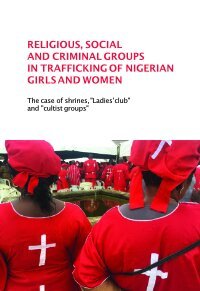
Religious, Social and Criminal Groups in Trafficking of Nigerian Girls and Women: The case of shrines, "Ladies’clubs" and "cultist groups"

By Élodie Apard, Éléonore Chiossone, Precious Diagboya, Aurélie Jeannerod, Bénédicte Lavaud-Legendre, Cynthia Olufade, Cécile Plessard, Sara Panata, Vanessa Simoni and Sam O. Smah

In an innovative manner, Packing research addresses human trafficking from Nigeria to Europe, beyond the perspective of the ‘victim/madam’ duo as classically analysed. It postulates the involvement of several social groups whose activity does not originate in the practice of human trafficking, neither is reduced to it. The offense of trafficking is therefore perceived as based on an organization that, beyond the criminal activity itself, has a highly structured and legitimized social, community and religious base. More precisely, this research describes the operation – activities and development – of each of religious groups (such as the neo-traditional Temples in Edo State, Nigeria), women’s groups (such as the Ladies’ clubs) and cultist groups (including Black Axe (Aye) and Supreme Eiye Confraternity) in Nigeria and France and then identifies their role and level of involvement in human trafficking. This research highlighted different elements that support the thesis of a misuse of beliefs, own practices and operating rules applied by these groups for criminal purposes.

Ibadan: IFRA-Nigeria - Institut Français de Recherche en Afrique - Nigeria, 2019. 183p.

Victims, Actors and Violence: Human Trafficking and Prostitution in Communities along Nigeria-Benin Republic Border

By Modupe Adeleye

A multiscalar phenomenon, human trafficking can be studied at the national and international levels, rendering the border a significant analytical object. This paper questions the specificities of the Nigerian-Benin border as affecting human trafficking. Based on field research undertaken in the communities of Shaki and Seme, the study examines how border dynamics affect the framing of networks and actors involved in the human trafficking process. It illustrates the gradual entanglement of human trafficking with other traffics and economic activities at play within bordering communities

Ibadan: Ifra-Nigeria, 2017. 27p.

Sustenance of Sex Trafficking in Edo State: the Combined Effect of Oath Tacking, Transnational Silence and Migration Imaginaries on Trafficked Women in Edo State

By Cynthia Olufade

This Research is part of the European Project PACKING (Protection of Migrants and Asylum seekers, especially Children and Women coming from Nigeria and victims of trafficking), conducted from 2017 and 2019, both in Nigeria and in France. PACKING Project is co-funded by the European Instrument for Democracy and Human Rights (EIDHR) of the European Union and is coordinated by the NGO ECPAT France. The general objective of the project is that rights of Migrants are promoted and respected and migrants are protected from trafficking in Human beings. This publication was elaborated with the support of European Union. The contents of this publication are the sole responsibility of ECPAT France and the partners of the project and can in no way be taken to reflect the views of the European Union.

Ibadan: Ifra-Nigeria, 2019. 26p.