Open Access Publisher and Free Library
HUMAN RIGHTS.jpeg

HUMAN RIGHTS

Human Rights-Migration-Trafficking-Slavery-History-Memoirs-Philosophy

Posts tagged United Nations
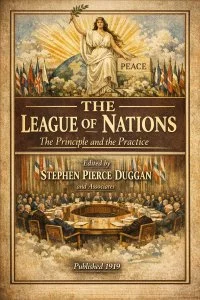
THE LEAGUE OF NATIONS: The Principle and the Practice

Edited by Stephen Pierce Duggan. Introduction by Graeme R. Newman

A Landmark Vision of International Order at the Dawn of the Modern World

Published in 1919 at the very moment when the post–First World War settlement was taking shape, The League of Nations: The Principle and the Practice, edited by Stephen Pierce Duggan, is one of the most authoritative and illuminating contemporary statements of the ideas that sought to prevent another global catastrophe. Written as the Covenant of the League of Nations moved toward ratification, this volume captures the urgency, optimism, and hard-headed realism of thinkers grappling with the central political question of the twentieth century: how can peace be made durable in a world of sovereign states?

Bringing together leading scholars, jurists, historians, and policy practitioners, the book moves beyond slogans to examine how an international organization must actually function. It explains not only the moral and historical foundations of the League idea, but also its practical machinery—arbitration, sanctions, international administration, and continuous cooperation across borders. Readers are guided through the institutional logic of collective security, the limits of national sovereignty, and the challenges posed by armaments, small nations, and postwar reconstruction.

Distinctive for its clarity and documentary richness, the volume includes key historical texts and the full Covenant of the League itself, allowing readers to engage directly with the constitutional framework of early international governance. Written in accessible but rigorous prose, it was intended for educated citizens as well as specialists—an informed guide for public debate at a decisive historical moment.

Today, The League of Nations: The Principle and the Practice stands as an indispensable primary source for understanding the intellectual foundations of modern global governance. It reveals how the ambitions and anxieties of 1919 shaped later institutions, including the United Nations, and it remains strikingly relevant in an era once again marked by questions of collective security, international law, and global cooperation. For historians, political scientists, legal scholars, and readers interested in the origins of the contemporary international order, this book is both a historical document and a continuing challenge to think seriously about how peace is organized.

The Atlantic Monthly Press. BOSTON. 1919. Read-Me.Org Inc. New York-Philadelphia-Australia. 2025. p.253.

download free
Kindle $2.99 -- paperback $10.99
Global Report on Trafficking in Persons 2024

By The United Nations Office on Drugs and Crime

The 2024 UNODC Global Report on Trafficking in Persons is the eighth of its kind mandated by the General Assembly through the 2010 United Nations Global Plan of Action to Combat Trafficking in Persons. This edition of the Global Report provides a snapshot of the trafficking patterns and flows at global, regional and national levels. It covers 156 countries and provides an overview of the response to the trafficking in persons by analysing trafficking cases detected between 2019 and 2023. A major focus of this edition of the Report is on trends of detections and convictions that show the changes compared to historical trends since UNODC started to collect data in 2003, and following the Covid-19 Pandemic.

The findings are further informed and enriched through the analysis of summaries of more than 1000 court cases adjudicated between 2012 and 2023, providing closer insights into the crime, its victims and perpetrators, and how trafficking in persons comes to the attention of authorities.

As with previous years, this edition of the Global Report on Trafficking in Persons presents a global picture of the trends, patterns and flows of trafficking (Chapter 1), alongside detailed regional analyses (Chapter 3). This edition of the Global Report presents a special chapter on Africa (Chapter 2) produced with the purpose of unveiling trafficking patterns and flows within the African continent. The chapter is based on unprecedented number of African countries covered for the Global Report.

This edition of the Report presents a new contribution from an early career and young academic researchers, as part of UNODC’s Generation 30 initiative, aimed at building new connections between the UN and academia, while expanding research opportunities for young people. The contributions featured in the report was submitted in response to a call for proposals issued on the UNODC website in 2023.

Vienna: UNODC, 2024. 176p.

DOWNLOAD
Converging universes: 20 years of human rights and drug policy at the United Nations

By Adrià Cots Fernández & Marie Nougier

In recent years, the historical isolation between the United Nations (UN) drug policy and human rights bodies has eroded significantly, and with accelerating speed. The human rights consequences of drug policies have become an unavoidable – if fractious – topic in global drug policy debates, and human rights bodies routinely monitor the impacts of drug responses. The growing convergence between the UN human rights and drug policy regimes is the result of 15 years of progress across the whole UN environment, with contributions from Geneva, Vienna, and New York-based bodies reinforcing and encouraging one another. Civil society has been a constant and necessary presence, broadening the horizon of what is possible, transmitting key information across the UN system, and consistently advocating for change. Despite some reluctance to engage in drug-related discussions up until the 2010s, the Geneva-based human rights system has become gradually more influential in pushing for this alignment. The first call for convergence between the two regimes came from Geneva, in 2008. Since then, a large number of UN human rights bodies have regarded drug policies to be under their mandate, including the Human Rights Council, the Office of the UN High Commissioner for Human Rights (OHCHR), special mandate procedures, and human rights treaty bodies.

London: International Drug Policy Consortium IDPC, 2022. 33p.

download