Open Access Publisher and Free Library
HUMAN RIGHTS.jpeg

HUMAN RIGHTS

Human Rights-Migration-Trafficking-Slavery-History-Memoirs-Philosophy

Posts tagged analytics
Can place‐based crime prevention impacts be sustained over long durations? 11‐Year follow‐up of a quasi‐experimental evaluation of a CCTV project

By Eric L. Piza, Brandon C. Welsh, Savannah A. Reid, David N. Hatten


A long-standing critique of place-based crime prevention interventions has been that any reductions in crime are often short-lived. If researchers do not carry out longer-duration follow-ups, we cannot know for sure if the effects of these interventions will persist, decay, or even strengthen. Using a rigorous micro synthetic control design, we evaluated the long-term impacts of a large-scale, public-area closed-circuit television (CCTV) surveillance project in Newark, New Jersey. Results show that the CCTV project was associated with a statistically significant reduction of auto theft in the intermediate term (3–4 years). The reduction of auto theft approached statistical significance (= 0.08) during the short term (1–2 years). The analysis also observed potential displacement effects, with displacement of robbery (= 0.09) in the short term (1–2 years) and theft from auto (= 0.06) in the long term (9–11 years) approaching statistical significance.

Policy implications

The results of this study may suggest the potential for a slightly modified view of deterrence decay. The CCTV project's effect on auto theft grew from approaching significant to statistically significant between the short-term and intermediate-term periods. Such “sleeper effects” suggest that an extended period was necessary for CCTV to generate deterrence. The deterrence decay during the long-term period did not occur until after these sleeper effects emerged, which may be understood as deterrence attenuation. Although only approaching statistical significance—and not as pronounced as the reduction of auto theft—the potential displacement of robbery and theft from auto indicates that static CCTV target areas may facilitate offenders taking advantage of nearby crime opportunities while appearing inconspicuous within CCTV viewsheds. In sum, policymakers should be mindful that research evidence limited to short-term impacts may fail to detect nuanced effects relevant for policy and public guidance.

Criminology & Public Policy, Volume 24, Issue 3, Aug 2025, Pages307-497
Enhancing State Courts' Efforts to Address Child Abuse and Neglect: A Three-site Evaluation of the Implementation of the Enhanced Resource Guidelines

By: Kristan Russell, Marly Zeigler, Moriah Taylor

Implementing best practices in child welfare court cases is critical to ensuring positive outcomes for youth and families. However, it is also essential that courts are assessed for their fidelity to implement these practices and whether they are having the intended impacts. This article outlines findings from a pre/post evaluation examining the impacts of the implementation of the Enhanced Resource Guidelines (ERGs) in three urban jurisdictions. The findings from this study yield valuable insights regarding the extent to which ERGs implementation positively impacts key outcomes in court practices and case processing. Implications for ongoing practice and future research are discussed. From Volume 76, Issue 2.


Pittsburgh: National Center for Juvenile Justice, National Council of Juvenile and Family Court Judges,, 2025. 18p.

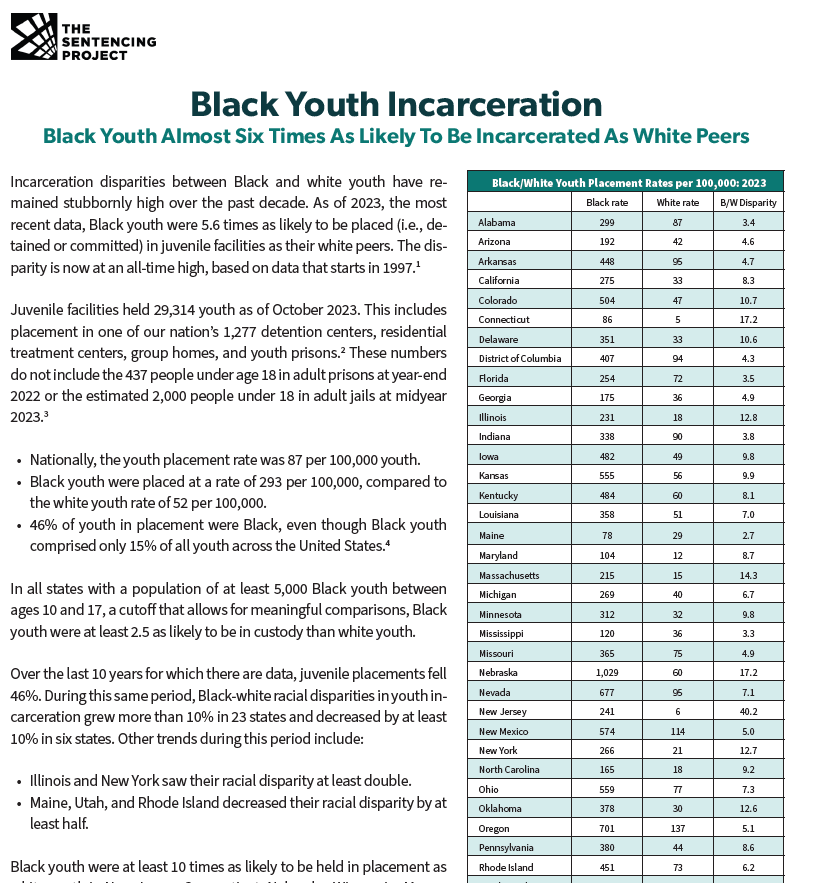
Black Youth Incarceration. Black Youth Almost Six Times As Likely To Be Incarcerated As White Peers

By Josh Rovner

  Incarceration disparities between Black and white youth have remained stubbornly high over the past decade. As of 2023, the most recent data, Black youth were 5.6 times as likely to be placed (i.e., detained or committed) in juvenile facilities as their white peers. The disparity is now at an all-time high, based on data that starts in 1997. Juvenile facilities held 29,314 youth as of October 2023. This includes placement in one of our nation’s 1,277 detention centers, residential treatment centers, group homes, and youth prisons. These numbers do not include the 437 people under age 18 in adult prisons at year-end 2022 or the estimated 2,000 people under 18 in adult jails at midyear 2023. • Nationally, the youth placement rate was 87 per 100,000 youth. • Black youth were placed at a rate of 293 per 100,000, compared to the white youth rate of 52 per 100,000. • 46% of youth in placement were Black, even though Black youth comprised only 15% of all youth across the United States. In all states with a population of at least 5,000 Black youth between ages 10 and 17, a cutoff that allows for meaningful comparisons, Black youth were at least 2.5 as likely to be in custody than white youth. 

Washington, DC: The Sentencing Project, 2025. 3p.

Justice at a Crossroads in New York City Studying Crimes in New York City Using the National Crime Victimization Survey (NCVS) By Min Xie, Preeti Chauhan, Michael Rempel, and Jeremy Travis

By Min Xie, Preeti Chauhan, Michael Rempel, and Jeremy Travis 

This study relies on data from the National Crime Victimization Survey (NCVS) and presents trends from 1996 to 2022 in crime victimization, rates at which victims report crimes to the police, confidence in the police, and victims’ use of services in New York City. This is one of two studies falling under the umbrella of the Crossroads Project. Its goal is to trace New York City’s trends in crime victimization, enforcement, incarceration, and racial disparities from the 1990s to the early 2020s in the hopes that empirical data over a long timeframe might provide a much-needed perspective capable of informing future policy. Both of the two resulting reports and a joint executive summary may be found at the project landing page. What is the NCVS, and why is it important for studying crime? Crime data for cities and communities across the country relies primarily on criminal complaints reported to local police agencies. The many crimes that victims never report to law enforcement are omitted. However, by collecting data directly from crime victims, the National Crime Victimization Survey (NCVS) can provide estimates of both reported and unreported crime. The NCVS is the world’s largest and oldest national victimization survey (Xie, Lynch, & Lauritsen, 2025). It has provided information on the criminal victimization of the U.S. household population for over 50 years (1973 to present). It surveys persons aged 12 years or older from a nationally representative sample of U.S. households randomly selected from a stratified multistage cluster sampling design, with the goal of getting an accurate and representative count of crime victimization in the United States (Cantor, 2025). The U.S. Census Bureau administers the interviews for the Bureau of Justice Statistics (BJS). The primary information from the NCVS includes nonfatal violent crimes (rape or sexual assault, robbery, aggravated assault, and simple assault) and household property crimes (i.e., burglary, motor vehicle theft, and other types of theft), both reported and not reported to the police. Therefore, the estimates for nonfatal violence crimes are by persons, and the estimates for property crimes are by households. The NCVS data is an important complement to the Uniform Crime Reporting (UCR) Summary program and the National Incident-Based Reporting System (NIBRS). The UCR and NIBRS databases, which rely on crimes reported to the police, are often used to follow crime trends by policymakers, journalists, and the general public, and to guide public safety decision making. But nationwide, the NCVS shows that more than 50% of crimes are NOT reported to the police (Xie, Ortiz Solis, & Chauhan, 2024). This is known as the dark figure of crime and shows that relying on police-recorded crimes provides an incomplete picture of crime trends (Lynch & Addington, 2007). The NCVS also provides critical information such as why the crime was not reported to the police. Much information in the NCVS is not available from the UCR summary program or NIBRS, such as the circumstances of crimes based on the victims’ descriptions, the consequences of the victimizations, the victims’ responses to victimization, and their interaction with the criminal justice or victim service systems or lack thereof. These data are critical to policymakers as they think of responses to crime and how to enhance public safety.  

New York: Data Collaborative for Justice, at John Jay College, 2025. 18p.   

Unsportsmanlike Behavior: Examining Variation in Arrests at National Football League Games

By Ryan Bowman


While previous research has explored the relationship between sporting events and crime in larger geographic spaces, research has not comprehensively examined how characteristics of sporting events influence arrests made inside stadiums themselves. Using a dataset of police records encompassing several seasons of the National Football League (NFL), this study explores how individual game characteristics influence the number of arrests made by police within the confines of the stadiums and stadium parking lots. Grounded in the routine activities theory, multilevel regression models suggest that certain game characteristics can influence the number of arrests made at a game.


DEVIANT BEHAVIOR 2025

Children and youth in mixed migration: Insights and key messages drawn from a decade of MMC’s research and 4Mi data collection

By  Jane Linekar, Jennifer Vallentine

This paper on “children and youth in mixed migration” summarizes some key messages on the topic, and with an aim to provoke thoughts on how to address information gaps and take into account the specific dynamics, needs and vulnerabilities of children and youth travelling on mixed migration routes. The annex brings together in one resource all our research publications on children and youth.

London/Denmark: Mixed Migration Centre, 2023. 8p

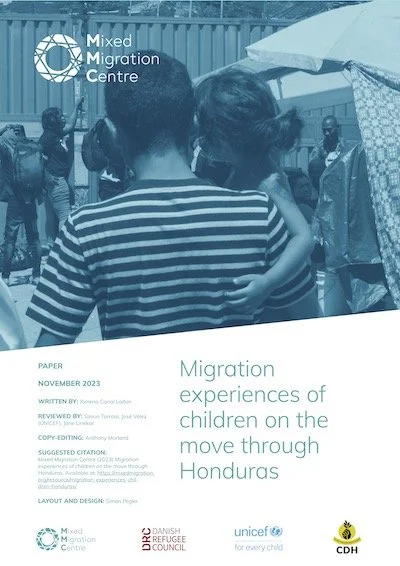
Migration experiences of children on the move through Honduras

By Ximena Canal Laiton

This paper explores the migration experiences of children and caregivers on the move in Honduras. The research project was developed by the Mixed Migration Centre (MMC), the Centro de Desarrollo Humano (CDH), and the United Nations Children‘s Fund (UNICEF) Honduras to gather evidence regarding children on the move throughout Latin America and the Caribbean. The study contains an analysis and findings on children‘s and caregivers‘ travel conditions and impacts, perceived and experienced security risks during the journey, an Honduras through the 4Mi project.d humanitarian needs identified by caregivers surveyed in

CDH, MMC, UNICEF, 2023. 15p