Open Access Publisher and Free Library
HUMAN RIGHTS.jpeg

HUMAN RIGHTS

Human Rights-Migration-Trafficking-Slavery-History-Memoirs-Philosophy

Posts in Sociology
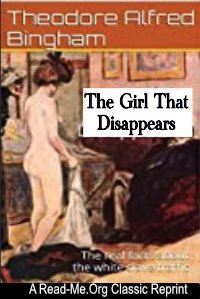
The Girl That Disappears: the real facts about the white slave traffic

By Theo. A. Bingham.

 This story is one of many that could be told to illustrate the sin- ister fact that every year thousands of young girls disappear from their homes in the cities or go from the small towns to the cities and drop out forever from all knowledge of their families. What becomes of them? Where do they go? Why do they go ? Into whose hands do they fall ? Some of them go down to nameless graves, but more go to a fate infinitely worse. What that fate is we all know, in a vague way at least; but, unfortunately, few of us are willing to realize that the thing is of any real concern to us personally. Not because we are heartless or cold or selfish do we Americans ignore the fact that we have a terrible social problem at our doors. No; our unwillingness to look the facts squarely in the face is due solely to inherited Puritanism. We have allowed ourselves to become con- vinced that we are morally superior to the people of Europe. Our belief in our superior purity is founded on ignorance or hypocrisy. We have made laws saying that the social evil shall not exist. Then we thoroughly blindfold ourselves and raise our hands in horror at any mention of the subject. The plain, shocking facts are that this American attitude encourages the growth and spread of vice. It makes it possible for a girl to disappear from your town, from your own neighborhood, and be drawn into the net of the underworld. And until we overcome our timidity and hypocrisy and go after the situation frankly, vigorously, and openly, the social evil will continue to grow. It thrives on secrecy and hypocrisy.

Read-Me.org classic reprint. Boston: R.G. Badger, 1913, 87p.
download
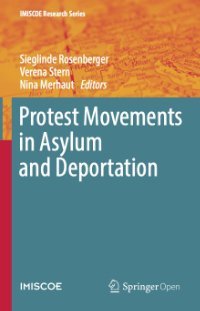
Protest Movements in Asylum and Deportation

Edited by Sieglinde Rosenberger,, Verena Stern and Nina Merhaut

European societies have been confronted with rapid social and cultural transformation, which took on a new magnitude with the “long summer of migration” in 2015. In general, the perceptions and experiences of change never go uncontested; change gives rise to conflicts and struggles over collective identities, policy, and legal responses. International migration flows and related issues such as asylum and the deportation of non-citizens have grown into one of Europe’s most controversial and politicized topics. Political parties campaign on these issues, but there is also political protest articulated by movements, activists, grassroots organizations and ordinary citizens. These acts of resistance are gaining in qualitative and quantitative importance. They include voices for more liberal and open stances towards migration on the one hand, and voices calling for greater deterrents and coercive policy approaches on the other.

Cham: Springer, 2018, 294p.

download
Border Watch: Cultures of Immigration, Detention and Control

By Alexandra Hall.

Questions over immigration and asylum face almost all Western countries. Should only economically useful immigrants be allowed? What should be done with unwanted or 'illegal' immigrants? In this bold intervention, Alexandra Hall shows that immigration detention centres offer a window onto society's broader attitudes towards immigrants. Despite periodic media scandals, remarkably little has been written about the everyday workings of this system, or about the people responsible for setting immigration policy. Detention, particularly, is a hidden side of border politics, despite its growing international importance as a tool of control and security.

London: Pluto Books, 2012, 209p.

download
Fugitive Borders

By Nele Sawallisch.

“Fugitive Borders explores a new archive of 19th-century autobiographical writing by black authors in North America. For that purpose, Nele Sawallisch examines four different texts written by formerly enslaved men in the 1850s that emerged in or around the historical region of Canada West (now known as Ontario) and that defy the genre conventions of the classic slave narrative. Instead, these texts demonstrate originality in expressing complex, often ambivalent attitudes towards the so-called Canadian Promised Land and contribute to a form of textual community-building across national borders. In the context of emerging national discourses before Canada's Confederation in 1867, they offer alternatives to the hegemonic narrative of the white settler nation.”

New York: Columbia University Press, 2019. 218p.

download
Modes of Bio-Bordering

By Nina Amelung, Rafaela Granja, and Helena Machado.

The Hidden (Dis)Integration of Europe. This open access book explores how biometric data is increasingly flowing across borders in order to limit, control and contain the mobility of selected people, namely criminalized populations. It introduces the concept of bio-bordering, using it to capture reverse patterns of bordering and ordering practices linked to transnational biometric data exchange regimes. The concept is useful to reconstruct how the territorial foundations of national state autonomy are partially reclaimed and, at the same time, partially purposefully suspended. The book focuses on the Prüm system, which facilitates the mandatory exchange of forensic DNA data amongst EU Member States.

Springer Nature, 2021. 155p.

download