Open Access Publisher and Free Library
HUMAN RIGHTS.jpeg

HUMAN RIGHTS

Human Rights-Migration-Trafficking-Slavery-History-Memoirs-Philosophy

Posts in diversity
The End Of Faith: Religion, Terror, and the Future of Reason

USED BOOK. MAY CONTAIN MARK-UP

By Sam Harris

FROM THE COVER: “In The End of Faith, Sam Harris delivers a startling analysis of the clash between reason and religion in the modern world. He offers a vivid, historical tour of our willingness to suspend reason in favor of religious beliefs- even when these beliefs inspire the worst of human atrocities. While warning against the encroachment of organized religion into world politics, Harris draws on insights from neuroscience, philosophy, and Eastern mysticism to deliver a call for a truly modern foundation for ethics and spirituality that is both secular and humanistic.

"The End of Faith is a genuinely frightening book. ... Read Sam Harris and wake up." -Richard Dawkins, The Guardian

NY. W•W• Norton. 2004. 341p.

Freethinkers: A History Of American Secularism

USED BOOK. MAY CONTAIN MARK-UP

By Susan Jacoby

FROM THE JACKET: At a time when the separation of church and state is under attack as never before, Freethinkers celebrates the noble and essential secularist heritage that gave Americans the first government in the world founded not on the authority of religion but on the bedrock of human reason. In impassioned, elegant prose, Susan Jacoby offers a powerful defense of more than two hundred years of secularist activism, beginning with the fierce debate over the omission of God from the Constitution. Moving from nineteenth-century abolitionism and suffragism through the twentieth-century's civil liberties, civil rights, and feminist movements, Freethinkers illuminates the neglected accomplishments of secularists who, allied with tolerant and liberal religious believers, have stood at the forefront of the battle for social reforms opposed by reactionaries in the past and today. Rich with such iconic figures as Thomas Jefferson, Thomas Paine, James Madison, Abraham Lincoln, Elizabeth Cady Stanton, and Clarence Darrow--as well as once-famous secularists such as Robert Green Ingersoll, "the Great Agnostic"-Freethinkers restores to history generations of dedicated humanist champions. It is they, Jacoby shows, who have led the struggle to uphold the unique combination of secular government and religious liberty that is and always has been the glory of the American system.

NY. Henry Holt and Company. 2004. 441p.

Who Moved the Stone?

USED BOOK. MAY CONTAIN MARK-UP

By Frank Morison

FROM THE COVER: “I wanted to take this last phase of the life of Jesus, with all its quick and pulsating drama, its sharp, clear-cut background of antiquity, and its tremendous psychological and human intersEt - -to strip it of its overgrowth of primitive beliefs, dogmatic suppositions, and to see this supremely great Person as He really was.”

Such was English journalist Frank Morison's drive to learn of Christ. The strangeness of the Resurrection story had captured his attention, and, influenced by skeptic thinkers at the turn of the century, he set out to prove that the story of Christ's Resurrection was only a myth. His probings, however, led him to discover the validity of the biblical record in a moving, personal way. Who Moved the Stone? is considered by many to be a classic apologetic on the subject of the Resurrection. Morison includes a vivid and poignant account of Christ's betrayal, trial, and death as a backdrop to his retelling of the climactic Resurrection itself.”

Grand Rapids. Michigan. Lamplighters Books. 1958 (1930) 192p.

Martin Luther's 95 Theses

USED BOOK. MAY CONTAIN MARK-UP

By Martin Luther

“Out of love for the truth and from desire to elucidate it, the Reverend Father Martin Luther, Master of Arts and Sacred & Theology, and ordinary lecturer therein at Wittenberg, intends to defend the following state- ments and to dispute on them in that place. There fore he asks that those who cannot be present and dispute with him orally shall do so in their absence by letter. In the name of our Lord Jesus Christ, Amen.”

The Saint and the Boy: And Twenty Other Stories For Children

USED BOOK. MAY CONTAIN MARK-UP

By John Leale

“'Saint,' said a boy as they were having a walk together. 'If you went home andfound that a bad man was in your house, what would you do about it?'

'I would try to make friends with him,' replied the saint.

'Yes, but supposing that he didn't want to make friends with you, what would you do then?” asked the boy.

'I would go on trying to make friends with him,' said the saint.

'Yes, but supposing he stamped his foot and thumped the table with his fist, and said: "Saint, I won't be friends with you." What would you do then?*

'I would ask the Good Lord what I ought to do.'

…..

London. The Epworth Press. 1957. 104p.

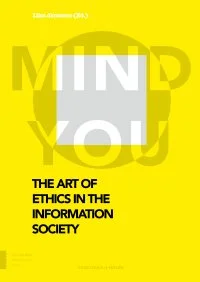
Mind you: The Art of Ethics in the Information Society.

Edited by Liisa Janssens

New technologies are often implemented before their ethical consequences have been fully understood. In this volume, experts working in the sciences, arts, and philosophy of technology share novel perspectives on how we can

Amsterdam: Amsterdam University Press, 2016. 144p.

The Church and the Age of Reason 1648-1789

USED BOOK. MAY CONTAIN MARK-UP

By Gerald R. Cragg

FROM THE PREFACE: “This span in the history of the Christian church stretches from the age of religious and civil strife which existed before the middle of the seventeenth century to the age of industrialism and republicanism which followed the French Revolution and the beginning of the Napoleonic wars. The church in general, reacting strongly against the turbulences of the Civil War and the Thirty Years' War, placed a premium on order, moderation, and stability. Movements suspected of enthusiasm, such as Puritanism, Quietism, and Jansenism, fell into disrepute, and the authority exercised by the state in religious affairs became more pronounced. It was an age dominated by Reason, which, until it provoked a reaction in such movements as Pietism and Evangelicism, posed a formidable challenge to Christianity.”

London. Penguin. 1960. 297p.

Documents Of The Christian Church

used book. may contain mark-up

Selected and Edited by Henry Bettenson

FROM THE COVER FLAP: This book presents a selection from the most important records of the history of the Christian Church from its beginning. It goes in all cases to official documents and other sources, and provides the general reader with many extracts, about most of which he may have heard, though he will have seen very few and will certainly not have them conveniently to his hand in one volume. The book opens with references to Christianity in the Classical authors, and continues with, among other subjects, the Relation of Church and State in the Roman Empire, the Formation of the Creeds, the Development of Doctrine, the Breach between East and West, the Empire and the Papacy, the Relations between Church and State….”

London. Oxford University Press. 1959. 479p.

Constantine's Sword: The Church and the Jews

By James Carroll

FROM THE COVER: In this "rare book that combines searing passion ... with a subject that has affected all of our lives" (Chicago Tribune), the novelist and cultural critic James Carroll maps the profoundly troubling two-thousand-year course of the Church's battle against Judaism and faces the crisis of faith it has provoked in his own life as a Catholic. More than a chronicle of religion, this dark history is the central tragedy of Western civilization, its fault lines reaching deep into our culture. A courageous and affecting reckoning with difficult truths that will touch every reader, Constantines Sword is truly a book for our times.

A Mariner Boo.k Houghton Mifelin Company. 2002. 757p. USED BOOK. CONTAINS MARK-UP.

Altruism, Morality, and Economic Theory

Edited by Edmund S. Phelps

From the Preface: “The self-interest model has had sweeping success over recent decades in the study of both economics and politics. Yet the inner ambiguities and limitations of that model could not indefinitely escape notice and examination. Self interest in some interpretation is some of the story some of the time, never the whole story. On March 3 and 4, 1972, a number o fsocial scientists met at Russell Sage Foundation to speculate and theorize on the roles that altruism and morality in a society may play in shaping human behaviorand institutions within it. The nine papers presented at the conference are by economists. The commentaries on them were drawn from representatives of other disciplines, primarily philosophy and law. This volume is a rough. approximation to the proceedings of the conference. An introduction by the editor has been added to announce some of the main themes and to bring out some of the interrelations among the papers.”

NY. Russell Sage Foundation. 1975. 225p. CONTAINS MARK-UP

Evolutionary Ethics

By A. G. N. Flew

FROM THE INTRODUCTION: The obvious and the right place from which to begin a study of evolutionary ethics is the work of Charles Darwin. For, primarily, it is his ideas - or what have been thought to be his ideas which advocates of evolutionary ethics or evolutionary politics have tried to apply more widely. This is not, of course, to say that Darwin hadn ointellectual ancestors; any more than it is to suggest that biological theory has since his death stood still. To say or to suggest either thing would be absurdly wrong…”

NY. St. Martinn’s Press. 1967. 78p. CONTAINS MARK-UP

The Calendar of Saints

Compiled By Vincent Cronin

From the introduction: “…With the portrayal of saints, on the other hand, artists have felt no nced to transcend the limitations of time and place. Such portraits accurately reflect the ciilization which gave them birth, without, however, being merely local or national. Hagio-iconography has scldom been tainted by chauvinism. St George, a martyr in Palestine, is patron saint of England, while St Nicholas is honoured no less in Italy than in Russia. I can remember my surprise and delight in finding a stained- glass window of St Thomas à Becket in a church in Sicily, and a picture of St Theresa of Lisieux in a peasant cottage in the depths of Yugoslavia. The portrayal of saints, though some may regard it as merely a side-line in the history of Western civilization, can actually claim to be one of its most central and distinctive features…”

Westminster. Newman Press. 1963. 381p.

Conjectures And Refutations: The Growth of Scientific Knowledge

By Karl R. Popper

Conjectures and Refutations is one of Karl Popper's most wide-ranging and popular works, notable not only for its acute insight into the way scientific knowledge grows, but also for applying those insights to politics and to history. It provides one of the clearest and most accessible statements of the fundamental idea that guided his work: not only our knowledge, but our aims and our standards, grow through an unending process of trial and error.

NY. Harper Torchbooks. 1963. 423p.

Dying with Dignity: A Legal Approach to Assisted Death

By Giza Lopes

From the series foreword by Graeme R. Newman: “ Lopes convincingly argues that not only have the clergy as the shepherds of Death been replaced by modern medicine’s doctors and technologies, but that the rule of law has intervened to codify the ways and rights of helping people to die. She catalogues, with fascinating case studies and detailed historical observation, the quite different ways that the United States and European countries have tackled this problem of all problems. This is an erudite book that leaves no detail untouched; relentlessly unravels the moral, judicial, and political events that arguably precede—seen and unseen—not only every assisted death but arguably every single death on earth; and shows how these events have relentlessly set the stage for the coming movement to quicken the time it takes to die.”

Santa Barbara. Praeger. 2015. 256p.

Darwin’s Dangerous Idea: Evolution And The Meanings Of Life

By Daniel C. Dennett

From the preface: Darwin’s theory of evolution by natural selection has always fascinated me, but over the years I have found a surprising variety of thinkers who cannot conceal their discomfort with his great idea, ranging from nagging skepti­cism to outright hostility. I have found not just lay people and religious thinkers, but secular philosophers, psychologists, physicists, and even biol­ogists who w'ould prefer, it seems, that Darwin were wrong. This book is about why Darwin’s idea is so powerful, and why it promises—not threat­ens—to put our most cherished visions of life on a new foundation.

NY. Touchstone.1995. 568p. CONTAINS MARK-UP

The Book of Mormon

Translated by Joseph Smith Jr.

An account written by the Hand of Mormon, upon Plates taken from the Plates of Nephi. Wherefore It Is an abridgment of the record of the people of Nephi, and also of the Lamanltes; written to the Lamanites who are a remnant of the house of Israel; and also to Jew and Gentile: written by way of commandment, and also by the Spirit of prophecy and of revelation. Written and sealed up, and hid up unto the Lord, that they might not be destroyed; to come forth by the gift and power of God unto the inter­pretation thereof: sealed by the hand of Moroni, and hid up unto the Lord, to come forth in due time by the way of Gentile; the interpretation thereof by the gift of God.

An abridgment taken from the Book of Ether also; which Is a record of the people of Jared; who were scattered at the time the Lord con­founded the language of the people when they were building a tower to get to heaven; which is to shew unto the remnant of the House of Israel whut great things the Lord hath done for their fathers; and that they may know the covenants of the Lord, that they are not cast off forever; and also to the convincing of the Jew and Gentile that JESUS is the CHRIST, the ETERNAL GOD, manifesting himself unto all nations. And now if there are faults, they are the mistakes of men; wherefore condemn not the things of God, that ye may be found spotless at the Judgment-seat of Christ.

Chicago. Press of Henry C. Often & Co.1905. 637p.

Beyond Memory: Italian Protestants in Italy and America

By Dennis Barone

In Beyond Memory, Dennis Barone uncovers the richness and diversity of the Italian Protestant experience and places it in the context of migration and political and social life in both Italy and the United States. Italian Protestants have received scant attention in the fields of Italian American studies, religious studies, and immigration studies, and through literary sources, church records, manuscript sources, and secondary sources in various fields, Barone introduces such forgotten voices as the Baptist Antonio Mangano, the Methodist Antonio Arrighi, and his great-grandfather Alfredo Barone, a Baptist minister to congregations in Italy and Massachusetts. Examining the complex histories of these and other Italian Protestants, Barone argues that Protestantism ultimately served as a means to negotiate between Old World and New World ways, even as it resulted in the double alienation of rejection by Roman Catholic immigrants and condescension by Anglo-Protestants. Though the book focuses on the years of high immigration (1890-1920), it also looks at precursors to post-reunification Protestants as well as Protestants in Italy today, now that the nation has become a country of in-migration.

NY. SUNY Press. 2016. 182p.