

PHYSIQUE AND DELINQUENCY
by Graeme Newman (Author), Sheldon Glueck (Author), Eleanor Glueck
Does the shape of a body shape a life?
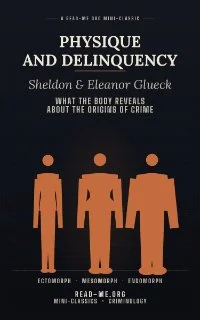
In 1956, Harvard criminologists Sheldon and Eleanor Glueck published one of the most provocative findings in the history of criminology: among the 500 persistent juvenile delinquents at the heart of their landmark study, six in ten were built like athletes — solid, muscular, "mesomorphic" — compared to fewer than one in three of the matched non-delinquent boys from the very same streets. Boys of slight, fragile build were strikingly rare among the delinquents. Matched for age, intelligence, ethnicity, and neighborhood, the two groups differed sharply in one thing neither had chosen: the body they were born with.
Physique and Delinquency is the Gluecks' full investigation of what that difference meant — and what it didn't. Carefully, methodically, and explicitly rejecting the old "born criminal" theories of the nineteenth century, the Gluecks set out to show that physical constitution is not destiny. Instead, they found something more nuanced and more interesting: the very same trait, and the very same troubled home, can push a sturdy, energetic boy toward trouble while leaving a more sensitive, delicately built boy untouched — and can devastate that same sensitive boy when the pressures at home turn severe.
This Read-Me.Org Mini-Classic distills the Gluecks' densely tabulated 1956 original into a compact, readable narrative — every chapter, every major finding, and the six theoretical hypotheses that close the book — while leaving the statistical tables and technical appendixes to specialists and to the full edition. It's an ideal introduction for students of criminology, psychology, and the history of science, and for anyone curious about a study that remains as influential as it is uncomfortable, nearly seventy years after it first raised the question.
Includes a new introductory essay situating the book in its historical context, and a set of review and discussion questions suited to classroom or book-club use.
Part of the Read-Me.Org Mini-Classics series — short, careful introductions to landmark and forgotten works of criminology, sociology, and social history.
This edition was prepared with AI assistance used to condense and adapt the source text under human editorial review; abridgment choices and framing are the editor's own. Published under Creative Commons licensing.
Read-Me.Org Inc. New York-Philadelphia-Australia. 2026. p.80.