

Open Access Free Library
JUVENILE JUSTICE.jpeg

JUVENILE JUSTICE

JUVENILE JUSTICE-DELINQUENCY-GANGS-DETENTION

Posts tagged delinquency research
Family Environment and Delinquency : a Mini-Classic

by Graeme Newman (Author), Sheldon Glueck (Author), Eleanor Glueck

Why do some children in a family, or on the same street, turn to delinquency while their brothers, sisters and neighbors do not?

In Family Environment and Delinquency (1962), Sheldon and Eleanor Glueck, the most celebrated husband-and-wife team in the history of criminology, set out to answer one of the oldest and most stubborn questions in the study of crime. Drawing on their landmark comparison of 500 persistent delinquents and 500 matched non-delinquents from the poor neighborhoods of Boston, they traced how the home, what they called the "under-the-roof culture," shapes children's traits, and how those traits and family conditions combine to push some boys over the edge.

Their answer was startling for its time and remains compelling today: the family environment works selectively. A drunken father, a chaotic household, harsh or erratic discipline, chronic poverty: none of these alone reliably produces a delinquent. What matters is the meeting of a particular pressure with a particular child. The Gluecks called it "differential contamination," which depends "not merely on exposure but also on susceptibility." It is an idea that anticipates today's research on gene-environment interaction and differential susceptibility.

The original book is dense with thousands of statistical tables. This Mini-Classic sets out its argument clearly and concisely, chapter by chapter. It includes an introduction to the book and its central ideas; a profile of Sheldon and Eleanor Glueck and their four-decade research partnership; the historical context of Unraveling Juvenile Delinquency, Physique and Delinquency, and the Gluecks' battle with differential association theory; a clear summary of every chapter, from the origins of traits to the practical management of delinquency; a chapter on modern relevance, from Sampson and Laub's rediscovery of the Glueck files to today's family-based prevention programs, with a frank account of what has not survived; and twenty review questions for students and discussion groups.

Ideal for students of criminology, sociology, psychology and social work, for practitioners working with young people and families, and for anyone interested in the enduring question of Nature and Nurture.

Read-Me.Org Mini-Classics make the landmark works of social science accessible to modern readers in brief, readable editions. Download the original book here.

Read-Me.Org Inc. New York-Philadelphia-Australia. 2026. p.67.
Unraveling Juvenile Delinquency- A Reader's Guide

by Graeme Newman (Author), Sheldon Glueck (Author), Eleanor Glueck

What makes a boy a persistent delinquent? A reader's guide to one of criminology's great matched-comparison studies.

In 1939, Sheldon and Eleanor Glueck of Harvard stopped asking what happens to offenders after they are caught and asked a harder question: why do some boys from the same poor neighborhoods become persistent delinquents while others do not?

Their answer, Unraveling Juvenile Delinquency (1950), compared 500 delinquent boys with 500 non-delinquents, matched pair by pair on age, intelligence, ethnic origin and neighborhood. They examined family life, schooling, health, body build, intelligence, personality and temperament. Then they built "prediction tables" meant to spot at-risk children when they start school.

The book is long, technical and dated in its language. This Reader's Guide makes it accessible without replacing it. It explains how the study was designed, what it found, and how far its evidence can be trusted, and it connects the Gluecks to the research that followed.

INSIDE THIS GUIDE

  • A reading plan and a chapter-by-chapter map of the original

  • How the two groups were built, and what the design can and cannot show

  • The findings on family, school, the street, health, physique, intelligence and temperament, explained in plain language

  • The prediction tables, with a worked example that shows why "79 chances in a hundred" can mean something quite different in real life

  • Five common misreadings of the book

  • What has changed since 1950, including later reanalyses of the Gluecks' data, and what has not

  • A primer on statistics, a glossary, an annotated reading list, an FAQ, 26 discussion questions and classroom activities

WHO IT'S FOR: Students of criminology, sociology, psychology, social work and law; teachers and reading groups; and general readers who want to understand a landmark study and the debates it started, from risk assessment to the role of the family.

Part of the Read-Me.Org Reader's Guide series, bringing back landmark out-of-print works in criminology and social science..

NOTE: This is an independent guide, not an abridgment or edition of the Gluecks' book. It does not reproduce the original's text or tables and is not endorsed by the authors' heirs or the original publisher. It is meant to be read alongside the original. Written by Graeme R. Newman with the assistance of Claude, an AI model made by Anthropic. The AI-generated content is disclosed in accordance with Read-Me.Org policy. Read the Original Book online.

Read-Me.Org Inc. New York-Philadelphia-Australia. 2026. p.67.
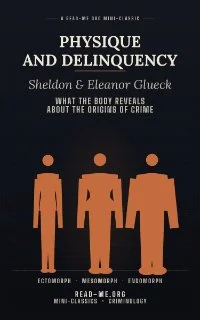
Physique And Delinquency

by Graeme Newman (Author), Sheldon Glueck (Author), Eleanor Glueck

Does the shape of a body shape a life?

In 1956, Harvard criminologists Sheldon and Eleanor Glueck published one of the most provocative findings in the history of criminology: among the 500 persistent juvenile delinquents at the heart of their landmark study, six in ten were built like athletes — solid, muscular, "mesomorphic" — compared to fewer than one in three of the matched non-delinquent boys from the very same streets. Boys of slight, fragile build were strikingly rare among the delinquents. Matched for age, intelligence, ethnicity, and neighborhood, the two groups differed sharply in one thing neither had chosen: the body they were born with.

Physique and Delinquency is the Gluecks' full investigation of what that difference meant — and what it didn't. Carefully, methodically, and explicitly rejecting the old "born criminal" theories of the nineteenth century, the Gluecks set out to show that physical constitution is not destiny. Instead, they found something more nuanced and more interesting: the very same trait, and the very same troubled home, can push a sturdy, energetic boy toward trouble while leaving a more sensitive, delicately built boy untouched — and can devastate that same sensitive boy when the pressures at home turn severe.

This Read-Me.Org Mini-Classic distills the Gluecks' densely tabulated 1956 original into a compact, readable narrative — every chapter, every major finding, and the six theoretical hypotheses that close the book — while leaving the statistical tables and technical appendixes to specialists and to the full edition. It's an ideal introduction for students of criminology, psychology, and the history of science, and for anyone curious about a study that remains as influential as it is uncomfortable, nearly seventy years after it first raised the question.

Includes a new introductory essay situating the book in its historical context, and a set of review and discussion questions suited to classroom or book-club use.

Part of the Read-Me.Org Mini-Classics series — short, careful introductions to landmark and forgotten works of criminology, sociology, and social history.

This edition was prepared with AI assistance used to condense and adapt the source text under human editorial review; abridgment choices and framing are the editor's own. Published under Creative Commons licensing. Read online the original book.

Read-Me.Org Inc. New York-Philadelphia-Australia. 2026. p.80.