Open Access Publisher and Free Library
JUVENILE JUSTICE.jpeg

JUVENILE JUSTICE

JUVENILE JUSTICE-DELINQUENCY-GANGS-DETENTION

Posts tagged juvenile detention
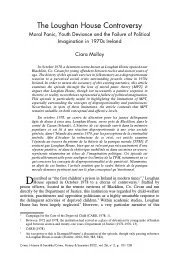
The Loughan House Controversy: Moral Panic, Youth Deviance and the Failure of Political Imagination in 1970s Ireland

By Ciara Molloy

In October 1978, a detention centre known as Loughan House opened near Blacklion, Co. Cavan for young offenders between twelve and sixteen years of age. The history of this episode survives in folk memory as a disproportionate reaction to a perceived social crisis surrounding juvenile crime in 1970s Ireland. In order to assess the accuracy of this existing narrative, this article examines the episode through the lens of moral panic theory [MPT]. It argues that Loughan House, though not necessarily a punitive response in rhetoric or reality, nevertheless represented a failure of political imagination. This episode is particularly useful in highlighting the limitations of MPT, especially surrounding the concepts of disproportionality and punitiveness. Nevertheless, in spite of these limitations, the article contends that MPT remains valuable on both conceptual and affective levels. En octobre 1978, un centre de détention pour les jeunes délinquants âgés de douze à seize ans, Loughan House, ouvre près de Blacklion, dans le comté de Cavan (Irlande). L’histoire de cet épisode survit dans la mémoire populaire et est lié à une réaction disproportionnée à une crise sociale générée, dans l’Irlande des années 1970, par les perceptions de la criminalité juvénile. Afin d’évaluer la robustesse de ce récit, cet article examine l’épisode au travers du prisme de la théorie de la panique morale [TPM]. Il soutient que Loughan House, bien que ne relevant pas nécessairement d’une réponse punitive, ni dans la rhétorique mobilisée ni dans ses mises en œuvre, représente néanmoins un échec de l’imagination politique. Cet épisode est particulièrement utile pour souligner les limites de la TPM, notamment en ce qui concerne les concepts de disproportionnalité et de punitivité. Néanmoins, en dépit de ces limites, l’article soutient que le cadre théorie de la panique morale demeure pertinent tant sur le plan conceptuel qu’émotionnel:.

Crime, History & Societies, 26:2 (2022), pp. 101–128.

download
Youth in Adult Courts, Jails, and Prisons

By Marcy Mistrett and Mariana Espinoza

At the turn of the 21st century, it was estimated that 250,000 children every year were charged as adults in the United States. By 2019, that number had dropped 80% to 53,000. This drop is to be celebrated and is the result of legislative changes in 44 states and the District of Columbia, as well as federal funding incentives. However, there is still much work to be done.

The children that remain exposed to the adult criminal legal system are overwhelmingly youth of color. The vast majority serve short sentences in adult jail or prison and return home by their 21st birthdays, the age at which services can be extended to in the youth justice system in the vast majority of states; indicating that many youth could be served, more appropriately, by the youth justice system.

This brief reviews the history, harms, pathways and trends that treat children as if they were adults.

Washington, DC: The Sentencing Project, 2022. 10p.

Download
Dreams Deferred: The Impact of Juvenile Fees on Florida’s Children, Families, and Future

By the Fines and Fees Justice Center (FFJC)

Every young person who comes into contact with Florida’s courts — regardless of guilt or innocence — is saddled with fees. Florida law authorizes 31 different court fees, costs and surcharges to be imposed on youth and their families. Together, these fees are quietly leading our youth, and their families, down a path of inescapable debt and poverty.

This report outlines the catastrophic consequences of juvenile fee debt for Florida’s children, families, and economy including: increased poverty, increased recidivism, and the exacerbation of racial disparities in the justice system. It also shows how the accumulation of fee debt is particularly damaging for Black youth and youth in the child welfare system.

Using county-level and statewide data, the report highlights the futility of both government, and private collection efforts, arguing that the costs of fee assessment and collection far outweigh the meager revenue received from such efforts.

Philadelphia: Fines and Fees Justice Center, 2022. 23p.

download
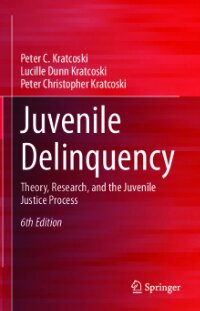
Juvenile Delinquency: Theory, Research, and the Juvenile Justice Process. 6th ed.

By Peter C. Kratcoski, Lucille Dunn Kratcoski, Peter Christopher Kratcoski

Combining theory with practical application, this seminal introduction to juvenile delinquency and juvenile justice integrates the latest research with emerging problems and trends in an overview of the field.

Now in its sixth edition, this book features new interviews and discussions with child care professionals and juvenile justice practitioners on their experiences translating theory to practice. It addresses recent changes in the characteristics of delinquents alongside changes in laws and the rise of social media and smartphones. It includes a new chapter of international perspectives on juvenile justice and delinquency. Incorporated throughout is consideration of the mental health and special needs of youth in the juvenile justice system, as well as at-risk and non-fault children as victims.

Cham, SWIT: Springer Nature, 2020. 457p.

download
Children in Custody

By Mary McAuley.

Anglo-Russian Perspectives.. Despite their very different histories, societies, political and legal systems, Russia and the UK stand out as favouring a punitive approach to young law breakers, imprisoning many more children than any other European countries. The book is based on the author's primary research in Russia in which she visited a dozen closed institutions from St Petersburg to Krasnoyarsk and on similar research in England and Northern Ireland. The result is a unique study of how attitudes to youth crime and criminal justice, the political environment and the relationship between state and society have interacted to influence the treatment of young offenders. McAuley's account of the twists and turns in policy towards youth illuminate the extraordinary history of Russia in the twentieth century and the making of social policy in Russia today. It is also the first study to compare the UK (excluding Scotland because of its separate juvenile justice system) with Russia, a comparison which highlights the factors responsible for the making of 'punitive' policy in the two societies. McAuley places the Russian and UK policies in a European context, aiming to reveal how other European countries manage to put so many fewer children behind bars.

Bloomsbury Academic (2010) 263 pages.

download