

By Runnymede Trust
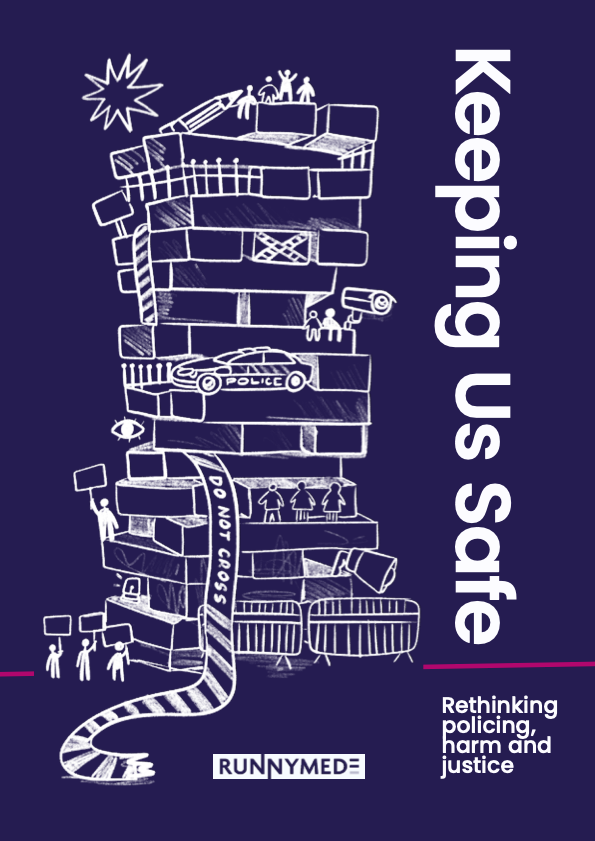
Keeping Us Safe: Rethinking policing, harm and justice, is a major new report calling for a fundamental shift in how the UK approaches safety, harm prevention and justice.
Drawing on nationally representative polling of 5,405 people in England and Wales, alongside in-depth community-based qualitative research, the report finds strong public support for social investment over punitive enforcement when given nuanced choices.
Key findings from the national polling include:
More than half (52%) think investing in public and social services would do more to prevent crime than increasing police powers (18% disagree, the rest are unsure). Half (50%) of the public believe investing in public and social services would do more to prevent crime than increasing the number of police officers (22% disagree, the rest are unsure). Keeping Us Safe critiques the dominant political and media framing that more police and more policing powers are common-sense solutions to social issues. It argues that binary polling questions obscure these nuances and reinforce a narrow public narrative that equates safety with police presence.
In the report, we trace modern British policing to its colonial origins, finding that contemporary policing continues to reproduce racial injustices through stop and search, punitive practices in educational settings, policing the border, mental health detentions and the overrepresentation of Black and racialised communities in the criminal legal system.
We argue that despite decades of inquiries and reform efforts, including high-profile reviews into institutional racism - from the 1999 Macpherson Report which found ‘institutional racism’ in the Metropolitan Police, to the 2023 Casey Review which identified a culture of racism, misogyny, and homophobia - attempts to reform policing have failed to address systemic issues. Instead, it argues, reform has often individualised racism as a matter of ‘bad apples’, leaving structures which produce inequality intact.
Police spending reached £19.9 billion last year, while youth services, mental health provision, housing support and community infrastructure face chronic underfunding.
Across six key areas (‘serious youth violence’, education, housing and homelessness, border enforcement, gender-based violence and mental health), the research finds that policing often deepens harm and fails to address root causes such as poverty, social exclusion, trauma and racism. It highlights community-led models already in practice, including: transformative justice practices that address harm without reproducing
violence, grounded in care, consent and collective accountability; reparative justice approaches that acknowledge and seek redress for historic and ongoing harms caused by racism, colonialism and slavery
and the inequalities they produced; restorative justice initiatives that empower survivors and create genuine opportunities for people who’ve caused harm to take responsibility and repair relationships; healing justice models that recognise harm as both systemic and interpersonal and treat healing as part of a collective political project.
The report sets out a series of ‘non-reformist reforms’ designed to build safer, more resilient communities. These include investing in teachers and pastoral support; ending school exclusions and the Prevent Duty; overhauling the Mental Health Act to end the use of police in responding to people in crisis; and an end to the No Recourse to Public Funds policy.
Keeping Us Safe concludes that safety does not begin with enforcement but with meeting people’s basic needs. It calls for a redistribution of public resources away from punitive systems and towards harm prevention, collective care and accountability.