

By Violence Policy Center
Large capacity ammunition magazines are the common thread running through most mass shootings in the United States. Since 1980, there have been at least 110 mass shootings (three or more fatalities not including
the shooter) where the shooter used large capacity ammunition magazines containing more than 10 rounds.
A total of 981 people were killed in these shootings, and 1,328 were wounded. This number is likely a significant undercount of actual incidents as there is no consistent collection or reporting on this data. Even in many high-profile shootings, information on magazine capacity is neither released nor reported. The Violence Policy Center has compiled this list of incidents by analyzing news reports and follow-up investigative reports
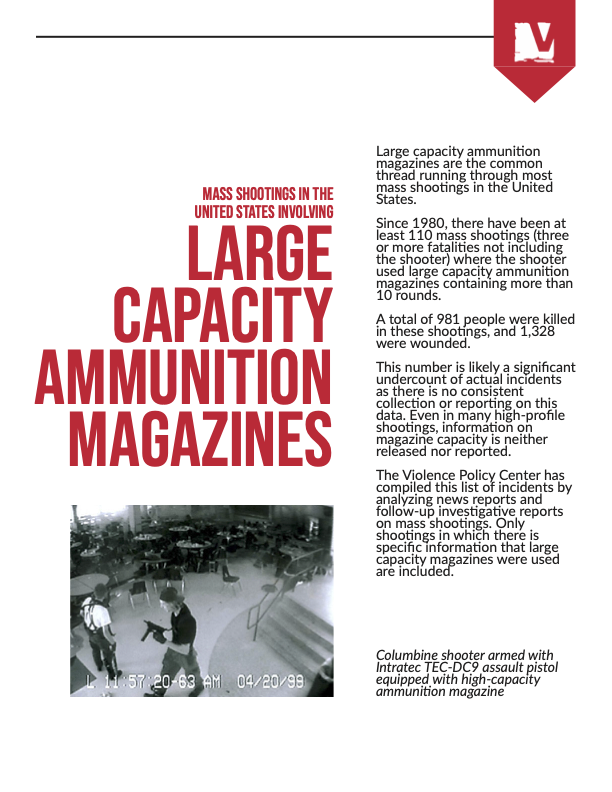
on mass shootings. Only shootings in which there is specific information that large capacity magazines were used are included. Columbine shooter armed with Intratec TEC-DC9 assault pistol equipped with high capacity ammunition magazine
Large capacity ammunition magazines are the common thread running through most mass shootings in the United States. Since 1980, there have been at least 110 mass shootings (three or more fatalities not including
the shooter) where the shooter used large capacity ammunition magazines containing more than 10 rounds.
A total of 981 people were killed in these shootings, and 1,328 were wounded. This number is likely a significant undercount of actual incidents as there is no consistent collection or reporting on this data. Even in many high-profile shootings, information on magazine capacity is neither released nor reported. The Violence Policy Center has compiled this list of incidents by analyzing news reports and follow-up investigative reports
on mass shootings. Only shootings in which there is specific information that large capacity magazines were used are included.
BY JASON JOHNSON AND SEAN KENNEDY
LELDF RESEARCH BRIEF | AUGUST 2023
Consent decrees are a blunt instrument for enacting police reform. The approach has proven ill-suited at enacting effective change in law enforcement agencies. These coercive reforms face institutional resistance from departments and their personnel and fall victim to mission creep from the unaccountable lawyers, judges, and bureaucrats who oversee the design and later the implementation of the reforms. The situation worsened significantly as the Obama Administration increased the use of consent decrees, a policy resumed under the Biden Department of Justice. Often built on limited and flimsy evidence, the Justice Department’s allegations against police agencies put local jurisdictions in a near impossible position to contest civil rights violations findings. Additionally, the Justice Department frequently injects its policy preferences into the required remedies that do not reflect urgent or even necessary changes, but policy agenda of the Civil Rights Division and the White House. Subject jurisdictions are often compelled to accept settlements with unachievable compliance goals and required to spend vast sums to remedy problems outside the scope of the statutory requirements.
Consent decrees are not a quick, easy, or inexpensive fix. And this type of settlement can have consequences – higher crime, lower police morale, ballooning costs, drifting timelines, and dissatisfied residents. In many cases, consent decrees prove to be damaging boondoggles rather than bolstering effective and constitutional policing. Federal intervention for some agencies may still be necessary but less onerous and more effective tools exist for enacting necessary reforms. Those alternatives should be preferred where possible. The Justice Department’s interventions in law enforcement agencies should be precise in their
methods and practicable in their goals.

By Ruth Halkon
Digital technologies have moved rapidly from novelty to normality. Now a routine feature of everyday life, smart doorbells, journey cameras, mobile phones, wearable devices and connected home technologies are
changing how evidence is generated, captured and shared. Our new report, launched at the Emergency Services Tech Show in Birmingham, argues that this shift should be understood as more than a technological development. Rather, it represents a new form of public participation in policing. Citizens have long contributed to public safety through witness reporting, Neighbourhood Watch and Community Speedwatch. What is different today is their growing ability to provide digital evidence of events as they happen. Digital citizen evidence gives public participation a scale, permanence and immediacy that previous forms of engagement could not achieve, creating both opportunities and challenges for policing.
The scale of this shift is already significant. A nationally representative YouGov survey commissioned for this report found that half of adults (50 per cent) own and regularly use at least one technology capable of generating digital evidence, while nearly one in three (31 per cent) own and regularly use a smart doorbell camera. Public attitudes towards these technologies are also broadly positive: 69 per cent of adults believe smart doorbells improve their personal safety and security, while 58 per cent believe journey cameras improve personal safety on the roads. Crucially, the public appear willing to use these technologies in support of public safety. Three quarters (75 per cent) say they would be likely to share footage of suspicious activity outside their home, while nearly three quarters (73 per cent) would share footage of dangerous driving. Even where incidents do not affect them directly, many citizens appear willing to contribute evidence when they believe it could help make their communities safer.
Citizens are already generating and sharing digital evidence at scale. Policing now needs the capacity, governance and public trust required to receive, assess and respond to that evidence effectively. When
people submit evidence and can see that it has been reviewed, acknowledged or acted upon, participation is reinforced. When evidence appears to disappear into a black hole, confidence can be undermined
and future participation discouraged. Realizing the benefits of digital citizen evidence will depend on
appropriate safeguards and governance. Questions about how evidence is collected, retained, shared and used are central to maintaining public trust. If citizens are concerned that their information is being used
inappropriately, retained unnecessarily or handled without sufficient transparency, there is a risk of creating a chilling effect that discourages participation and weakens confidence in policing.
The report concludes that technology and evidence-submission portals, while important, are only part of the solution. Equal attention must be given to the principles, processes and governance arrangements that
determine how citizen-generated evidence is received, assessed, and acted on. To support this, we propose ten principles for the effective, proportionate and trusted use of digital citizen evidence. Digital citizen evidence is already here. The public are willing to participate. The challenge now is whether policing can create the systems, standards and safeguards needed to ensure that participation strengthens both public safety and public confidence.

By Alexander Ritzmann
This article is part four of CEP’s series on the violent extreme left in Europe. It focuses on antisemitism and eliminationist anti-Zionism within violence-oriented left-wing milieus. The article provides examples and analysis from France, Germany, Greece, Italy, and Spain and asks how antisemitic and anti-Zionist narratives can justify violence, connect extremist actors, or contribute to target selection. It concludes with policy recommendations for EU and national authorities on identifying, assessing, and responding to violence-oriented antisemitic extremism.
Key Findings
The Israel–Palestine conflict has become an additional mobilizing issue within parts of Europe’s existing violence-oriented extreme left. Several actors examined here have incorporated antisemitism and/or eliminationist anti-Zionism into established revolutionary, anti-imperialist, or antifascist agendas. Justifying violence as “resistance” is a recurring pattern. Some actors praise attacks or present militant action as a model for political action. The risk of violence increases when general support for “resistance” develops into endorsement of specific attacks, identification of concrete targets, or encouragement of further
violence. Target expansion is an important escalation indicator. In several cases, hostility moves from Israel and Israeli institutions toward businesses, organizations, and identifiable people described as “Zionists. Public lists, collection of identifying information, and intimidation reduce the distance between ideological hostility and physical targeting. Actors perform different functions: some legitimize violence, connect
groups, identify targets, or organize and conduct attacks. These functions can overlap without common leadership. Available statistics cannot establish the scale of antisemitic violence attributable to left-wing extremist actors across Europe. National systems measure different phenomena, and perpetrators’
affiliations often remain unknown.

By Lindsay Graef, Aurelie Ouss
Despite increasing attention to prosecutors' role in shaping criminal justice outcomes, there is limited empirical research on what prosecutors do. While most theories of prosecutorial discretion emphasize overarching goals related to justice and safety, our paper shifts the focus toward the practical realities of the job, particularly in the lower courts. We propose a case management model of prosecutorial discretion, grounded in analyses of misdemeanor cases handled by the Philadelphia District Attorney's Office. Importantly, our dataset includes hearing-level prosecutor identifiers and decisions. By adapting established benchmarking methods, we identify credible counterfactuals and analyze how prosecutor actions influence case and defendant outcomes. We find that prosecutors vary in their case management skills, which are an important driver of conviction. Defendants fare better under prosecutors who secure fewer convictions, indicating negative consequences of conviction, but prosecutors who secure fewer convictions tend to be less effective in their day-to-day case management tasks. This highlights a fundamental tension in a prosecutor's work: prosecutors meeting office standards demonstrate worse outcomes in terms of future criminal justice contacts. Our findings underscore the need to rethink what makes an effective prosecutor in order to achieve policy goals such as public safety, rehabilitation, and efficient resource use.
By Jeremy M. Wilson and Clifford A. Grammich
This publication illustrates elements of the police staffing challenge and explores how they form a broader ecosystem that agencies should consider when assessing staffing issues, contemplating goals and strategies, and implementing solutions. It presents a six-step approach for police workforce planning and managing workload demand and addresses planning for three common staffing scenarios.
By Robin S. Engel, Nicholas Corsaro, Gabrielle T. Isaza, Hannah D. McManus, University of Cincinnati
In recent months, law enforcement officers have been faced with an unprecedented set of circumstances, navigating major social unrest in communities amid a pandemic and economic crisis. Acknowledging the dangers to both the community and officers, efforts have intensified to identify “solutions” to reduce the frequency and severity of violent encounters between police and the public. Calls for the adoption of “de-escalation” policies and training – widely endorsed by policy makers, policing experts, and the public – have been especially strong, and recent statistics on law enforcement practices suggest the field has responded (Engel et al., 2020b). For example, in a 2019 national survey of 155 large police departments in the United States, nearly all responding agencies indicated they offered some form of de-escalation training to officers in their agency (CBS, 2019). Although the implementation of de-escalation training is often encouraged, the effects of this training on police officers and their interactions with the public has not been systematically evaluated (Engel et al., 2020a). For this reason, the impact of de-escalation training on the frequency and severity of officers’ use of force and the subsequent injuries to citizens and officers is not well understood. It was within this context that the Louisville (KY) Metro Police Department (LMPD) stepped forward to both deliver and participate in the evaluation of a deescalation training. Specifically, the LMPD introduced the Police Executive Research Forum’s (PERF) Integrating Communications, Assessment, and Tactics (ICAT) training program to instruct officers in de-escalation tactics and critical thinking skills for the management of potentially volatile police-citizen encounters. Seeking to understand the effectiveness of this training, the LMPD partnered with the International Association of Chiefs of Police/University of Cincinnati Center for Police Research and Policy (IACP/UC Center) to conduct an independent, external evaluation of the effects of the ICAT training on their agency. This report documents the methodology and findings of the evaluation of ICAT training implemented within the LMPD. This study represents one of the first large-scale, methodologically rigorous evaluations of a well-known de-escalation training for police. Specifically, this study uses a multi-method approach, relying upon two distinct survey designs (i.e., repeated measure survey design, cross-sectional survey design) to assess the impact of training on the perceptions and self-reported experiences of officers and first-line supervisors, and a stepped-wedge randomized control trial design to examine training effects on officers’ behaviors and changes in the outcomes of police-citizen encounters. This seminal study is the first randomized control trial to demonstrate a significant reduction in officer use of force following de-escalation training implementation.

by Graeme R. Newman with the assistance of Claude.
Can you stop crime before it starts, without fully knowing what causes it? A reader's guide to the 1936 symposium that gathered twenty-four programs trying to find out.
Preventing Crime: A Symposium, edited by Sheldon and Eleanor Glueck, brought together the directors of coordinated community councils, school bureaus, police prevention units, residential homes, child guidance clinics, a parent school, and boys' clubs, and asked each the same questions: what evidence shows the need for your program, how does it work, and how do you know whether it succeeds? The editors were candid from the start. Their title, they admitted in the preface, was optimistic, and a more accurate one would have been "Promising Efforts to Prevent Delinquency and Criminality." Only time and real evaluation, they wrote, could say whether these programs actually prevented anything.
The book is a portrait of what serious people believed about crime prevention in the depths of the Depression, and a case study in the gap between good intentions and good evidence. This Reader's Guide makes it accessible without replacing it. It explains what each program did, sets out the twelve principles the Gluecks drew from the contributions, and shows exactly what counted as proof of success in 1936, and how little of it would count today.
INSIDE THIS GUIDE
A reading plan and a chapter-by-chapter map of the original, with all twenty-five contributors
The Gluecks' opening argument: can crime be prevented without knowing its causes?
Twelve principles distilled from the programs, from starting early to using trained personnel
Community councils, school programs, police prevention bureaus, residential homes, clinics, and boys' clubs, program by program
A close look at "the audit problem": what each contributor offered as evidence, and what it actually showed
A worked example that tests one program's before-and-after numbers against six hard questions
What has changed since 1936, including the Cambridge-Somerville Youth Study's sobering results and decades of research on what works, what doesn't, and what's promising
Five common misreadings, a primer of evaluation terms, a glossary, an annotated reading list, an FAQ, 26 discussion questions and classroom activities
WHO IT'S FOR: Students of criminology, social work, education, public policy and program evaluation; practitioners designing youth programs; teachers and reading groups; and general readers curious about where crime prevention came from and why proving it works is so hard.
PLEASE NOTE: This is an independent guide, not an abridgment or edition of the original symposium. It does not reproduce the original's text and is not endorsed by the editors', or contributors', heirs. It is meant to be read alongside the original, which is in the public domain in the United States.
Written by Graeme R. Newman with the assistance of Claude, an AI model made by Anthropic. The AI-generated content is disclosed in accordance with Read-Me.Org policy.
Download the original book here.
Read-Me.Org Inc. New York-Philadelphia-Australia. 2026. p.54p.

By the Sentry
Despite channelling Libyan public funds into the 2019 assault on Tripoli, flooding the economy with unauthorized dinar banknotes, and orchestrating arms shipments that appear to defy international law, Gadalla has faced no consequences. He lives lavishly in Canada and continues to expand his influence in Libya.
This is not just about one individual. Gadalla’s influence reflects deeper systemic weaknesses in Libya’s governance and financial systems that enable corruption, economic instability, and the continued diversion of national wealth away from ordinary Libyans.
The report calls for:
Targeted sanctions on Gadalla, his companies, and associates
Investigations into financial institutions linked to his activities
Coordinated international action to address these networks and restore accountability
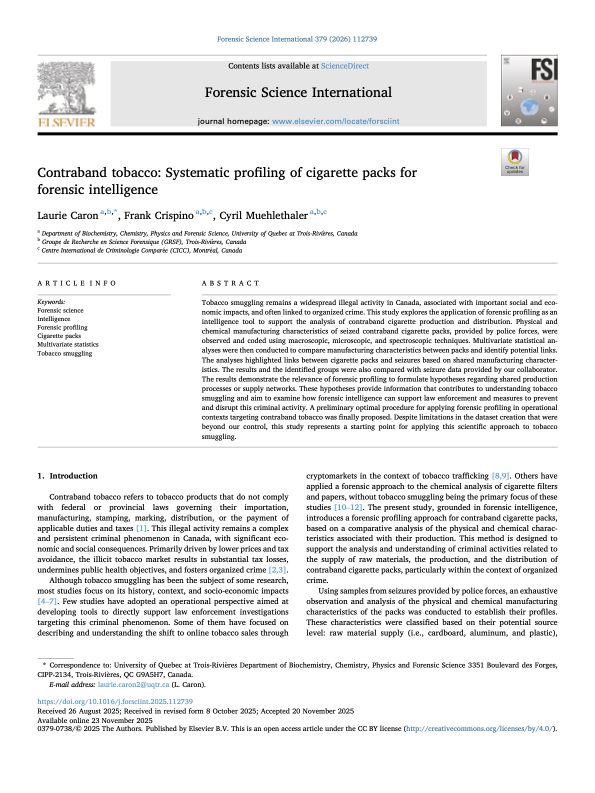
By Laurie Caron, Frank Crispino, Cyril Muehlethaler
Tobacco smuggling remains a widespread illegal activity in Canada, associated with important social and economic impacts, and often linked to organized crime. This study explores the application of forensic profiling as an intelligence tool to support the analysis of contraband cigarette production and distribution. Physical and chemical manufacturing characteristics of seized contraband cigarette packs, provided by police forces, were observed and coded using macroscopic, microscopic, and spectroscopic techniques. Multivariate statistical analyses were then conducted to compare manufacturing characteristics between packs and identify potential links. The analyses highlighted links between cigarette packs and seizures based on shared manufacturing characteristics. The results and the identified groups were also compared with seizure data provided by our collaborator. The results demonstrate the relevance of forensic profiling to formulate hypotheses regarding shared production processes or supply networks. These hypotheses provide information that contributes to understanding tobacco smuggling and aim to examine how forensic intelligence can support law enforcement and measures to prevent and disrupt this criminal activity. A preliminary optimal procedure for applying forensic profiling in operational contexts targeting contraband tobacco was finally proposed. Despite limitations in the dataset creation that were beyond our control, this study represents a starting point for applying this scientific approach to tobacco smuggling.
By Yael Anahí López Torres
Mexico is grappling with a crisis of insecurity after over 30 years since its transition to democracy. Its top-down and frequently militarised policies have been ineffective, leading to calls by scholars to alter the state’s security paradigm that has not been able to fulfil the basic right of citizens to live in a secure country. As a response to these calls, this thesis goes beyond the common state-centric perspectives on security policies and instead it focuses on the often-overlooked subnational responses to criminal violence. In particular, I perform an analysis of bottom-up responses, considering the local dynamics of institutions and civil society. My research questions are: What is the role of bottom-up approaches in responding to criminal violence? And as an extension, what are the factors that enable or constrain their responses? To achieve these objectives, I conducted micro-level analyses and comparisons of two different case studies: Ciudad Juárez, Chihuahua and Monterrey, Nuevo León. These analyses explore variations in bottom-up responses, drawing on fieldwork in the form of 57 interviews with key state and societal actors and complementary documentary resources. The analysis emphasises Mexico’s subnational democratisation processes, considering its effects on the (un)rule of law and violence. My findings reveal that uneven democratisation hinders state capacity to address the security crisis, requiring organised society to intervene. In both cases, this contributed to countering and shaping the patterns of criminal violence. Local organised society pursued broader democratic goals by promoting the means for the rule of law, while high-risk collective mobilisation was fundamental in increasing political participation. The pre-existing institutions, the local actors and the alliances thatenabled these changes varied between cases, and followed waves of political urgency and electoral periods that both provided opportunities for change, but also disrupted ongoing projects. This contributes to the scholarship of criminal politics by bridging the literature of democratisation and state capacity.

by Graeme R. Newman
In 1862, Henry Mayhew and John Binny walked into eleven of London's most notorious institutions — Newgate, Millbank, Pentonville, Brixton, the prison hulks at Woolwich, Coldbath Fields, Tothill Fields, Wandsworth, Holloway, the House of Detention at Clerkenwell, and Horsemonger Lane — and wrote down exactly what they saw: the governors, the warders, the chaplains, and the prisoners themselves, in their own words.
This edition brings that record back to life. Each chapter has been fully rewritten in modern prose while preserving every fact, every interview, and every argument the original authors made — from their case against purposeless hard labour to their unflinching accounts of the convict nursery, the condemned cell, and the boy discharged from prison with no one waiting at the gate.
A new introduction and retrospective, written for this edition, follows these institutions into the present: which ones were demolished, which became galleries, cathedrals, and post offices — and which are still open today, cited in current inspection reports for the very same overcrowding and neglect that Victorian reformers were fighting a century and a half ago.
What you'll find inside: • Eleven Victorian prisons, reconstructed room by room, cell by cell • Real testimony from governors, chaplains, and prisoners — first offenders and lifelong professionals alike • A frank, often moving record of Victorian London's poorest and most desperate • A new historical retrospective connecting each institution to its fate today
Part social history, part true crime, part uncomfortable mirror — London Prisons: A Retrospective is a door-by-door tour of a city's conscience, then and now.
Read-Me.Org Inc. New York-Philadelphia-Australia. 2026. p.339.

by Nettly Lucas (Author), Graeme Newman (Introduction)
Step into the hidden London of the 1920s—a city of fashionable hotels and crowded streets, respectable suburbs and shadowy back rooms, Scotland Yard detectives and professional criminals who made deception, burglary, fraud and blackmail their trade.
First published in 1926, London and Its Criminals is Netley Lucas’s remarkable journey through the criminal underworld of interwar London. Rather than simply recounting celebrated crimes, Lucas sets out to describe criminals themselves: how they lived, where they gathered, the methods they used, the slang they spoke, and the elaborate machinery of policing that pursued them.
The result is an extraordinary period portrait of crime and criminal justice.
Lucas takes his readers inside Scotland Yard and its Criminal Record Office, explaining the growing importance of fingerprints, criminal records and systematic detection. From there he ventures into a very different London—the world of professional burglars, pickpockets, confidence tricksters, jewel thieves, forgers, blackmailers and criminal gangs. He introduces his readers to figures he describes as the “Kings” and “Queens” of the Underworld: men and women who move between cheap public houses, prosperous suburban homes, exclusive restaurants and fashionable hotels while living secret criminal lives.
Among the book’s most striking chapters are Lucas’s accounts of “master criminals” and “crooked women.” His characters include expert burglars, ingenious forgers, sophisticated jewel thieves and accomplished confidence tricksters. Some are frightening, some ingenious, some surprisingly ordinary. Again and again Lucas emphasizes the unsettling proximity of the criminal world to respectable society.
Yet London and Its Criminals is more than a gallery of rogues. Lucas was writing at a moment when attitudes toward crime and punishment were beginning to change. He opens the book by discussing the emerging scientific study of crime, criminal psychology, rehabilitation and the limitations of imprisonment—questions that remain central to debates about criminal justice a century later.
Lucas is also an unusually provocative guide. He claims familiarity with criminals themselves and repeatedly describes conversations, meals and encounters with people operating on the wrong side of the law. His London is consequently not the London of official police reports alone. It is a city observed from its restaurants, streets, clubs, pubs, courtrooms and criminal meeting places.
Modern readers should approach some of Lucas’s language, assumptions and sweeping judgments as products of their time. That is also part of the historical importance of the book. It provides a vivid primary-source window into how crime, policing, punishment, class and the urban underworld were represented during the 1920s.
This new Read-Me.Org Classic Reprint presents Lucas’s fascinating account to a new generation of readers, accompanied by a detailed new Introduction by Graeme Newman that places the work in its historical and criminological context.
For readers interested in true crime, criminology, Scotland Yard, policing, criminal history, London history, organized crime and the social history of the 1920s, London and Its Criminals offers a fascinating journey into a vanished—but sometimes surprisingly familiar—criminal world
Read-Me.Org Inc. New York-Philadelphia-Australia. 2026. p.194.
By Theodore E. Trigylidas , Patricia G. Schnitzer , Heather K. Dykstra , Gia M. Badolato , Robert McCarter, Jr. , Monika K. Goyal and Richard Lichenstein
We sought to compare risk factors contributing to unintentional, homicide, and suicide firearm deaths in children. We conducted a retrospective review of the National Fatality Review Case Reporting System. We included all firearm deaths among children aged 0–18 years occurring from 2007 to 2016. Descriptive analyses were performed on demographic, psychosocial, and firearm characteristics and their relationship to unintentional, homicide, and suicide deaths. Regression analyses were used to compare factors contributing to unintentional vs. intentional deaths. There were 6148 firearm deaths during the study period. The mean age was 14 years (SD ± 4 years), of which 81% were male and 41% were non-Hispanic White. The most common manners of death were homicide (57%), suicide (36%), and unintentional (7%). Over one-third of firearms were stored unlocked. Homicide deaths had a higher likelihood of occurring outside of the home setting (aOR 3.2, 95% CI 2.4–4.4) compared with unintentional deaths. Suicide deaths had a higher likelihood of occurring in homes with firearms that were stored locked (aOR 4.2, 95% CI 2.1–8.9) compared with unintentional deaths. Each manner of firearm death presents a unique set of psychosocial circumstances and challenges for preventive strategies. Unsafe firearm storage practices remain a central theme in contributing to the increased risk of youth firearm deaths.
By David C. Pyrooz, James A. Densley, Jillian K. Peterson
INTRODUCTION Mass shootings, defined as incidents where 4 or more people are shot with a firearm, have become a significant public health concern in the US.
OBJECTIVE To estimate the prevalence of direct exposure to mass shootings among US adults and identify the sociodemographic groups most affected.
DESIGN, SETTING, AND PARTICIPANTS A survey was administered in January 2024 to a sample of 10 000 respondents (18 years or older) designed to be representative of US adults using a multistage matched sampling design. In addition to exposure to mass shootings, the survey also collected sociodemographic information, including age, gender, self-reported race and ethnicity, and socioeconomic status.
EXPOSURE Survey respondents were asked about their lifetime presence at the scene of a mass shooting, any physical injuries sustained (including being shot or trampled or experiencing a related physical injury), and the features of such incidents.
MAIN OUTCOME AND MEASURES Multivariable logistic regression was used to generate adjusted odds ratios (AORs) of the associations between sociodemographic measures and being present on the scene of and injured in a mass shooting. All analyses undertaken to generate population and relational inferences were weighted to achieve representativeness of US adults.
RESULTS Of the 10 000 respondents included in the analysis, 51.34% (95% CI, 50.27%-52.40%) were female. In terms of race and ethnicity, 3.04% (95% CI, 2.71%-3.38%) were Asian, 12.46% (95% CI, 11.81%-13.12%) were Black, 16.04% (95% CI, 15.10%-16.98%) were Hispanic, 62.78% (95% CI, 61.73%-63.84%) were White, and 5.67% (95% CI, 5.23%-6.11%) were other race or ethnicity. The findings indicated that 6.95% (95% CI, 6.39%-7.50%) of respondents were present at the scene of a mass shooting, and 2.18% (95% CI, 1.85%-2.50%) sustained physical injuries, such as being shot or trampled, during such incidents. A total of 54.89% of mass shootings to which respondents were exposed occurred in 2015 or more recently, and 76.15% took place in respondents’ local communities. Mass shootings were most likely to occur in neighborhoods. Younger individuals (eg, AOR for Baby Boomer and Silent generations vs Generation Z, 0.12; 95% CI, 0.09-0.18) and males (AOR, 1.55; 95% CI, 1.29-1.85) were more likely to report exposure compared with those from older generations or female individuals, respectively. Black respondents reported higher rates of being present at mass shootings (AOR, 1.87; 95% CI, 1.49-2.34), while Asian respondents reported lower rates (AOR, 0.36; 95% CI, 0.19-0.66), compared with White respondents, but there were no racial and ethnic differences in injuries sustained. CONCLUSIONS AND RELEVANCE The findings from this survey study of US adults underscore the extensive and often overlooked regular exposure to mass shootings in this country. The demographic disparities in exposure highlight the need for targeted interventions and support for the most affected groups, particularly younger generations and males. Understanding these patterns is essential for addressing the broader impacts of gun violence on public health and community well-being.
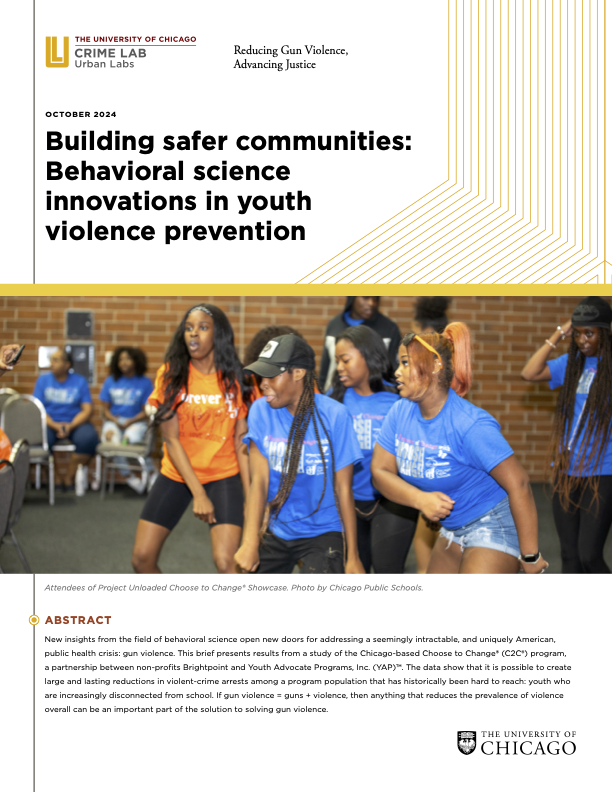
By University of Chicago, Crime Lab
New insights from the field of behavioral science open new doors for addressing a seemingly intractable, and uniquely American, public health crisis: gun violence. This brief presents results from a study of the Chicago-based Choose to Change® (C2C®) program, a partnership between non-profits Brightpoint and Youth Advocate Programs, Inc. (YAP)™. The data show that it is possible to create large and lasting reductions in violent-crime arrests among a program population that has historically been hard to reach: youth who are increasingly disconnected from school. If gun violence = guns + violence, then anything that reduces the prevalence of violence overall can be an important part of the solution to solving gun violence.