
Open Access Free Library
CRIME+CRIMINOLOGY.jpeg

CRIME

Violent-Non-Violent-Cyber-Global-Organized-Environmental-Policing-Crime Prevention-Victimization

Posts tagged delinquency research
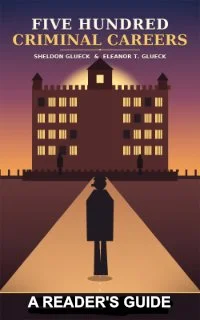
Five Hundred Criminal Careers: A Reader's Guide

by Graeme Newman (Author), Sheldon Glueck (Author), Eleanor Glueck

Did the reformatories really reform? In 1930, two Harvard researchers went and checked.

For decades, American reformatories reported that most of their graduates went straight. Estimates ran from 60 to 85 percent, and they were repeated in textbooks and legislatures. In Five Hundred Criminal Careers, Sheldon and Eleanor Glueck tested the claim. They took every man whose parole from the Massachusetts Reformatory expired in 1921 or 1922, 510 in all, and traced what happened to each over the next five years. Their answer reversed the figures: almost four in five of the men they could trace had committed offenses after parole.

This Reader's Guide explains how the study was done, what it found, and how far its evidence can be trusted. It also shows why the book still matters. It is the model for later follow-up studies, an early account of how to find ex-prisoners without harming them, and the origin of the prognostic tables that became today's risk assessments.

INSIDE THIS GUIDE

  • A reading plan and a chapter-by-chapter map of the original

  • How 510 men were traced through fingerprint files, police letters, and hundreds of interviews

  • What "success" and "failure" meant, and a worked example showing how the 79 percent headline changes under other definitions

  • The men, their families, the Reformatory and parole, and what the community did for them

  • How the authors tried to separate the institution's effect from the men's own history

  • The prognostic tables, their strengths, and their limits

  • What the ex-prisoners themselves said, and the authors' program of reform

  • What has changed since 1930, including modern recidivism research and risk assessment, and what has not

  • Five common misreadings, a statistics primer, a glossary, an annotated reading list, an FAQ, 26 discussion questions and classroom activities

WHO IT'S FOR: Students of criminology, criminal justice, sociology, social work and law; teachers and reading groups; and general readers who want to know how anyone can tell whether a prison or a program works.

PLEASE NOTE: This is an independent guide, not an abridgment or edition of the Gluecks' book. It does not reproduce the original's text or tables and is not endorsed by the authors' heirs or the original publisher. It is meant to be read alongside the original. Download the original book.

Written by Graeme R. Newman with the assistance of Claude, an AI model made by Anthropic. The AI-generated content is disclosed in accordance with Read-Me.Org policy.

Read-Me.Org Inc. New York-Philadelphia-Australia. 2026. p.80.
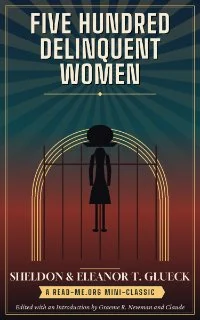
FIVE HUNDRED DELINQUENT WOMEN: Mini-Classic

by Graeme Newman.

by Graeme Newman (Author), Sheldon Glueck (Author), Eleanor Glueck

In 1934, two Harvard criminologists asked the question no one else had bothered to ask: what actually happens to a woman after a reformatory says she's been "reformed"?
Five Hundred Delinquent Women is Sheldon and Eleanor Glueck's landmark — and largely forgotten — study of five hundred women released from the Massachusetts Reformatory for Women at Framingham, once hailed as a model institution for the entire country. Rather than taking the state's word for it, the Gluecks tracked these women for years after their sentences ended, through court records, social-agency files, and hundreds of personal interviews, to find out what "rehabilitation" actually looked like once no one was watching anymore.
What they found was neither the triumph the reformers promised nor the failure the cynics predicted, but something far more human and far more troubling: real improvement, tangled up with real relapse; institutional success stories that quietly came apart; and a system that too often mistook a woman's arrest record for the whole of who she was.
Running through the statistics is a gallery of unforgettable case histories — Marie, Alice, Fleur, Margaret, Angelina, Dora, Louisa, and others — whose own words and fates give this pioneering work of criminology the pull of a novel.

This Read-Me.Org Mini-Classic edition brings a five-hundred-page academic monograph back into print in a compact, accessible form, condensed and adapted for the modern reader while preserving the Gluecks' argument, their most vivid case histories, and the voice of Jessie D. Hodder, the reformatory superintendent whose own unanswered questions about her life's work set this whole study in motion.

Inside this edition:

• A new introduction placing the Gluecks' work in the history of criminology and the women's reformatory movement
• Roscoe Pound's original 1934 introduction, condensed
• The complete "Gallery of Women" case histories
• All eighteen original chapters, following the book's three-part structure
• An afterword connecting the book's prognostic tables and its picture of criminalized women to present-day debates over risk assessment and criminal justice reform
• Discussion questions for readers, students, and reading groups

Essential reading for students of criminology, sociology, women's history, and the history of American criminal justice — and for anyone who has ever wondered whether the institutions built to save people ever stopped to ask if they were actually working.

Part of the Read-Me.Org Mini-Classics series, bringing landmark out-of-print scholarship back to readers in accessible, affordable editions. Read the original book online..

Read-Me.Org Inc. New York-Philadelphia-Australia. 2026. p.70.