Open Access Publisher and Free Library
CRIME+CRIMINOLOGY.jpeg

CRIME

Violent-Non-Violent-Cyber-Global-Organized-Environmental-Policing-Crime Prevention-Victimization

Posts in Crime Record
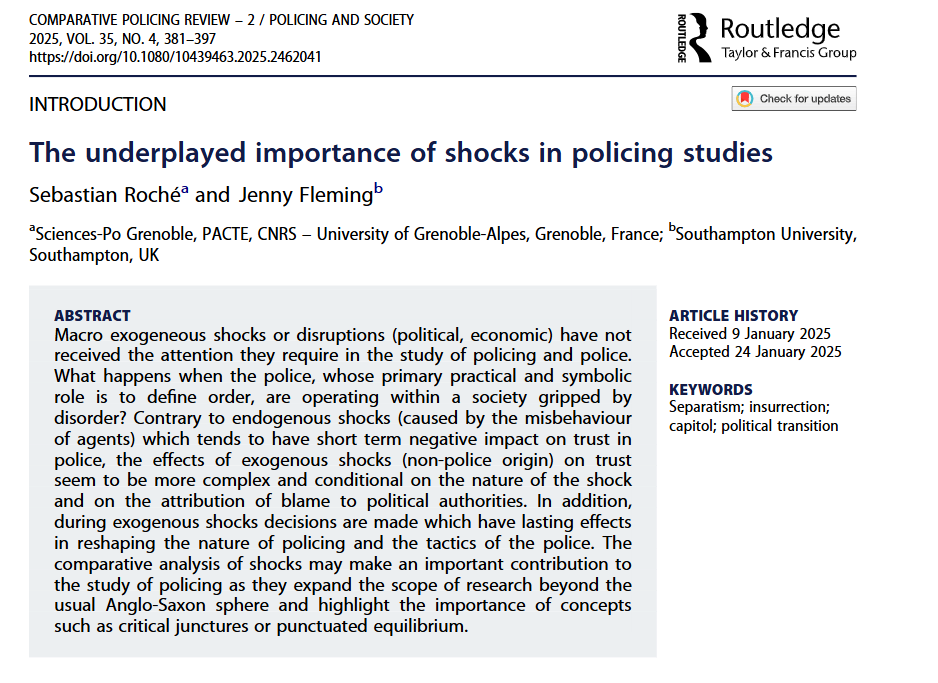
The underplayed importance of shocks in policing studies

By Sebastian Rochéa and Jenny Fleming


Macro exogeneous shocks or disruptions (political, economic) have not received the attention they require in the study of policing and police.What happens when the police, whose primary practical and symbolic role is to define order, are operating within a society gripped by disorder? Contrary to endogenous shocks (caused by the misbehaviour of agents) which tends to have short term negative impact on trust in police, the effects of exogenous shocks (non-police origin) on trust seem to be more complex and conditional on the nature of the shock and on the attribution of blame to political authorities. In addition, during exogenous shocks decisions are made which have lasting effects in reshaping the nature of policing and the tactics of the police. The comparative analysis of shocks may make an important contribution tothe study of policing as they expand the scope of research beyond the usual Anglo-Saxon sphere and highlight the importance of concepts such as critical junctures or punctuated equilibrium


COMPARATIVE POLICING REVIEW – 2 / POLICING AND SOCIETY2025, VOL. 35, NO. 4, 381–397

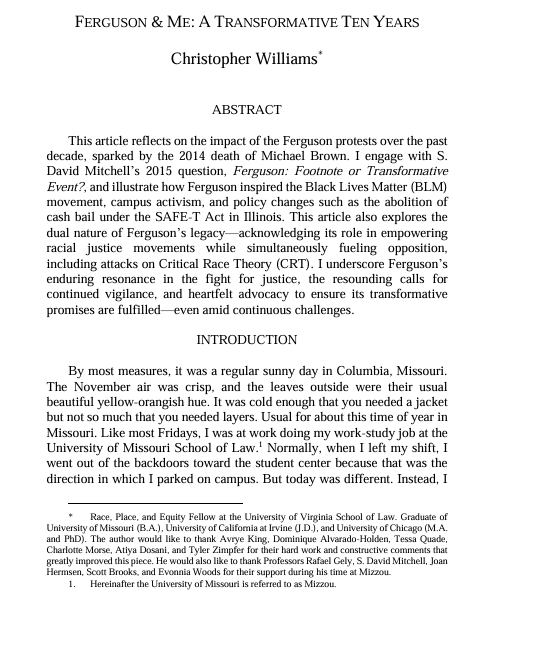
FERGUSON & ME: A TRANSFORMATIVE TEN YEARS

By Christopher Williams

 This article reflects on the impact of the Ferguson protests over the past decade, sparked by the 2014 death of Michael Brown. I engage with S. David Mitchell’s 2015 question, Ferguson: Footnote or Transformative Event?, and illustrate how Ferguson inspired the Black Lives Matter (BLM) movement, campus activism, and policy changes such as the abolition of cash bail under the SAFE-T Act in Illinois. This article also explores the dual nature of Ferguson’s legacy—acknowledging its role in empowering racial justice movements while simultaneously fueling opposition, including attacks on Critical Race Theory (CRT). I underscore Ferguson’s enduring resonance in the fight for justice, the resounding calls for continued vigilance, and heartfelt advocacy to ensure its transformative promises are fulfilled—even amid continuous challenges.

  Washington University Journal of Law and Policy, Volume 78 • Issue 1 • 2025 

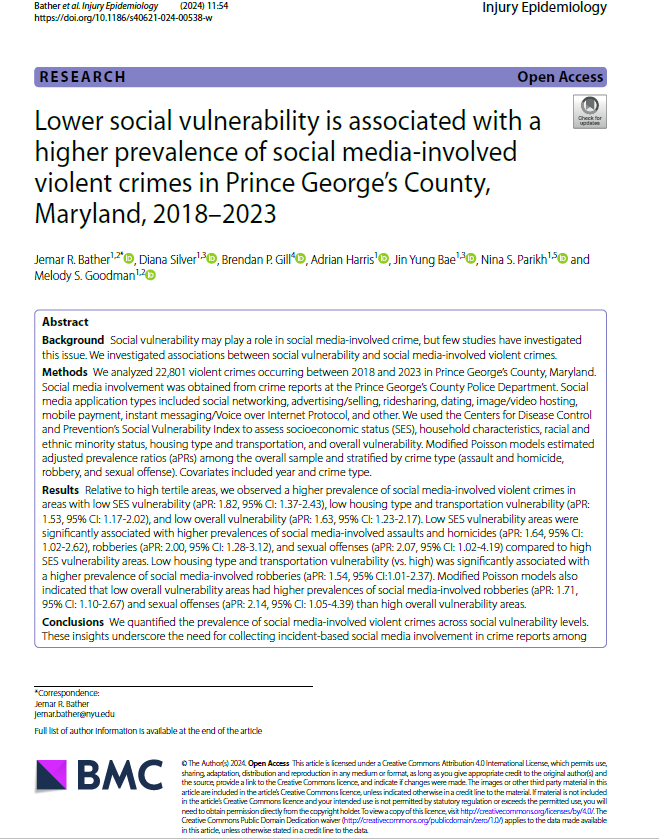
Lower social vulnerability is associated with a higher prevalence of social media-involved violent crimes in Prince George’s County, Maryland, 2018–2023

By Jemar R. Bather, Diana Silver, Brendan P. Gill, Adrian Harris, Jin Yung Bae, Nina S. Parikh & Melody S. Goodman 

Background

Social vulnerability may play a role in social media-involved crime, but few studies have investigated this issue. We investigated associations between social vulnerability and social media-involved violent crimes.

Methods

We analyzed 22,801 violent crimes occurring between 2018 and 2023 in Prince George’s County, Maryland. Social media involvement was obtained from crime reports at the Prince George’s County Police Department. Social media application types included social networking, advertising/selling, ridesharing, dating, image/video hosting, mobile payment, instant messaging/Voice over Internet Protocol, and other. We used the Centers for Disease Control and Prevention’s Social Vulnerability Index to assess socioeconomic status (SES), household characteristics, racial and ethnic minority status, housing type and transportation, and overall vulnerability. Modified Poisson models estimated adjusted prevalence ratios (aPRs) among the overall sample and stratified by crime type (assault and homicide, robbery, and sexual offense). Covariates included year and crime type.

Results

Relative to high tertile areas, we observed a higher prevalence of social media-involved violent crimes in areas with low SES vulnerability (aPR: 1.82, 95% CI: 1.37-2.43), low housing type and transportation vulnerability (aPR: 1.53, 95% CI: 1.17-2.02), and low overall vulnerability (aPR: 1.63, 95% CI: 1.23-2.17). Low SES vulnerability areas were significantly associated with higher prevalences of social media-involved assaults and homicides (aPR: 1.64, 95% CI: 1.02-2.62), robberies (aPR: 2.00, 95% CI: 1.28-3.12), and sexual offenses (aPR: 2.07, 95% CI: 1.02-4.19) compared to high SES vulnerability areas. Low housing type and transportation vulnerability (vs. high) was significantly associated with a higher prevalence of social media-involved robberies (aPR: 1.54, 95% CI:1.01-2.37). Modified Poisson models also indicated that low overall vulnerability areas had higher prevalences of social media-involved robberies (aPR: 1.71, 95% CI: 1.10-2.67) and sexual offenses (aPR: 2.14, 95% CI: 1.05-4.39) than high overall vulnerability areas.

Conclusions

We quantified the prevalence of social media-involved violent crimes across social vulnerability levels. These insights underscore the need for collecting incident-based social media involvement in crime reports among law enforcement agencies across the United States and internationally. Comprehensive data collection at the national and international levels provides the capacity to elucidate the relationships between neighborhoods, social media, and population health.

Inj. Epidemiol. 11, 54 (2024

RE-PUNISHED FOR THE PAST How Criminal Records Increase Prison Terms and Racial Injustice

By: Nazgol Ghandnoosh, Ph.D., Director of Research, Bobby Boxerman, Ph.D., former Extreme Sentencing Research Fellow, and Celeste Barry, former Program Associate at The Sentencing Project.

Although it is a widespread practice in the United States to increase criminal penalties for people with prior convictions, there is little evidence that this practice advances public safety.1 Research by the Robina Institute has shown that state and federal sentencing guidelines dramatically increase sentence lengths based on individuals’ prior criminal records. This effect is even more pronounced for African Americans. Given the limited public safety benefits from criminal record “enhancements” and the accompanying harms to incarcerated individuals, their families, and communities — and the steep financial costs — this further lengthening of sentences should be reconfigured.