Open Access Publisher and Free Library
CRIME+CRIMINOLOGY.jpeg

CRIME

Violent-Non-Violent-Cyber-Global-Organized-Environmental-Policing-Crime Prevention-Victimization

Posts tagged examination
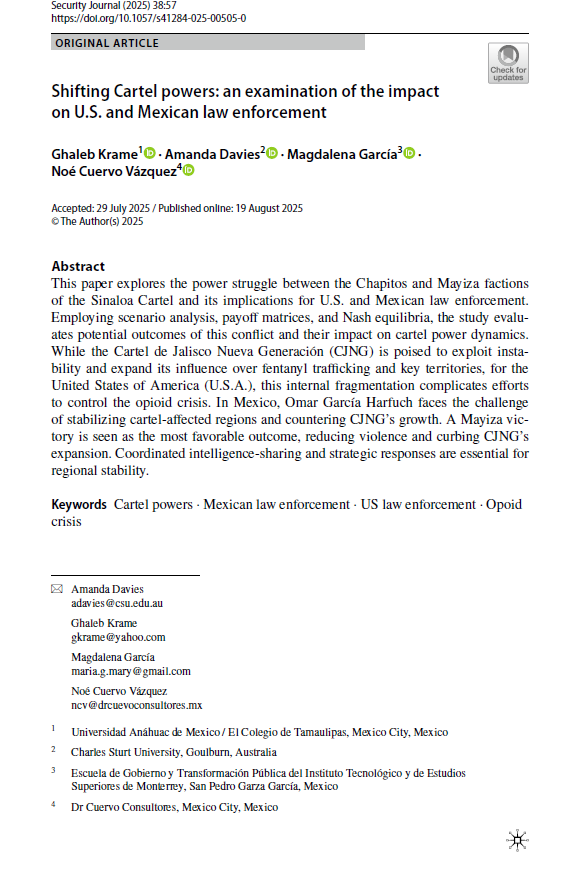
Shifting Cartel powers: an examination of the impact on U.S. and Mexican law enforcement


By: Ghaleb Krame, Amanda Davies, Magdalena García & Noé Cuervo Vázquez 

This paper explores the power struggle between the Chapitos and Mayiza factions of the Sinaloa Cartel and its implications for U.S. and Mexican law enforcement. Employing scenario analysis, payoff matrices, and Nash equilibria, the study evaluates potential outcomes of this conflict and their impact on cartel power dynamics. While the Cartel de Jalisco Nueva Generación (CJNG) is poised to exploit instability and expand its influence over fentanyl trafficking and key territories, for the United States of America (U.S.A.), this internal fragmentation complicates efforts to control the opioid crisis. In Mexico, Omar García Harfuch faces the challenge of stabilizing cartel-affected regions and countering CJNG’s growth. A Mayiza victory is seen as the most favorable outcome, reducing violence and curbing CJNG’s expansion. Coordinated intelligence-sharing and strategic responses are essential for regional stability.

Security Journal (2025) 38:57
Parental Leave and Intimate Partner Violence

By Dan Anderberg. Line Hjorth Andersen,  N.Meltem Daysal, Mette Ejrnæs

We examine the impact of a 2002 Danish parental leave reform on intimate partner violence (IPV) using administrative data on assault-related hospital contacts. Using a regression discontinuity design, we show that extending fully paid leave increased mothers’ leave-taking and substantially reduced IPV, with effects concentrated among less-educated women. The reform also lengthened birth spacing, while separations remained unchanged and earnings effects were modest. The timing and heterogeneity of impacts point to fertility adjustments—rather than exit options or financial relief—as the key mechanism. Parental leave policy thus emerges as an underexplored lever for reducing IPV.

Information Manipulation & Organised Crime: Examining the Nexus

By Tena Prelec

The research paper that this briefing note summarises introduces a new framework for assessing the relationship between information manipulation and organised crime. Through applied real-world case studies from Russia, Ukraine, Moldova (Transnistria), and Albania, the framework reveals diverse patterns in these relationships, and the varying intensity of the information manipulation employed at a granular level. An emerging hypothesis emerging from the research suggests that authoritarian states may wield greater freedom in misusing information when they have intermediate – rather than high – levels of integration with the organised crime groups (OCG’s) executing disinformation campaigns on their behalf. The paper also identifies several areas for further research, including public receptivity to information manipulation, the mercurial nature of ties between elite actors and the use of information manipulation by elites, to create confusion amongst the public rather than to change their minds.

SOC ACE Research Paper. Birmingham, UK: University of Birmingham. 2024. 7p.

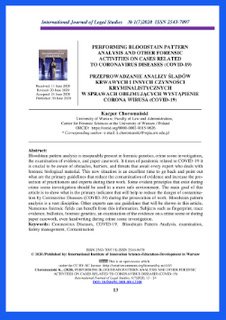
PERFORMING BLOODSTAIN PATTERN ANALYSIS AND OTHER FORENSIC ACTIVITIES ON CASES RELATED TO CORONAVIRUS DISEASES (COVID-19)

By: Kacper Choromański

Bloodstain pattern analysis is inseparably present in forensic genetics, crime scene investigation, the examination of evidence, and paper casework. It times of pandemic related to COVID-19 it is crucial to be aware of obstacles, barriers, and threats that await every expert who deals with forensic biological material. This new situation is an excellent time to go back and point out what are the primary guidelines that reduce the contamination of evidence and increase the protection of practitioners and experts during their work. Some evident principles that exist during crime scene investigation should be used in a more safe environment. The main goal of this article is to show what is the primary indicator that will help to reduce the danger of contamination by Coronavirus Diseases (COVID-19) during the prosecution of work. Bloodstain pattern analysis is a vast discipline. Other experts can use guidelines that will be shown in this article. Numerous forensic fields can benefit from this information. Subjects such as fingerprint, trace evidence, ballistics, forensic genetics, an examination of the evidence on a crime scene or during paper casework, even handwriting during crime scene investigation.

International Journal of Legal Studies No 1(7)2020 ISSN 2543-7097