Open Access Publisher and Free Library
Fiction+Mediajpg.jpg

FICTION and MEDIA

CRIME AND MEDIA — TWO PEAS IN A POD

Adventures of the world's greatest detectives

By George Barton

It is a trite saying that "truth is stranger than fiction. " Like most proverbs, this one has to be taken with the proverbial grain of salt. It is a fact, nevertheless, that the raw truth often possesses greater human interest than the most polished fiction. Crime, in itself, is painful and sometimes repulsive, but a study of the methods of criminal investigation by which difficult problems are solved and the guilty brought to justice , is entertaining and may be profitable. With this thought in mind, the reader is invited to a consideration of a few of the famous cases that are to be found in the history of the world's greatest detectives. Each story is complete in itself, and outside of its own interest is intended to illustrate the peculiar system of the official and the nation therein portrayed. (From the Preface)

New York : McKinlay Stone & Mackenzie, 1909.

download part 1
download part 2
Read-Me.Org
The detective and the somnambulist. The murderer and the fortune teller

By Allan Pinkerton

Maroney, the expressman, is living in Georgia, having been released during the war. Mrs. Maroney is also alive. Any one desiring to convince himself of the absolute truthfulness of this narrative can do so by examining the court records in Montgomery, Ala., where Maroneywas convicted. The facts stated in the second volume are well known to many residents of Chicago. Young Bright was in the best society during his stay at the Clifton House, and many of his friends will remember him. His father is now largely interested in business in New York, Chicago,and St. Louis. The events connected with the abduction of " The Two Sisters," will be readily recalled byW. L. Church, Esq., of Chicago, and others. The storyof " Alexander Gay," the Frenchman, will be found in the criminal records of St. Louis, where he was sentenced for forgery. So with the stories in this volume. The characters in "The Detective and the Somnambulist," will be easily recognized by many readers in the South. As the family of Drysdale are still living and holding a highly respectable place in society, the locality is not correctly given, and fictitious names are used throughout. (From Book)

Toronto, Belford , 1877. 274p.

download
Read-Me.Org
Professional thieves and the detective

By Allan Pinkerton

Containing numerous detective sketches : collected from private records. “ The life of a Detective is naturally a varied and excitable one. At one time he is engaged in the pursuit of the hardened Criminal, whose hands are crimson with the blood of his victim—at another, the Burglar, whose manipulations of the protecting appliances which have been invented to secure the wealth of others from his rapacious grasp, engrosses his attention—and anon he is found working his silent way through the intricate mazes of science, where the Counterfeiter and the Forger, with their miraculous chemicals and deft handiwork, require not only a familiarity with their mode of procedure, but an astute knowledge of human nature and their various characteristics. In the succeeding pages will be found a series of incidents which will fully justify my previous expressionsj and will throw a ray of light upon some of the hidden mysteries which surround the Criminal, but which must eventually present themselves to the intelligent eye of the Detective.”

New York : G.W. Carleton & Co., 1883. 682p.

download part 1
download part 2
Read-Me.Org
Train Robberies, Train Robbers, and the "Hold-Up" Men

By William A. Pinkerton

Address Given at the Annual Convention of the International Association of Chiefs of Police, 1907. “Heretofore my addresses have been upon subjects with which most of us are familiar and, while I know there are among those present, members of this Association who have had more or less t(3 do with the apprehension of the train robber or ''hold-up" criminal, a product we have that no other country has ex- cept as our fugitives ; I believe some reminiscences of these outlaws will be of interest. As the detective agents throughout the United States of many railroad, express and stage companies and of the American Bankers' Association, and co-operating with police officials, United States marshals, sheriffs, railroads detectives and various other law enforcement authorities, for over fifty years our agency has been, engaged investigating many of the robberies of railroad trains, banks and stages by this desperate robber ; my father, the late Allan Pinkerton, my brother Robert and I, often in these years personally taking part in running down this now almost extinct outlaw.

Wm. A. and Robert A. Pinkerton, Chicago and New York. 1907. 86p.

download
Read-Me.Org
Bucholz and the Detectives

By Allan Pinkerton

“one of the cardinal principles of my detective system, viz.: "That crime can and must be detected by the pure and honest heart obtaining a controlling power over that of the criminal." The history of the old man who, although in the possession of unlimited wealth, leaves the shores of his native land to escape the imagined dangers of assassination, and arrives in America, only to meet his death — violent and mysterious — at the hands of a trusted servant, is in all essential points a recital of actual events.”

New York: G.W. Gillingham, 1880.

download
Read-Me.Org
The Model Town and the Detectives, Bryon as a Detective

By Allan Pinkerton

FROM PREFACE. Almost every community has known one or more periods when the dissolute elements of the place have seemed to be unusually active, and the majesty of the law so little regarded and feared as to cause a perfect carnival of crime. Under such circumstances, the honest portion of the population become bewildered and disheartened, and the rogues apparently take charge of affairs, until some sudden dis- covery brings to punishment a number of the guilty men, and then order returns. Such was the experience of "The- Model Town." It was a very pleasant and thriving inland place, the law- abiding people far outnumbering the law-breakers; yet previous to the time when my services were engaged there was a period of almost total disregard of law and authority.in the place. In a few weeks my detectives were successful in identifying the ringleaders of all the evil-doers of the town, and I was able to gather them in for punishment in small groups, without exposing my plans or alarming the others, whose guilt was yet to be discovered. At length, having effectually broken up all the parties of thieves, counterfeiters, burglars, and incendiaries, I left the place to enjoy a career of peace and prosperity. There are many persons yet living who will remember the circumstances herein related, and they will recall how complete the reformation was worked by the arrest and conviction of the criminals. From the moment it was re- vealed that Pinkerton's detectives were at work in the town, the orderly character of the place was assured for an indefi- nite length of time, and the good effect lasted many years after my men had been withdrawn. As the story of " Byron as a Detective " may call forth some discussion, I merely desire to say that, concerning his being the son of Lord Byron, I have no means of determining the truth or falsity of the claim ; and only give the facts, which were then common among his associates, to the public for what they are worth. There were doubtless hundreds of other men of legitimate, as well as illegitimate, birth, each one of whom chance might have thrown into habits of reckless adventure resulting in crime, the temperament and mental conditions of each of whom might have given rise to the theory of being Byron's son, especially when the claim was so persistently put forward and so commonly accepted as in this case.

download
Read-Me.Org
The Rail-Road Forger and the Detectives

By Allan Pinkerton

“The characters with whom the reader will make acquaintance have all been in the flesh. But few of them, so far as I know, have yet quitted it. The identity of some has been veiled by fictitious names. ..any one of those introduced would be able to recognize a faithful account of the events narrated. ..of the events themselves it will be sufficient for me to state that they had a wide public notoriety at the time of their occurrence….the slight embellishment which is here given them…” from the Preface.

New York: G.W. Dillingham, 1881. 364p.

download
Read-Me.Org
The Molly Maguires and the Detective

By Alan Pinkerton

The governing idea in the mind of the author, while preparing this volume for the press, has been to give details connected with the MOLLIE Maguires, and follow strictly the truth concerning the adventures of the detectives during three years passed in their midst. He is aware that, in many places, the relation reads much like fiction, and that it will be accepted as romance by very many who are totally unacquainted with the country and the people attempted to be described. It has been the constant endeavor to adhere closely to facts, and if the incidents are, in a great degree, novel and absorbing, it is due to these facts, and they were worked out, through arduous labors, in sleepless nights and undivided attention to the ends to be gained. The coal regions of Pennsylvania are inhabited by a mixture of races, the ingredients perhaps more widely differing, in character and origin, than those of any other portion of the globe. Living within a stone's throw of each other will be found the German, Swede, Norwegian, Pole, Irish, Scotch, English Bohemian, and Russian. And in moving across the country, from one colliery to another, representatives of nearly all of these widely separated nations may be encountered, with here and there an American and Pennsylvania German. All endeavor to express themselves in Anglo-Saxon, but their foreign idioms and native eccentricities will, spite of themselves, occasionally crop out. Hence the life of a person, who is sensitively alive to diversified phases of human nature and having a keen sense of the humorous, in the mining districts, cannot well be devoid of enjoyment. Some extraordinary habits and peculiarities are found in the coal fields not discovered elsewhere.

New York: G.W. Carleton, 1880. 552p.

download
Read-Me.Org
Mississippi Outlaws and the Detectives.

By Allan Pinkerton

The Mississippi River has for many years more especially since the close of the war been infested by a class of men who never would try to get an honest living, but would prey upon their neighbors or attack the property of southern railroads and express companies ; these marauders could be seen any day prowling along the banks of the Mississippi, in fact, the shores and immediate neighborhood were peopled by just such a class, who cared not how they obtained a living ; for the crimes they committed, they often suffered infinitely worse punishment, more so than any suffering which could hare been entailed on them from leading a poor but honest life. The story of the "Mississippi OUTLAWS AND THE DETECTIVES '' is written to illustrate incidents which took place in the southern section of the country at no rery remote date. " DON PEDEO AND THE DETECTIVES " is another story of detective experience, which came under my own observation and management ; it is a truthful narrative, and shows that some men are worse than known criminals, and can squander the money they have obtained by false pretenses, in a very lavish manner. " THE POISONER AND THE DETECTIVES " is a well- known bit of detective experience, which, when read, will be recognized by any one who ever takes an inter- est in crime, and the bringing to justice its perpetrators. The reader must remember that fictitious names are used in all of these stories, otherwise the facts are plainly and truthfully told as they occurred. (From Preface)

New York: G.W. Dillingham, 1882. 377p.

download
Read-Me.Org
Life of Pat F. Garrett and the Taming of the Border Outlaw

By John Milton Scanlan

A History of the "Gun Men" And Outlaws, and a Life-Story of the Greatest Sheriff of the Old Southwest. “Though simple and not attended by ostentation, the ceremonial was very impressive, and there were tears for the brave and generous Pat Garrett as his mortal remains were consigned to earth.”

El Paso, TX: Carleton F. Dodge, 1908. 42p.

download
Read-Me.Org
Once Upon A Time in Palermo: Giovanni Falcone and the Fight Against Cosa Nostra

By Ruggero Scaturro

In July 2021, the president of the Antimafia Commission of the Italian Parliament – established in 1963 to look into the phenomenon of organized crime in Italy and assess the adequacy of existing legislative and administrative measures to counter it – declassified the minutes of a meeting between the Commission, the celebrated judge, Giovanni Falcone, and the other prosecuting magistrates of the so-called ‘Antimafia Pool’ of judges (see below). The meeting was held in Palermo, Sicily, in June 1990.1 Barring cases concerning national security or the safety of public officials, over recent decades the Commission has developed the practice of publishing the minutes of all its meetings, demonstrating a commitment to transparency and the rule of law. The decision to declassify this 117-page record of the meeting, however, comes more than a year after a commitment taken by the Commission’s president, Nicola Morra, in 2020 to declassify all the Commission’s minutes from 1963 to 2001.2 Having scrutinized the entire archive of its minutes, Italian civil society movement I Cittadini Contro le Mafie e la Corruzione (‘citizens against the mafia and corruption’) realized that the 1990 document was the only one yet to be made public. Given the potential relevance of its contents, they formally requested the Commission’s president to keep to his word and declassify it.3 A full unofficial translation of the minutes of the meeting is available at: https://globalinitiative.net/wp-content/uploads/2022/05/gitoc-falcone-annex.pdf. From the initial pages of the minutes, it emerges that the 1990 meeting had been convened to discuss the reasons for delays in investigations carried out by the Antimafia Pool. When discussing these delays in the magistrates’ work, however, Falcone went on to disclose what appear to be new details pertaining to the context of the unsolved assassination a decade earlier of Piersanti Mattarella, the Governor of Sicily and brother of the current President of the Italian Republic, Sergio Mattarella.4 Mattarella, whose killers are still unknown – although there is consensus that Cosa Nostra kingpins were behind the hit – arguably personifies the anti-mafia movement in Sicily since the early 1960s, a period in which he began to gain international recognition and support for his good governance.5 The following section offers an analysis of those parts of the minutes that deal with a theory Falcone had developed that offered, in his mind, a reliable investigative route to uncovering the truth of the unresolved murder of the Governor of Sicily. In addition, thanks to an interview with Judge Antonio Balsamo, current President of the Court of Palermo, it sets out an explanation of how Cosa Nostra may have teamed up with an unusual ally to eliminate the respected politician.

Geneva: Global Initiative Against Transnational Organized Crime, 2022. 26p.

read
Read-Me.Org
Ferry to Williamstown

By CoIin Heston.

In this raucous Aussie story, corpses pop up in the Yarra river while Lizzie entertains her powerful and kinky clients in her Winnebago, parked on the ferry to Williamstown. Tightly bound Detective Striker, confronted by the mob of Catholics, wharfies and communists who rule Williamstown, struggles to solve the mystery. Lizzie gets engaged to her uncle Bobby, the lame ferry driver, and her mum, Babs, spellbound by the strange Father Zappia, tries to solve her own mystery of St. Robert’s toe. She throws a raucous send-off party for Lizzie, and out of the chaos emerges many truths..

Five Star Readers’ Favorite! “…true Aussie humor…a satirical drIama …will reward those who can untie the hilarious Gordian knot.” See all reviews

NY. Harrow and Heston Publishers. 2020. 284p.

download
Read-Me.Org
The milk of paradise

By M.H. Abrams..

The effect of opium visions on the works of DeQuincey, Crabbe, Francis Thompson, and Coleridge. “ Four eminent English authors were addicted to opium. Each author spent a considerable part of his life in a dream world which differs amazingly from that in which we live. Each author utilized the imagery from these dreams in his literary creations, and sometimes, under the direct inspiration of opium, achieved his best writing. Thus, a knowledge of the opium world these authors inhabited is essential to a complete understanding of their work. In the cases where critics have not entirely neglected this factor, their analysis of opium effects is too often a flight of conjecture unimpeded by any burden of definite knowledge. Strangely enough, although “there is hardly a more difficult chapter in the whole of pharmacology than . . . a thoroughly exact analysis of the effects of drugs,”(Louis Lewin, Phantastica, London, 1931, Preface, p. x.) this is just the field wherein each man seems to consider himself expert. When a critic of established reputation is misled into characterizing all of Coleridge’s finest poems as “the chance brain-blooms of a season of physiological ecstasy,”(John Mackinnon Robertson, New Essays towards a Critical Method, London, 1897, p. 190) it is time to examine the facts.

  • Accordingly, I have based my investigation of the nature of opium phenomena on the statements of habituates and the findings of psychological authorities. Moreover, since to postulate addiction to opium merely from the “abnormality” of a man’s work. although the usual method, is illogical, my approach to each of the authors under consideration is biographical. Limitations of the length allowed for this thesis have imposed limitations in subject. I have dealt with no drug but opium, except in a passing reference in the Notes. Foreign authors I have had to omit; and of English authors I have been able to treat at length only those four whose long addiction to the drug is certain: DeQuincey, Crabbe, Francis Thompson, and Coleridge. Even with these men, it has been necessary to cut down evidence to a minimum, but indications for further investigation will be found in the Notes. There is no definite proof of addiction to opium in the lives of James Thomson and Poe. In their works, too, indications of the influence of alcohol are so strong that it would be difficult to distinguish any possible effect of opium. Since the date of the inception of Coleridge’s opium habit is necessary for a determination of the influence of the drug on his great creative period, I have gathered in an appendix all the evidence available on this agitated question.”

New York: Octagon Books, 1971. 104p.

read
Read-Me.Org
Hard-Boiled Crime Fiction and the Decline of Moral Authority

By Susanna Lee.

The cynical but kind-hearted detective is the soul of the classic hard-boiled story, that chronicle of world-weary urban pessimism. In Hard-Boiled Crime Fiction and the Decline of Moral Authority, Susanna Lee argues that this fiction functions as a measure for individual responsibility in the modern world and that it demonstrates the enduring status of individual conscience across a variety of cultural crises. In this major rethinking of the hard-boiled genre, Lee suggests that, whether in Los Angeles, New York, or Paris, the hard-boiled detective is the guardian of individual moral authority and the embodiment of ideals in a corrupt environment. Lee traces the history of the hard-boiled detective through the twentieth century and on both sides of the Atlantic (France and the United States), tying the idea of morality to the character model in nuanced, multifaceted ways. When the heroic model devolves, the very conceptual validity of individual moral authority can seem to devolve as well. Hard-Boiled Crime Fiction and the Decline of Moral Authority charts the evolution of that character model of the hard-boiled hero, the mid-century deterioration of his exemplarity, and twenty-first-century endeavors to resuscitate the accountable hero. The history of hard-boiled crime fiction tells nothing less than the story of individual autonomy and accountability in modern Western culture.

Columbus, OH: Ohio State University Press, 2016. 248p.

download
Fictions of the Bad Life: The Naturalist Prostitute and Her Avatars in Latin American Literature, 1880–2010

By Claire Solomon.

The first comprehensive and interdisciplinary study of the prostitute in Latin American literature, Claire Thora Solomon’s book The Naturalist Prostitute and Her Avatars in Latin American Literature, 1880–2010 shows the gender, ethnic, and racial identities that emerge in the literary figure of the prostitute during the consolidation of modern Latin American states in the late nineteenth century in the literary genre of Naturalism. Solomon first examines how legal, medical, and philosophical thought converged in Naturalist literature of prostitution. She then traces the persistence of these styles, themes, and stereotypes about women, sex, ethnicity, and race in the twentieth and twenty-first century literature with a particular emphasis on the historical fiction of prostitution and its selective reconstruction of the past.

Columbus, OH: Ohio State University Press, 2014. 223p.

download
Fear, Loathing, and Victorian Xenophobia

Edited By Marlene Tromp Maria K. Bachman Heidi Kaufman.

In this groundbreaking collection, scholars explore Victorian xenophobia as a rhetorical strategy that transforms “foreign” people, bodies, and objects into perceived invaders with the dangerous power to alter the social fabric of the nation and the identity of the English. Essays in the collected edition look across the cultural landscape of the nineteenth century to trace the myriad tensions that gave rise to fear and loathing of immigrants, aliens, and ethnic/racial/religious others. This volume introduces new ways of reading the fear and loathing of all that was foreign in nineteenth-century British culture, and, in doing so, it captures nuances that often fall beyond the scope of current theoretical models. “Xenophobia” not only offers a distinctive theoretical lens through which to read the nineteenth century; it also advances and enriches our understanding of other critical approaches to the study of difference. Bringing together scholarship from art history, history, literary studies, cultural studies, women’s studies, Jewish studies, and postcolonial studies, Fear, Loathing, and Victorian Xenophobia seeks to open a rich and provocative dialogue on the global dimensions of xenophobia during the nineteenth century.

Columbus, OH: Ohio State University Press, 2013. 390.

download
The Economics of Fantasy: Rape in Twentieth-century Literature

By Sharon Stockton.

In The Economics of Fantasy: Rape in Twentieth-Century Literature, Sharon Stockton examines the persistence and the evolution of the rape narrative in twentieth-century literature—the old story of male power and violence; female passivity and penetrability. What accounts for its persistence? How has the story changed over the course of the twentieth century? In this provocative book, Stockton investigates the manner in which the female body—or to be more precise, the violation of the female body—serves as a metaphor for a complex synthesis of masculinity and political economy. From high modernism to cyberpunk, Pound to Pynchon, Stockton argues that the compulsive return to the rape story, articulates—among other things—the gradual and relentless removal of Western man from the fantastical capitalist role of venturesome, industrious agency. The metamorphosis of the twentieth-century rape narrative registers a desperate attempt to preserve traditional patterns of robust, entrepreneurial masculinity in the face of economic forms that increasingly disallow illusions of individual authority. It is important to make clear that the genre of rape story studied here presumes a white masculine subject and a white feminine object. Stockton makes the case that the aestheticized rape narrative reveals particular things about the way white masculinity represents itself. Plotting violent sexual fantasy on the grid of economic concerns locates masculine agency in relation to an explicitly contingent material system of power, value, and order. It is in this way that The Economics of Fantasy discloses the increased desperation with which the body has been made to carry ideology under systems of advanced capitalism.

Columbus, OH: Ohio State University Press, 2006. 235p.

download
Dickens's Forensic Realism: Truth, Bodies, Evidence

By Andrew Mangham.

“Bodies are very unstable things in Dickens. In addition to the various characters with parts that are missing or defunct, like Wackford Squeers, Silas Wegg, Mr Smallweed, Mrs Skewton, Captain Cuttle, and Mrs Clennam, we find bodies that are taken apart (like the mangled remains of Mr Carker and Rigauld) and (re)assembled (like Mrs Jarley’s waxworks or Mr Venus’s French Gentleman). We encounter living bodies without souls, like the prisoners in “A Visit to Newgate” (1836) and American Notes (1842), and souls like Little Nell and Oliver Twist whose bodies seem barely capable of holding them in. More gruesomely, Dickensian bodies have a tendency to turn into slime and ash, such as when Miss Havisham is burned in Great Expectations (1860–61), or when the inhabitants of a city churchyard threaten to sully the appropriated dress of Lady Dedlock.”

Columbus, OH: Ohio State University Press, 2016. 272p.

download
The Burleigh Murders

By Guy Morton.

We have few authors on our fiction list possessed with the same gift of analysis into human character and motive as Mr. Morton. Indeed, nothing pleases him more than to play one type of individual against another, and since their actions culminate, as a rule, in deeds of violence, the author is never lacking either in material or scope for his own peculiar abilities. When, therefore, Mr. Morton turns his attentions to a rather mixed gathering at The Briars, a pleasantly situated country-house, the reader is entitled to expect some starthng disclosures. Nor does he find himself disappointed. Two murders, each of great brutaHty, take place in rapid succession, and the perpetrator, obviously one who has little to learn either in the art of con- cealment or dissimulation, effectively side-tracks the poHce from the vital issues and appears to rest securely behind the cloak of their incompetence. But whoever committed the crime completely under-estimated the talents of the ever vigilant Amor Kairns, who finally brings the criminal to book in an extremely dramatic quick curtain.

London: Skeffington & Son, 1900. 288p.

download
Read-Me.Org
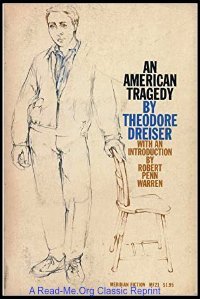
An American Tragedy

By Theodore Dreiser.

Theodore Dreiser was inspired by a true story to write this novel about an ambitious, socially insecure young man who finds himself caught between two very different women--and two very different visions of what his life could be. Clyde Griffiths was born poor and is poorly educated, but his prospects begin to improve when he is offered a job by a wealthy uncle who owns a shirt factory. Soon he achieves a managerial position, and despite being warned to stay away from the women he manages, he becomes involved with Roberta, a poor factory worker who falls in love with him. At the same time, he catches the eye of Sondra, the glamorous socialite daughter of another factory owner, and begins neglecting his lover to court her. When Roberta confronts Clyde with her pregnancy, Clyde's hopes of marrying Sondra are threatened, and he conceives a desperate plan to preserve his dream.

New York: Modern Library, 1925. 860p.

download part 1
download part 2
Read-Me.Org