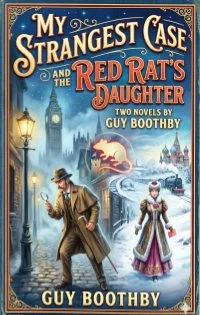
by Guy Boothby (Author), Colin Heston (Introduction)
To step into the world of Guy Boothby is to step into a whirlwind. At the turn of the 20th century, few authors could match Boothby's sheer velocity. A man who famously dictated his novels into a phonograph to keep pace with his imagination, Boothby was the architect of the "sensation novel," bridging the gap between the gothic mysteries of the past and the fast-paced thrillers of the future. This volume brings together two of his most gripping works: My Strangest Case and The Red Rat's Daughter. While different in setting, they share the quintessential Boothby hallmarks—exotic locales, high-stakes intrigue, and the relentless pursuit of justice (or survival).
The George Fairfax Mystery: My Strangest Case
In My Strangest Case, we are introduced to George Fairfax, a detective who stands in the long shadow of Sherlock Holmes but operates with a flair all his own. Originally published at the dawn of the 1900s, this story takes the reader from the high society of London to the rugged landscapes of the East. It is more than a simple whodunit; it is a globe-trotting adventure that explores the consequences of a long-hidden secret. Boothby’s talent for atmosphere ensures that the mystery feels as much a part of the environment as the characters themselves.
Intrigue in the East: The Red Rat's Daughter
The Red Rat's Daughter showcases Boothby’s obsession with the "Far East" and the political tensions of the era. Set against the backdrop of imperial Russia and the vast Siberian frontier, it is a tale of romance entangled with international conspiracy. The title itself—alluding to the mysterious "Red Rat"—promises a level of melodrama that Boothby delivers in spades. It captures a specific moment in literary history when the world felt both dangerously large and increasingly interconnected.
Why Boothby Matters Today
Reading Guy Boothby in the 21st century offers more than just nostalgia. It provides a window into the Victorian psyche:
The Pace: Boothby’s narrative drive is modern; he rarely lets a chapter end without a hook.
The Scope: He was an early pioneer of the "international thriller," refusing to keep his protagonists tethered to English soil.
The Style: His prose is unapologetically bold, designed to entertain the masses of the Edwardian era.
Whether you are a devotee of classic detective fiction or a newcomer to the "sensation" genre, these two novels represent a master storyteller at the height of his powers. Turn the page and prepare for a journey that spans continents and decades.
Read-Me.Org Inc. New York-Philadelphia-Australia. 2026. 350p.