

Artificial Intelligence Applications for Criminal Courts. An overview of artificial intelligence applications and associated considerations for the criminal court system
By Redden, J., Banks, D.,
Key Takeaways ¡ AI has the potential to transform many aspects of the court system in the years to come. Although not yet ubiquitous, AI-enabled tools are already being used in various applications relevant to the court system. ¡ AI-enabled tools may address pressing needs within the court system—including managing staffing and resources, processing digital information, improving court operations, managing cases, maintaining accountability, and creating partnerships and collaboration. ¡ AI systems that provide recommendations or predictions in the context of the court system should be approached with caution and evaluated carefully. ¡ Deploying AI-enabled tools effectively requires investing in a strategy for the operational, procedural, and change management efforts required for successful implementation. This technology brief is the third in a four-part series that examines artificial intelligence (AI) applications in the criminal justice system. This brief focuses on AI applications within criminal courts, with particular emphasis on AI’s role in addressing prosecutorial needs. These AI applications and associated needs may also be relevant to other types of courts, such as traffic and civil courts, as well as to other officers of the court—including defense counsel, judges, and court administrators. It also introduces frameworks for evaluating AI applications and highlights critical risks to consider when deploying AI systems. Although many of the examples in this brief have not yet been widely adopted, AI has the potential to address various needs within the court system. Additional briefs include a high-level overview of AI within the criminal justice system and AI topics specifically related to law enforcement and corrections
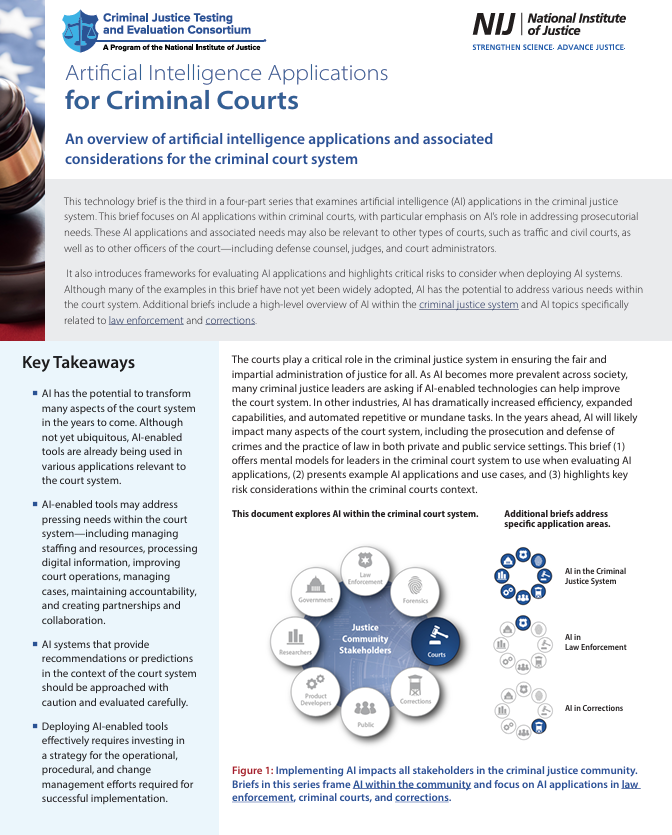
The courts play a critical role in the criminal justice system in ensuring the fair and impartial administration of justice for all. As AI becomes more prevalent across society, many criminal justice leaders are asking if AI-enabled technologies can help improve the court system. In other industries, AI has dramatically increased efficiency, expanded capabilities, and automated repetitive or mundane tasks. In the years ahead, AI will likely impact many aspects of the court system, including the prosecution and defense of crimes and the practice of law in both private and public service settings. This brief (1) offers mental models for leaders in the criminal court system to use when evaluating AI applications, (2) presents example AI applications and use cases, and (3) highlights key risk considerations within the criminal courts context.
Criminal Justice Testing (and Evaluation Consortium . 2020. 11p.