
Open Access Publisher and Free Library
CRIMINAL JUSTICE.jpeg

CRIMINAL JUSTICE

CRIMINAL JUSTICE-CRIMINAL LAW-PROCDEDURE-SENTENCING-COURTS

Posts in Global Crime
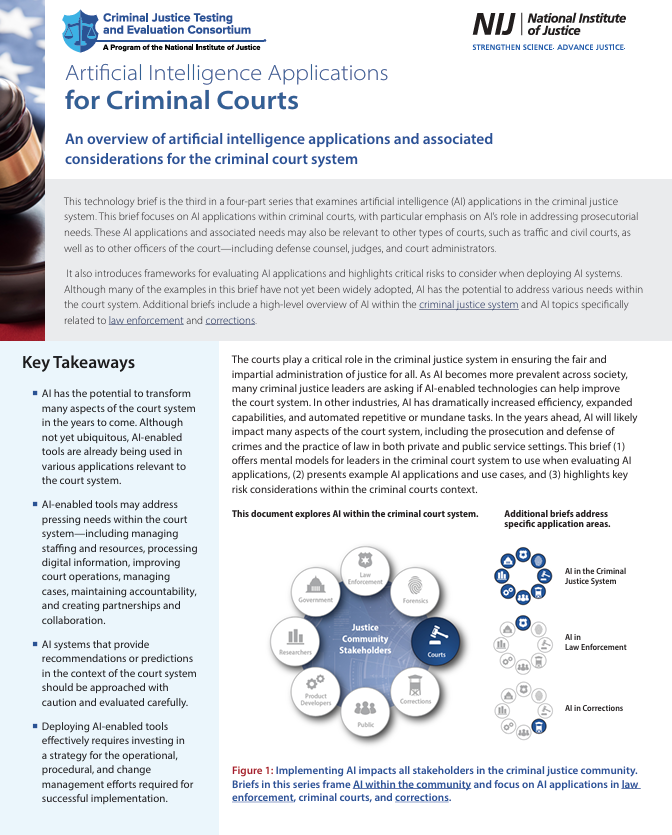
Artificial Intelligence Applications for Criminal Courts.  An overview of artificial intelligence applications and associated considerations for the criminal court system 

By Redden, J., Banks, D.,   

Key Takeaways ¡ AI has the potential to transform many aspects of the court system in the years to come. Although not yet ubiquitous, AI-enabled tools are already being used in various applications relevant to the court system. ¡ AI-enabled tools may address pressing needs within the court system—including managing staffing and resources, processing digital information, improving court operations, managing cases, maintaining accountability, and creating partnerships and collaboration. ¡ AI systems that provide recommendations or predictions in the context of the court system should be approached with caution and evaluated carefully. ¡ Deploying AI-enabled tools effectively requires investing in a strategy for the operational, procedural, and change management efforts required for successful implementation. This technology brief is the third in a four-part series that examines artificial intelligence (AI) applications in the criminal justice system. This brief focuses on AI applications within criminal courts, with particular emphasis on AI’s role in addressing prosecutorial needs. These AI applications and associated needs may also be relevant to other types of courts, such as traffic and civil courts, as well as to other officers of the court—including defense counsel, judges, and court administrators. It also introduces frameworks for evaluating AI applications and highlights critical risks to consider when deploying AI systems. Although many of the examples in this brief have not yet been widely adopted, AI has the potential to address various needs within the court system. Additional briefs include a high-level overview of AI within the criminal justice system and AI topics specifically related to law enforcement and corrections

  The courts play a critical role in the criminal justice system in ensuring the fair and impartial administration of justice for all. As AI becomes more prevalent across society, many criminal justice leaders are asking if AI-enabled technologies can help improve the court system. In other industries, AI has dramatically increased efficiency, expanded capabilities, and automated repetitive or mundane tasks. In the years ahead, AI will likely impact many aspects of the court system, including the prosecution and defense of crimes and the practice of law in both private and public service settings. This brief (1) offers mental models for leaders in the criminal court system to use when evaluating AI applications, (2) presents example AI applications and use cases, and (3) highlights key risk considerations within the criminal courts context.

Criminal Justice Testing (and Evaluation Consortium . 2020. 11p.

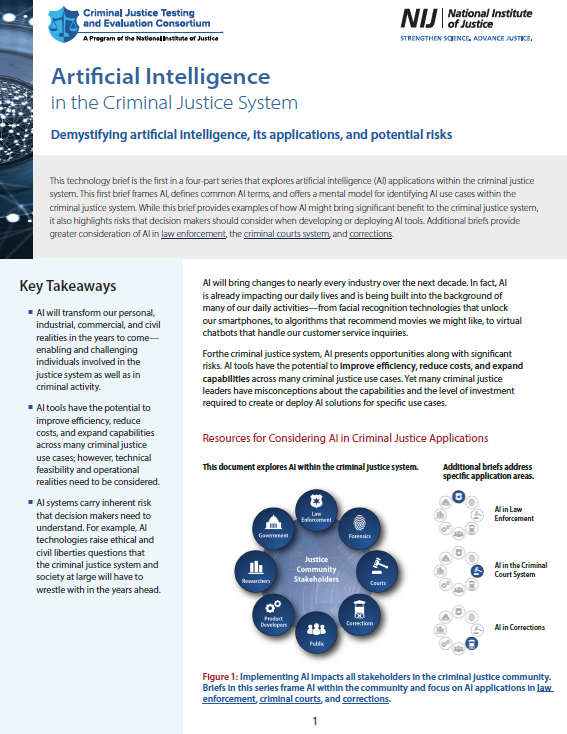
Artificial Intelligence in the Criminal Justice System.  Demystifying artificial intelligence, its applications, and potential risks 

By James Redden; Molly O'Donovan Dix

This technology brief is the first in a four-part series that explores artificial intelligence (AI) applications within the criminal justice system. This first brief frames AI, defines common AI terms, and offers a mental model for identifying AI use cases within the criminal justice system. While this brief provides examples of how AI might bring significant benefit to the criminal justice system, it also highlights risks that decision makers should consider when developing or deploying AI tools. Additional briefs provide greater consideration of AI in law enforcement, the criminal courts system, and corrections.   

  Key Takeaways ¡ AI will transform our personal, industrial, commercial, and civil realities in the years to come— enabling and challenging individuals involved in the justice system as well as in criminal activity. ¡ AI tools have the potential to improve efficiency, reduce costs, and expand capabilities across many criminal justice use cases; however, technical feasibility and operational realities need to be considered. ¡ AI systems carry inherent risk that decision makers need to understand. For example, AI technologies raise ethical and civil liberties questions that the criminal justice system and society at large will have to wrestle with in the years ahead. AI will bring changes to nearly every industry over the next decade. In fact, AI is already impacting our daily lives and is being built into the background of many of our daily activities—from facial recognition technologies that unlock our smartphones, to algorithms that recommend movies we might like, to virtual chatbots that handle our customer service inquiries. Forthe criminal justice system, AI presents opportunities along with significant risks. AI tools have the potential to improve efficiency, reduce costs, and expand capabilities across many criminal justice use cases. Yet many criminal justice leaders have misconceptions about the capabilities and the level of investment required to create or deploy AI solutions for specific use cases

Research Triangle Park, NC:RTI International.,   . 

2020. 10p.

Exploring the pattern of mental health support-seeking behaviour and related barriers among women experiencing intimate partner violence in urban slums of Bangladesh

By Kamrun Nahar Koly ,Jobaida Saba,Trisha Mallick,Fahmida Rashid,Juliet Watson,Barbara Barbosa Neves

Intimate partner violence (IPV) is a recognised global public health concern, substantially impacting women's well-being. While there is growing research on how IPV victim-survivors seek mental health support in the Global North, it remains understudied in the Global South, particularly for those residing in slums in low-income countries like Bangladesh. Through interviews and group discussions with different stakeholders, this study explored the mental healthcare-seeking behaviour of victim-survivors of IPV residing in urban slums, barriers to service utilisation, and recommendations to strengthen care pathways. Stakeholders perceived IPV as normalised in slums, indicating sociocultural norms and interpersonal causes as significant contributors to mental health issues and events of IPV. Seeking healthcare and moral support for IPV from local dispensaries and informal sources was common; however, IPV victim-survivors had no knowledge about mental-health-related services. Low mental health literacy and lack of financial support prevented them from seeking the necessary care. Social stigma regarding accessing mental healthcare, coupled with the absence of professional service providers and community-based services, represent critical systemic challenges. Recommendations included promoting community-level awareness of IPV and mental health issues, increasing mental healthcare services, training health workers, and fostering positive masculinities in community-based interventions. Stakeholders emphasised the need to adopt culturally relevant interventions for tackling IPV and improving mental healthcare pathways, especially for the low-income population of Bangladesh

. PLOS Glob Public Health 5(5),

Transformative Justice: Israeli Identity on Trial

By Leora Yedida Bilsky

Can Israel be both Jewish and democratic? Transformative Justice, Leora Bilsky's landmark study of Israeli political trials, poses this deceptively simple question. The four trials that she analyzes focus on identity, the nature of pluralism, human rights, and the rule of law-issues whose importance extends far beyond Israel's borders. Drawing on the latest work in philosophy, law, history, and rhetoric, Bilsky exposes the many narratives that compete in a political trial and demonstrates how Israel's history of social and ideological conflicts in the courtroom offers us a rare opportunity to understand the meaning of political trials. The result is a bold new perspective on the politics of justice and its complex relationship to the values of liberalism. Leora Bilsky is Professor of Law, Tel Aviv University.

Ann Arbor: University of Michigan Press, 2004. 393p