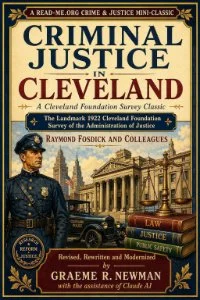
By Graeme R. Newman and Claude AI.
A landmark investigation into how America's criminal justice system actually worked, and why it often failed.
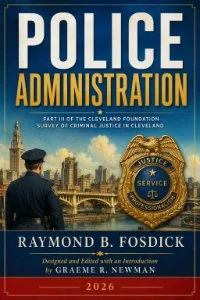
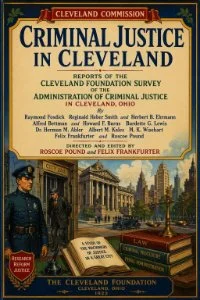
In 1921, a series of scandals and rising public concern about crime prompted the Cleveland Foundation to commission an unprecedented examination of the administration of justice in Cleveland, Ohio. Directed by two of the most influential legal minds of the twentieth century, Roscoe Pound and Felix Frankfurter, the resulting study became one of the most important reform documents in American criminal justice history.
Originally published in 1922, Criminal Justice in Cleveland was the first comprehensive effort to analyze an entire urban justice system as an interconnected whole. Drawing on detailed investigations of police, prosecutors, courts, corrections, probation, legal education, medical science, and the press, the survey revealed a system plagued by inefficiency, poor record-keeping, fragmented authority, political influence, and a startling lack of accountability.
This modernized edition, edited and introduced by Graeme R. Newman, makes this classic study accessible to today's readers while preserving its most important findings, statistics, and arguments. Readers will discover:
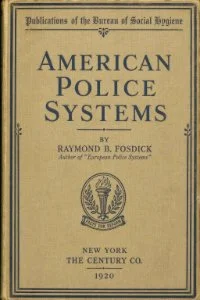
• How police departments operated in major American cities during the early twentieth century
• Why so many criminal cases disappeared before reaching trial
• The hidden influence of politics, public opinion, and newspapers on justice
• Early debates over probation, parole, rehabilitation, and sentencing reform
• The origins of evidence-based criminal justice research
• Reform proposals that continue to resonate more than a century later
Written during the Progressive Era but strikingly relevant today, Criminal Justice in Cleveland demonstrates that many of the challenges confronting modern police, prosecutors, courts, and correctional institutions are far older than most people realize. Its authors recognized that successful reform requires more than replacing individuals; it requires understanding how institutions work, how they fail, and how they can be improved.
Essential reading for students of criminology, criminal justice professionals, legal scholars, historians, policymakers, and anyone interested in the evolution of the American justice system.
More than a century after its publication, this pioneering study remains one of the most insightful examinations ever written of crime, law, and urban justice in America
Read-Me.Org Inc. New York-Philadelphia-Australia. 2026. p.90.