Open Access Publisher and Free Library
CRIMINAL JUSTICE.jpeg

CRIMINAL JUSTICE

CRIMINAL JUSTICE-CRIMINAL LAW-PROCDEDURE-SENTENCING-COURTS

AI Enabled Community Supervision for Criminal Justice Services

By Marcus Rogers

This study aimed to harness the potential of AI techniques and advancements to help the reintegration of justice-involved individuals (JII) into the community. The study centered on developing an AI-based system, referred to as the Support and Monitoring System for Community Supervision (SMS4CS), designed for the benefit of both JII and their case managers, focusing on aiding JII during their reentry into the community. The technology was seamlessly integrated into a functional community corrections environment, with no disruptions or reported interruptions to the day-to-day operations of the Tippecanoe County Community Corrections (TCCC). The technology enrollment process for participants (N = 35) and device setup achieved a remarkable 100% success rate. 

Lafayette, IN: Purdue University, 2024. 42p.

Download
Read-Me.Org
Overtime Under Review: NYPD Overtime and the Increased Risk of Negative Policing Outcomes

By Department of Investigation, Office of the Inspector General for the NYPD (OIG-NYPD) 

  New York City Charter, Chapter 34, Sections 803 and 808, require the Department of Investigation’s (“DOI”) Office of the Inspector General for the NYPD (“OIG-NYPD” or “the Office”) to develop recommendations relating to the discipline, training, and monitoring of police officers and related operations, policies, programs, and practices of the New York City Police Department (“NYPD” or “the Department”) by considering, among other things, “patterns or trends identified by analyzing actions, claims, complaints, and investigations” filed against NYPD. This Report, the fourth issued in connection with that law, examines NYPD’s use of overtime hours and how those overtime hours may impact the likelihood that litigation, claims, or complaints will be brought against the Department. OIG-NYPD examined the relationship between NYPD’s overtime hours and certain outcomes that are both measurable and direct sources of liability risk to the City.  These outcomes included lawsuits, substantiated Civilian Complaint Review Board (“CCRB”) complaints, substantiated NYPD Internal Affairs Bureau (“IAB”) complaints, workplace injuries, on-duty vehicle collisions, and uses of force resulting in Threat, Resistance, or Injury Interaction (“T.R.I.”) Reports.  These outcomes have been referred to as “negative policing outcomes" (“NPOs”), and this Report uses that term.  Each NPO poses risks of liability to the City because lawsuits, as well  as certain events that may lead to lawsuits and complaints, such as vehicle accidents, misconduct, or alleged uses of force, may result in liability to the City. Not only is each NPO a source of potential liability for the City, each NPO potentially costs the City time, money, and resources to address, whether or not the City ultimately is deemed liable for that outcome. Financial payments made by the City to litigants in settlements or as a result of court judgments are one measurement of the costs of these NPOs. In Fiscal Year 2022, there were 4,580 civil tort claims filed against NYPD. Of those claims, 62% alleged personal injury as a result of police action (which should result in the completion of a T.R.I. Report). Alleged personal injury or property damage due to NYPD motor vehicle accidents accounted for 9% and 13% of claims, respectively. Alleged misconduct, such as officers’ actions which may result in a CCRB or IAB complaint, is more difficult to quantify precisely. Lawsuits alleging civil rights violations by NYPD made up 9% of claims.8 Lawsuits alleging tort claims against NYPD resolved in Fiscal Year 2022 cost the City $237.2 million. Figures in 2021 were similar, though the overall number of tort claims were higher, and the resolution of lawsuits against NYPD cost the city $206.7 million in 2021.   

New York: 2023. 66p.

Download
Read-Me.Org
Recruitment and Retention in US Policing: Rethinking “Business as Usual”

By Joseph Schafer, Captain Cory Nelson (ret.)

Since the mid-1990s, policing has struggled to recruit and retain quality applicants. Although many efforts have been made to alleviate this problem, the situation persists. This paper offers alternative suggestions for the policing profession to alleviate its recruitment and retention crisis. The authors argue that it is time to look beyond typical human resource recommendations to fix this problem. The profession needs to begin to experiment with more innovative solutions if it is going to achieve more complete and quality staffing outcomes. 

CNA, 2022. 48p.

Download
Law Enforcement Deaths by Suicide

By  Daniel S. Lawrence and Jessica Dockstader with Karen Solomon, Lewis Z. Schlosser, and Joe Willis (First H.E.L.P.)

Police and correctional officers (hereafter referred to as public safety personnel) routinely confront arduous and psychologically taxing circumstances that can adversely affect their mental and emotional health. In a thorough survey encompassing 2,232 law enforcement officers, Mumford and colleagues (2021) noted that although two-thirds displayed healthy behaviors, approximately one-fourth encountered moderate health challenges, and a minority (6 percent) grappled with more severe health issues. Similarly, a separate study conducted by Drew and Martin (2023) involving 3,994 officers found that 44 percent experienced psychological distress, such as depression and anxiety within the previous four weeks, and nearly a quarter of them experienced moderate to severe distress.

Extensive research highlights the profound repercussions of poor wellness characteristics among public safety personnel, including cognitive dissonance toward society, feelings of isolation, and diminished self-worth, which potentially increase the risk of suicide attempts or deaths by suicide (Civilotti et al., 2022; Newiss et al., 2022; Stogner et al., 2020; Violanti & Steege, 2021). Thoen et al. (2020) reported that 12.4 percent of surveyed police officers expressed a likelihood of future suicide attempts, with 13.2 percent acknowledging suicidal thoughts in the past year. Moreover, compared to the general population, law enforcement officers face a 54 percent higher risk of dying by suicide (Violanti & Steege, 2021), underscoring the critical need for comprehensive wellness programs and support structures within the field.

Despite extensive research into the correlates of public safety personnel deaths by suicide, all police and public safety professions are challenged by the absence of a systematic, national, and comprehensive data collection effort to fully grasp the extent of the problem (Dixon, 2021; Malik et al., 2023; NASEM, 2023). Recognizing the critical need for accurate data in this area, Congress enacted the Law Enforcement Suicide Data Collection (LESDC) Act on June 16, 2020. Part of the LESDC Act mandates the Federal Bureau of Investigation (FBI) to establish a national data collection effort to seek incidental information on suicides, including gestures, ideation, and attempted suicides within the law enforcement community. However, initial federal efforts have been slow and have encountered numerous challenges.

The nonprofit organization First H.E.L.P. (Honor, Educate, Lead, Prevent) has been collecting data systematically since 2016 on deaths by suicide among public safety personnel. In late 2023, the CNA Corporation (hereafter “CNA”) initiated a partnership with First H.E.L.P. to undertake the first comprehensive analysis of its extensive dataset on public safety personnel deaths by suicide. This brief presents an overview of previous research and data collection endeavors related to public safety personnel deaths by suicide. It outlines the methodology employed by First H.E.L.P. for its data collection and offers descriptive insights into public safety personnel deaths by suicide. The results are organized according to the year of occurrence, agency information, geographical distribution, demographic attributes, position details, help-seeking behaviors, life challenges the person encountered before their death, and details about the death event.

Arlington VA: CNA, 2024. 29p.

Download
Read-Me.Org
Work and Life Stressors of Law Enforcement Personnel

By Daniel S. Lawrence and Benjamin Carleton

  In early 2023, the CNA Corporation, with support from the Bureau of Justice Assistance, conducted comprehensive staff surveys in nine law enforcement agencies nationwide. These surveys encompassed personnel from all levels and roles within the agencies, including sworn officers as well as nonsworn professional staff. This report presents a detailed analysis of the written responses gathered in response to a specific survey question. This question requested respondents to articulate the factors contributing to the deterioration of their mental and emotional well-being, both in their personal lives and within the context of their work. A total of 993 responses underwent a meticulous review process, resulting in the categorization of comments into 37 distinct categories, which were further consolidated into six overarching topical areas. The first three of these topical areas focused on various facets of the work environment, including leadership and supervision, other workplace-related stressors, and workplace culture. The two subsequent areas delved into the realm of the individual's private life, examining aspects of personal life stressors and mental health. The final topical area centered on stressors originating from the public that affected the respondents' lives and work. This report provides insights into the specific stressors identified by this cross-section of law enforcement staff. It also highlights variations in the mentions of topical areas across different demographic and positional characteristics, including statistically significant differences where applicable. In conclusion, the report presents policy recommendations aimed at enhancing the overall quality of life and the effectiveness of work for law enforcement personnel.

Arlington, VA ; CNA, 2023. 26p.

Download
Read-Me.Org
Review of Unduly Lenient Sentences

By  Jacqueline Beard and  Georgina Sturge
  The Attorney General has the power to refer to the Court of Appeal sentences for certain offences which they believe to be unduly lenient. This is sometimes called the unduly lenient sentence scheme. The Attorney General’s power to refer only applies to serious offences, being those that can only be dealt with by the Crown Court and some other offences specified in an order. In recent years the scheme has been extended to more offences. Anyone can ask the Attorney General to consider whether a sentence should be referred to the Court of Appeal as being unduly lenient, including a victim, a relative of a victim or a member of the public. The Attorney General will consider whether the sentence is unduly lenient. If the Attorney General considers that it might be, then they refer the sentence to the Court of Appeal for review. There is a strict 28-day time limit within which the Attorney General is able to refer a sentence to the Court of Appeal. If the Court of Appeal agrees that the sentence is unduly lenient then it may increase it. The Court of Appeal will only find a sentence to be unduly lenient where it falls outside the range of sentences which the judge, applying their mind to all the relevant factors, could reasonably consider appropriate. The scheme was established in the Criminal Justice Act 1988 and came into force in 1989. The purpose of the scheme is to correct gross errors. There have been calls for the scheme to be expanded further to include more offences. The Government has said it has no plans to do so. This briefing applies to England and Wales.
London: House of Commons Library 2022. 13p.

Download
Can Racial Diversity among Judges Affect Sentencing Outcomes?

By Allison P. Harris

How does racial diversity impact institutional outcomes and (in)equality? Discussions about diversity usually focus on how individuals’ identities shape their behavior, but diversity is a group-level characteristic. Scholars must, therefore, consider the relationship between group composition and the individual decisions that shape institutional outcomes. Using felony data from a large U.S. court system, I explore the relationship between racial diversity among the judges comprising a court and individual judges’ decisions. I find that as the percent of Black judges in a courthouse increases white judges are less likely to render incarceration sentences in cases with Black defendants. Increases in racial diversity decrease the Black–white gap in the probability of incarceration by up to 7 percentage points. However, I find no relationship between judge’s racial identities and disparities in their decisions. This study highlights the importance of conceptualizing diversity as a group characteristic and the relationship between institutional context and outcomes.

American Political Science Review, 2023, 16 pages

download
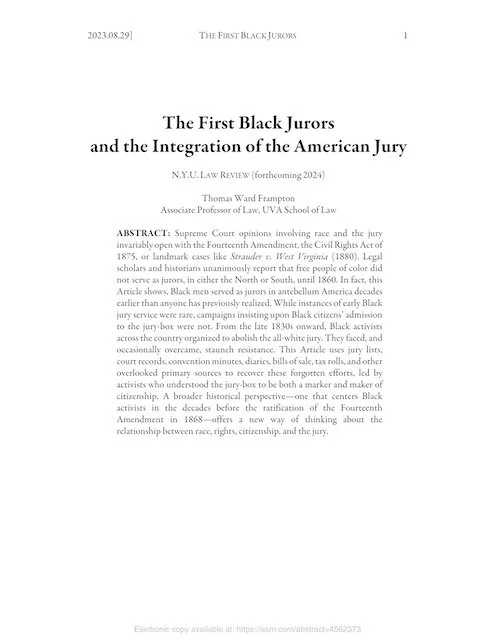
The First Black Jurors and the Integration of the American Jury

By Thomas Frampton

Supreme Court opinions involving race and the jury invariably open with the Fourteenth Amendment, the Civil Rights Act of 1875, or landmark cases like Strauder v. West Virginia (1880). Legal scholars and historians unanimously report that free people of color did not serve as jurors, in either the North or South, until 1860. In fact, this Article shows, Black men served as jurors in antebellum America decades earlier than anyone has previously realized. While instances of early Black jury service were rare, campaigns insisting upon Black citizens’ admission to the jury-box were not. From the late 1830s onward, Black activists across the country organized to abolish the all-white jury. They faced, and occasionally overcame, staunch resistance. This Article uses jury lists, court records, convention minutes, diaries, bills of sale, tax rolls, and other overlooked primary sources to recover these forgotten efforts, led by activists who understood the jury-box to be both a marker and maker of citizenship. A broader historical perspective—one that centers Black activists in the decades before the ratification of the Fourteenth Amendment in 1868—offers a new way of thinking about the relationship between race, rights, citizenship, and the jury.

 New York University Law Review, 2024, 66 pages

download
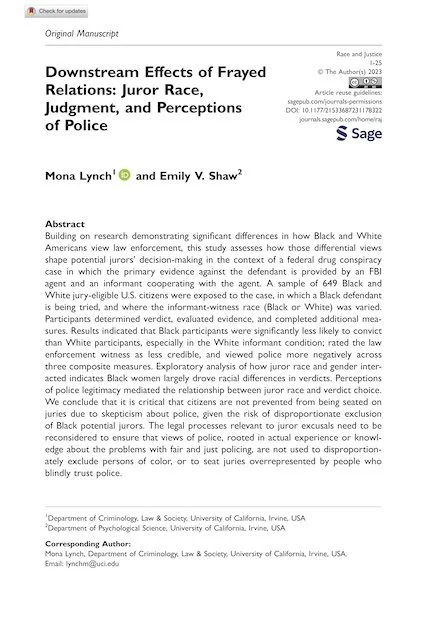
Downstream Effects of Frayed Relations: Juror Race, Judgment, and Perceptions of Police

By Mona Lynch and Emily V. Shaw

Building on research demonstrating significant differences in how Black and White Americans view law enforcement, this study assesses how views of police shape potential jurors’ decision-making. The authors conclude that it is critical that citizens are not prevented from being seated on juries due to skepticism about police, given the risk of disproportionate exclusion of Black potential jurors. The legal processes relevant to juror excusals need to be reconsidered to ensure that views of police, rooted in actual experience or knowledge about the problems with fair and just policing, are not used to disproportionately exclude persons of color, or to seat juries overrepresented by people who blindly trust police. A sample of 649 Black and White jury-eligible U.S. citizens were exposed a federal drug conspiracy case in which the primary evidence against the defendant is provided by an FBI agent and an informant cooperating with the agent, in which a Black defendant is being tried, and where the informant-witness race (Black or White) was varied. Participants determined verdict, evaluated evidence, and completed additional measures. Results indicated that Black participants were significantly less likely to convict than White participants, especially in the White informant condition; rated the law enforcement witness as less credible; and viewed police more negatively across three composite measures. Exploratory analysis of how juror race and gender interacted indicates Black women largely drove racial differences in verdicts. Perceptions of police legitimacy mediated the relationship between juror race and verdict choice

Race and Justice Volume: Online Dated: 2023 Pages: 1-25

download
Unleashing Rule 5.1 to Combat Prosecutorial Misconduct

By R. Michael Cassidy

Disciplining individual prosecutors will never be enough to overcome the multifarious incentives prosecutors have to cut corners to secure convictions. Although bar discipline against prosecutors is increasing in frequency, professional regulators tend to focus on individual actors rather than paying attention to systemic failures.

No single instance of prosecutorial misconduct—revealed perhaps by the reversal of a criminal case or the exoneration of an innocent defendant—can ever be fully explained by the deeds of a lone actor without looking at who establishes enforcement priorities, who sets office policies, and who does the training. Leaders in the office are usually involved, either by omission (failing to catch an error) or commission (creating an office culture where ethical lapses are tolerated or even encouraged).

The predominance of collective action and shared responsibility in business organizations often makes it difficult to pinpoint criminal liability. That challenge is addressed through the “responsible corporate officer” doctrine in criminal law, which holds executive-level individuals accountable for the wrongdoing to which they contributed, whether through commission or omission. Prosecutor’s offices are organizations with structures and incentives not dissimilar to that of a corporation. Because existing frameworks for addressing prosecutorial misconduct in the criminal justice system are ineffective, bar regulators should borrow from the responsible corporate officer doctrine by more aggressively enforcing Rule 5.1 of the Rules of Professional Conduct.

The notion that supervisory attorneys must be more actively involved in their colleagues’ ethical decisions and conduct has been recognized by the bar since the adoption of ABA Model Rule 5.1 in 1983, but the rule remains undertheorized by scholars and underutilized by disciplinary authorities. This article draws on important parallels between the responsible corporate officer doctrine and Rule 5.1 to explain why enforcement of professional discipline against leaders in a prosecutor’s office is necessary to incentivize more rigorous supervision and training. The author scrutinizes two recent cases in Colorado and Massachusetts where bar regulators have successfully utilized Rule 5.1 to discipline leaders in a prosecutor’s office for failing adequately to supervise the conduct of junior associates. The author then advocates for an even more expansive use of Rule 5.1 to force head prosecutors to adopt written, transparent, and publicly available policies and procedures. Finally, the author discusses three recurring and highly intractable problems of prosecutorial discretion that could benefit from comprehensive office policy manuals: grand jury practice, disclosure of exculpatory evidence; and use of cooperating witnesses.

Oregon Law Review, Vol. 102, 2024, Boston College Law School Legal Studies Research Paper No. 614, 37 p

download
Prosecutor-Initiated Record Relief in Ohio: A Survey of Prosecutorial Plans to Seal and Expunge Low-Level Controlled Substance Offenses

By  Jana Hrdinova, Dexter Ridgway, Douglas A. Berman and Peter Leasure

Ohio Senate Bill 288 (134th G.A.) created Ohio Revised Code Section (2953.39) to allow prosecutors to initiate sealing or expungement actions on behalf of defendants previously convicted of low-level controlled substance offenses. After passage of this new law, the Drug Enforcement and Policy Center at The Ohio State University surveyed all elected or appointed prosecutors in Ohio to gauge their office's interest and willingness to initiate record sealing or expungement applications on behalf of people who have been previously convicted of a low-level controlled substance offense. Overall, about 12% of respondents stated that they were willing to pursue prosecutor-initiated sealing for low-level controlled substance offenses. For those who reported that they were unlikely to pursue prosecutor-initiated sealing, common explanations for not doing so included the lack of staffing resources, the lack of financial resources, the lack of data, the belief it is not the responsibility of prosecutors, and the sufficiency of the defendant-initiated system

Drug Enforcement and Policy Center. August 2023, 19pg

DOWNLOAD
Balancing Promise and Caution in Pretrial Risk Assessments

By Kristin Porter, Cindy Redcross, Luke Miratrix
Across the country, release and detention decisions for defendants in the pretrial period — that is, the period after arrest while a criminal case is being adjudicated — are increasingly guided by risk assessments, which rely on data to estimate defendants’ risk of failing to appear for a court date or of being charged with new criminal activity if released pending trial. A risk assessment is generally used by a judicial body to help determine whether a defendant will be released while waiting for a case to be resolved, and if so, under what conditions (these are the defendant’s release conditions). The goal of pretrial risk assessments is to make any restrictions imposed on a defendant’s liberty better align with the risk that person poses to the community.

As has been widely discussed, these assessments — and the way they are used — have the potential to introduce new biases and further perpetuate racial disparities in the criminal justice system. This research brief describes the approach taken by MDRC’s Center for Criminal Justice Research and MDRC’s Center for Data Insights to understand, assess, and address bias in pretrial risk assessments and the systems that use them.

New York: MDRC, 2020. 11p.

Download
Read-Me.Org
Casting Out from the Inside: Abolishing Felony Disenfranchisement in New York

By Elizabeth Neuland

On May 4, 2021, New York became the 20th state to restore the right to vote to individuals upon release from custody, regardless of parole status. In a time when the United States government is trying to protect voting rights through the “For the People Act” and “The John Lewis Voting Rights Advancement Act,”  and while some states are seeing radical legislation proposed that would potentially suppress the right to vote, New York needs to abolish the antiquated practice of felony disenfranchisement and guarantee the right to vote to all eligible New Yorkers regardless of incarceration status. The practice of felony disenfranchisement does not align with the values and core curriculum of the programs being provided by the New York State Department of Corrections and Community Supervision (“DOCCS”) within state correctional facilities. The overview statement for program services reads, “DOCCS offers an extensive array of programs and services for incarcerated individuals to assist them in redirecting their lives and becoming productive, law-abiding members  of society.” Although the word “rehabilitation” is absent, this statement essentially summarizes what rehabilitation is. The argument to abolish felony disenfranchisement is highlighted by the vast rehabilitation efforts taken by DOCCS, through numerous employment and vocational programs, temporary release programs, and educational opportunities. Felony disenfranchisement stands in stark opposition to rehabilitation because it alienates individuals from the very communities to which DOCCS is taking great measures to help them to return In addition to rehabilitation, restoring the right to vote to all eligible New Yorkers regardless of incarceration status would raise the level of accountability for state politicians, lawmakers, and DOCCS itself. It is no secret that correctional facilities can be dangerous places, due to both interpersonal violence and acts of self-inflicted harm, including suicide. Accountability should apply to those that are the guardians of a vulnerable population. In Parts I and II, this Comment provides a brief overview of international and national practices of felony disenfranchisement to see where New York fits into the landscape. Part III concentrates on New York State. Its legislation affecting disenfranchisement and the number of individuals incarcerated are discussed to highlight how many people are affected by felony disenfranchisement. The argument to fully abolish felony disenfranchisement is made through discussions of rehabilitation and accountability. Lastly, this Comment describes how all New York citizens could be enfranchised.  

 City University of New York Law Review. 2022, 25pg

download
A Process and Outcome Evaluation of Project Reset

by Shamena AnwarMelissa M. LabriolaStephanie Brooks HollidayMatthew L. Mizel

In this report, RAND researchers share results of a process and outcome evaluation of Project Reset, a program that diverts adults arrested for low-level crimes into community-based support programs and out of the court system. Initially, the post-arrest pre-arraignment program was available only to individuals who did not have a criminal record, but the eligibility criteria eventually expanded to include those with prior convictions. The program served 2,149 individuals during the period analyzed. Researchers identified key program facilitators and barriers, documented participant experiences, determined the effect the program had on case outcomes and rearrest rates, and examined whether the program was cost-effective.

Key Findings

  • Project Reset led to improved case outcomes for participants. The program allowed individuals to attend a one-time, two-hour programming session and have their arrest sealed immediately afterwards. If not for the program, these individuals likely would have received an Adjournment in Contemplation of Dismissal (ACD) in the court system. Receiving an ACD would have required them to remain arrest-free and make multiple court appearances over a six-month to one-year supervisory period.

  • Project Reset did not lead to an increase in rearrests.

  • Project Reset was viewed favorably among staff and program participants.

  • Lack of reliable and accurate contact information for participants was a major barrier to recruitment, as 49 percent of those referred to Project Reset could not be reached by the provider.

  • Inequities in program completion may compound existing disparities in the criminal legal system. Outreach difficulties resulted in White Hispanic, Black non-Hispanic, and Black Hispanic individuals composing 65.2 percent of the population referred to Project Reset, but only 58.8% of program completers.

  • Under the existing program cost structure, the program costs outweighed the costs of traditional court adjudication. However, this relationship varied substantially by provider, and the program costs were actually significantly less expensive than court costs for the provider that served the largest number of clients.

  • Program cost-effectiveness would improve if the ratio of program staff to participants were lower, which could be accomplished either by lowering staff levels or increasing the number of participants.

Recommendations

  • Strategize how to collect better contact information for participants.

  • Increase public awareness of the program to improve its credibility when programs conduct outreach.

  • Examine whether current program eligibility criteria are leading to racial and ethnic disparities in program referral rates.

  • Reduce program provision costs by lowering the staff-to-participant ratio, which could be accomplished by either reducing the number of staff or increasing program caseloads.

  • Assess whether other populations could benefit from diversion programming.

  • Continue to hire, support, and keep well-qualified staff.

  • Support staff autonomy and program flexibility.

  • Continue to connect participants with needed services after completion.

Santa Monica, CA: RAND, 2023. 129p.

Download
Read-Me.Org
Beware, Not Everyone Lies the Same Way! Investigating the Effects of Interviewees’ Profiles and Lie Content on Verbal Cues

by Nicola Palena and Francesca De Napoli

 Research shows that lying is a common behaviour, and that verbal cues can be effective for lie detection. However, deception detection is not straightforward as there are several factors at play, such as interpersonal differences and the content of the lie. Consequently, the effectiveness of available cues for deception detection can vary significantly. In a pre-registered study involving 80 participants (a priori sample size analyses were conducted), we instructed participants to either tell the truth or lie about an autobiographical event and an opinion. The participants also completed questionnaires on personality traits and cognitive tasks, resulting in two participant clusters. Surprisingly, when analysing verbal behaviour, truthfulness, cluster memberships, and their interactions were not found to be significant. Only lie content affected verbal cues. Additional, non-pre-registered analyses revealed that liars displayed more micro-expressions than truth tellers, but only when describing their memories and when focusing on the latency time between the investigator’s question and the interviewee’s answer. The results were interpreted in terms of the experimental design, which encouraged only short answers from the interviewees, leaving limited room for verbal content to be effective.

Soc. Sci. 202413(2), 85; https://doi.org/10.3390/socsci13020085

Download
Read-Me.Org
Cybercrime during the COVID-19 pandemic: Prevalence, nature and impact of cybercrime for citizens and SME owners in the Netherlands

Steve van de Weijer a,* , Rutger Leukfeldt a,b,c , Asier Moneva a,b 

The outbreak of the COVID-19 virus in December 2019 and the restrictive measures that were implemented to slow down the spread of the virus have had a significant impact on our way of life. The sudden shift from offline to online activities and work may have resulted in new cybersecurity risks. The present study therefore examined changes in the prevalence, nature and impact of cybercrime among Dutch citizens and SME owners, during the pandemic. Qualitative interviews with ten experts working at various public and private organizations in the Netherlands that have insights into cybercrime victimization and data from victim surveys administrated in 2019 and 2021 were analyzed. The results show that there was only a small, non-statistically significant increase in the prevalence of cybercrime during the pandemic among citizens and SME owners. Nevertheless, the COVID-19 pandemic did have an impact on the modus operandi of cybercriminals: victims indicated that a considerable proportion of the offenses was related to the COVID-19 pandemic, particularly in the case of online fraud. Moreover, the use of new applications and programs for work was associated with an increased risk of cybercrime victimization during the COVID-19 crisis. These results suggest that increases in rates of registered cybercrime that were found in previous studies might be the consequence of a reporting effect and that cybercriminals adapt their modus operandi to current societal developments. 

Computers & Security Volume 139, April 2024, 103693

Download
Read-Me.Org
Neighborhood crime reduction interventions and perceived livability: A virtual reality study on fear of crime

William P. McClanahan  Carmen S. Sergiou , Aniek M. Siezenga , Dominik Gerstner , Henk Elffers , Job van der Schalk  Jean-Louis van Gelder

High levels of Fear of Crime (FOC) are associated with people engaging with their community less, lower use of public spaces, and a general sense of overall anxiety. In short, such fear may reduce the livability of an area. The primary goal of this research was to examine the potential consequences of environmental interventions intended to reduce crime on FOC and perceived livability of the area. Using immersive Virtual Reality (VR) technology, in two studies we examined how environmental interventions in residential neighborhoods influence FOC. In Study 1, we examined how motion-activated, dynamic street lighting and sound may decrease FOC. In Study 2, we applied an adapted ‘watching eyes’ intervention and examined how it may inadvertently increase FOC in a neighborhood. In Study 1 the intervention did not affect feelings of safety. In Study 2, the ‘watching eyes’ intervention indirectly increased FOC via feelings of being watched. In the Discussion, we highlight the importance of better understanding the boundary conditions of such environmental interventions.

Volume 147, April 2024, 104823

Download
Read-Me.Org
Community-based substance use treatment programs for reentering justice-involved adults: A scoping review

By Brian D. Graves , Michael Fendrich 

introduction For adults involved with the criminal justice system who are reentering their communities post-incarceration, there is a large need for community-based substance use treatment. Little is known, however, about the types, availability, and benefits of programs targeting the reentry population in community settings that operate independently from the criminal justice system. Methods We conducted a scoping review of community-based treatment programs for substance use among reentering justice-involved adults to examine the contemporary state of literature and identify research gaps. We searched four databases for peer-reviewed articles conducted in the United States and published between 2017 and 2021. Results The final sample included 58 articles. Interventions varied, but the two most prominent were medications for opioid use disorder (35%) and peer support or social support interventions (22.4%). Studies were more likely to show positive impact on substance use outcomes than criminal justice outcomes. Themes were identified around participant characteristics, treatment delivery, and treatment benefits. Conclusions Findings from this scoping review suggest that the range of evidence-based strategies for substance use treatment targeting the reentry population is growing, but there is a need for additional research that examines implementation, cost effectiveness, and racial/ethnic disparities.
February 2024 Drug and Alcohol Dependence Reports 10(1):100221

Download
Read-Me.Org
Association of Jail Decarceration and Anticontagion Policies With COVID-19 Case Growth Rates in US Counties

By Eric Reinhart,  Daniel L. Chen

IMPORTANCE Mass incarceration is known to foster infectious disease outbreaks, amplification of infectious diseases in surrounding communities, and exacerbation of health disparities in disproportionately policed communities. To date, however, policy interventions intended to achieve epidemic mitigation in US communities have neglected to account for decarceration as a possible means of protecting public health and safety. OBJECTIVE To evaluate the association of jail decarceration and government anti-contagion policies with reductions in the spread of SARS-CoV-2. DESIGN, SETTING, AND PARTICIPANTS This cohort study used county-level data from January to November 2020 to analyze COVID-19 cases, jail populations, and anti contagion policies in a panel regression model to estimate the association of jail decarceration and anti-contagion policies with COVID-19 growth rates. A total of 1605 counties with data available on both jail population and COVID-19 cases were included in the analysis. This sample represents approximately 51% of US counties, 72% of the US population, and 60% of the US jail population. EXPOSURES Changes to jail populations and implementation of 10 anti-contagion policies: nursing home visitation bans, school closures, mask mandates, prison visitation bans, stay-at-home orders, and closure of nonessential businesses, gyms, bars, movie theaters, and restaurants. MAIN OUTCOMES AND MEASURES Daily COVID-19 case growth rates. RESULTS In the 1605 counties included in this study, the mean (SD) jail population was 283.38 (657.78) individuals, and the mean (SD) population was 315.24 (2151.01) persons per square mile. An estimated 80% reduction in US jail populations, achievable through noncarceral management of nonviolent alleged offenses and in line with average international incarceration rates, would have been associated with a 2.0% (95% CI, 0.8%-3.1%) reduction in daily COVID-19 case growth rates. Jail decarceration was associated with 8 times larger reductions in COVID-19 growth rates in counties with above-median population density (4.6%; 95% CI, 2.2%- 7.1%) relative to those below this median (0.5%; 95% CI, 0.1%-0.9%). Nursing home visitation bans were associated with a 7.3% (95% CI, 5.8%-8.9%) reduction in COVID-19 case growth rates, followed by school closures (4.3%; 95% CI, 2.0%-6.6%), mask mandates (2.5%; 95% CI, 1.7%-3.3%), prison visitation bans (1.2%; 95% CI, 0.2%-2.2%), and stay-at-home orders (0.8%; 95% CI, 0.1%-1.6%). CONCLUSIONS AND RELEVANCE Although many studies have documented that high incarceration rates are associated with community-wide health harms, this study is, to date, the first to show that decarceration is associated with population-level public health benefits. Its findings suggest that, among other anti-contagion interventions, large-scale decarceration and changes to pretrial detention policies  are likely to be important for improving US public health, biosecurity, and pandemic preparedness. 

AMA Network Open. 2021;4(9):e2123405 

Download
Read-Me.Org
CASH BAIL REFORM: How Cash Bail Works, Why It’s a Flawed System and How It Can Be Reformed

By Interrogating Justice

The cash bail system used throughout every state in the U.S. leaves many innocent people incarcerated. That’s one of the reasons why so many advocacy groups are pursuing cash bail reform efforts to replace the discriminatory system with one that works. The term “cash bail” describes the funds that someone has to pay to be released from pretrial detention. Generally, the amount of cash bail that must be posted is based on the characteristics of the charged crime and alleged offender. But judges may raise or lower that amount as well. Once the amount is paid, it serves as a promise that the person will show up for their trial or hearing. If the person consistently appears for court, the money is returned. In they don’t appear, the money is not returned. And, if someone cannot afford to pay the cash bail, they won’t be released until their case is resolved. There are certain alternatives for when someone cannot come up with the bail amount on their own. For example, someone could get the money through a bail-bond company. The bond company covers the fee but will typically also charge a certain percentage of the bond to be paid back to them. If someone goes this route and does not show up to their trial or hearing, the bond company will use collateral to get its money back. WHY THE CASH BAIL SYSTEM IS FLAWED If you’re thinking that it seems unfair for someone to have to pay their way out of jail — whether that involves the fee alone or the cost of going through a bond company — other criminal justice advocates and allies would agree with you. Overcrowding in jails and prisons is already an issue in and of itself, so individuals being placed into that population simply because they don’t have the money to post bail only furthers the problem. There are two other significant reasons why the cash bail system is flawed, ultimately leading to an unnecessary burden on those in jail: racial and socioeconomic discrimination and psychological impacts. 

Durham, NC: Interrogating Justice, 2021. 5p.

Download
Read-Me.Org