

By JOY OLSON and ERIC L. OLSON
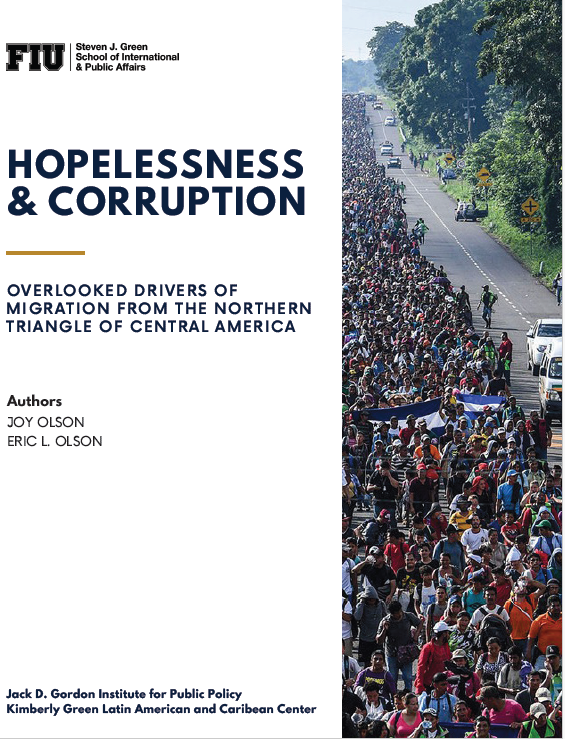
This paper analyzes the drivers of migration hypothesizing that persistent government failure driven in large part by corruption produces a sense of hopelessness among Central Americans that contributes to and propels their decision to migrate. Traditionally, corruption and its contribution to hopelessness have not been studied as drivers of migration. The authors conclude that addressing weak governance and corruption helps create a national context in which individuals can see a future in their own country. Central Americans from the Northern Triangle countries have a complex set of motivations for migration. Traditionally studied push factors include poverty, violence and natural disasters. Pull factors include economic opportunity/upward mobility, protection, and family reunification. The weight given to each factor is as varied as the number of people migrating. The intention to migrate is often based on one’s calculation of personal challenges and opportunities. Decisions are also influenced bylarger social, political, and economic factors. While it is an individual that migrates, it is their experience within their community and nation that informs their decision. Contextual factors contributing to migration include respect for human rights, governance and corruption. The State Department’s human rights reports paint a clear picture of the deplorable human rights situation in each Northern Triangle country and highlights the high level of impunity and, conversely, low expectations for justice that the majority can expect from their governments and justice systems. According to surveys of both experts and individuals, government corruption and/or the perception of corruption is widespread and endemic across the Northern Triangle. Weak governance can be the result of poor planning, lack of resources, and limited workforce capacity, but in many instances, it is also the result of corruption. While more research is needed, the thrust of the studies cited suggest that corruption can be both a direct and indirect driver of migration. The authors identify hopelessness as contributing to migration from the Northern Triangle. Since little research has been done in this area, proxies like Subjective Wellbeing (SWB) are considered. Hope, optimism, and SWB are concepts based not only on personal experience, but on one’s interaction with and perceptions of broader society. One’s experience with endemic corruption can contribute to a sense hopelessness. The authors argue that endemic corruption in Central America, and the destruction of mechanisms to control corruption, undermine peoples’ confidence in government and contribute to a lack of hope that their lives will improve. While the work done to date is insufficient to establish direct correlations. If the citizens of Central America believe that good governance and anti-corruption measures can be successful and see the results of such efforts reflected in improved healthcare, education, access to education, and justice, it could improve theirlives will improve. While the work done to date is insufficient to establish direct correlations. If the citizens of Central America believe that good governance and anti-corruption measures can be successful and see the results of such efforts reflected in improved healthcare, education, access to education, and justice, it could improve their sense of hope for the future and improve feelings of SWB thus lessening an underlying push factor from Central America. More must be done to address government corruption in the region and to learn about the relationship of hopelessness to migration.
Miami: jack D. Gordon Institute for Public Policy. Florida International University, 2021.