

Open Access Publisher and Free Library
HUMAN RIGHTS.jpeg

HUMAN RIGHTS

Human Rights-Migration-Trafficking-Slavery-History-Memoirs-Philosophy

Posts tagged South Africa
Legal and illegal export of cultural heritage artefacts from developing countries: Protection of cultural heritage in South Africa

By Jen Snowball, Alan Collins&Craig Bickerton

Cultural heritage is an important part of the capital of developing countries that can be leveraged for sustainable development. However, it also needs protection as the rise in the illegal trade of cultural artefacts shows. South Africa as an example of a middle-income African country that seeks to promote cultural heritage for development. As part of the attempt to preserve cultural capital, the South African Heritage Resources Agency (SAHRA) is tasked with the protection of cultural heritage that is of special cultural, historical, aesthetic or technical importance to the country, and is thus part of the “national estate”. SAHRA adjudicates applications for the permanent export of cultural artefacts, guided by national policy that defines the attributes of artefacts of national importance. There are also attempts to bypass SAHRA adjudication through illegal smuggling of important art and artefacts, which SAHRA also tracks through a database of artefacts reported stolen. This study analyses the way that SAHRA has applied the policy to make decisions about permanent export applications of cultural heritage artefacts, as well as the attributes of those artefacts reported stolen and thus lost to the national estate. Results showed that the SAHRA permit system seems to be providing effective protection for some of South Africa’s cultural heritage, but only 4% of applications were for art and artefacts representing black African cultures.

Cogent Social Sciences 

Volume 9, 2023 - Issue 1
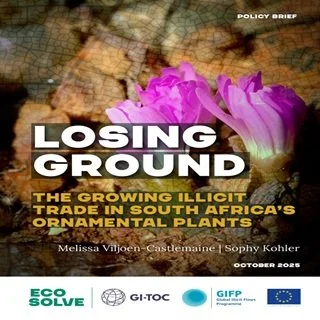
Losing Ground: The Growing Illicit Trade in South Africa’s Ornamental Plants

By Melissa Castlemaine, Sophy Kohler

This new policy brief examines how endangered flora are being systematically removed from the wild to meet international consumer demand for rare or unusual plants. This trade, once limited and opportunistic, has become more organized, commercialized and transnational, with buyers now concentrated in Europe, the US and Asia.

 South Africa, known for its rich biodiversity, faces threats from the increasing illicit trade in ornamental plants. Endangered species, like *Clivia mirabilis*, are being illegally harvested to satisfy international demand, with over 15,000 plants removed from the Oorlogskloof Nature Reserve by August 2025.

The illegal trade has expanded beyond succulents to include a variety of ornamental plants, with online platforms facilitating this activity. This poaching not only leads to biodiversity loss but also harms ecosystems and local communities.

Despite efforts like the National Response Strategy and Action Plan to Address the Illegal Trade in South African Succulent Flora (2022) and the National Integrated Strategy to Combat Wildlife Trafficking (2023), enforcement remains difficult. 

Upcoming international proposals aim to strengthen protections for threatened plant species. Coordinated responses are urgently needed to combat the illegal trade and protect South Africa’s unique flora.

Geneva: The Global Initiative Against Transnational Organized Crime, 2025. 36p

SLAVERY AT THE CAPE OF GOOD HOPE.

MAY CONTAIN MARKUP

by Rev. William Wright.

The text discusses the state of slavery at the Cape of Good Hope, detailing the author's observations and experiences during his ten-year residence there. It mentions various laws and ordinances related to slavery at the Cape, including Lord Charles Somerset's Proclamation of 1823 and the Consolidated Order in Council for the Crown Colonies, dated February 2, 1830. The author also references efforts towards ameliorating enactments and the potential for a scheme for the extinction of slavery by the colonists themselves.

John Rodwell, London. 1831. Reprinted in 1969 by Negro Universities Press,., New York. 116p.