Open Access Publisher and Free Library
HUMAN RIGHTS.jpeg

HUMAN RIGHTS

Human Rights-Migration-Trafficking-Slavery-History-Memoirs-Philosophy

Posts tagged arbitrary detention
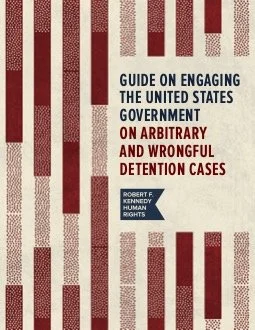
Guide on Engaging the United States Government on Arbitrary or Wrongful Detention Cases

By Robert F. Kennedy Human Rights Center

Addressing arbitrary and wrongful detention through advocacy and litigation is an area of extensive expertise and experience for RFK Human Rights. In the last decade, we have worked with families of arbitrarily and wrongfully detained individuals, including US persons, to facilitate their release and return home. A central reflection from our engagements with other practitioners and family members of arbitrarily or wrongfully detained persons is that the policy and legal architecture for the United States Government (USG) response to arbitrary and wrongful detention is complex and convoluted. Despite the successes in reuniting detained individuals with family members and the positive posture of the government toward negotiations, many stakeholders believe that clarity about the role each office or agency plays in the government’s response and uniformity in the government’s engagement with the families could facilitate even more positive outcomes.

In 2023, RFK Human Rights started a project aimed at steering USG and Congress towards more decisive action to address arbitrary and wrongful detention around the world and enhancing awareness around the government’s response architecture. Through the generous support from Open Society Foundations – United States, the project included advocacy engagements with the USG, litigation before the United Nations Working Group on Arbitrary Detention (UNWGAD), and publication of the Guide for Engaging the United States Government on Arbitrary and Wrongful Detention Cases.

About the Guide

The Guide on Engaging the United States Government on Arbitrary and Wrongful Detention Cases provides clear and concise information regarding advocacy strategies and engagement with the United States Government on arbitrary and wrongful detention cases. While every case is unique, this Guide aims to ease the burden of the engagement and advocacy process by shedding light on ways that the USG can engage on these cases and offering a set of best practices for advocating before the USG to secure the victim’s release. The Guide is based on RFK Human Rights’ institutional knowledge and experience working on arbitrary and wrongful detention cases, desk research, and a large number of interviews with experts and victims of arbitrary detention.

Washington, DC; New York: Robert F. Kennedy Human Rights, 2025. 68p.

download
All Conspirators

By Human Rights Watch

The 42-page report, “‘All Conspirators’: How Tunisia Uses Arbitrary Detention to Crush Dissent,” documents the government’s increased reliance on arbitrary detention and politically motivated prosecutions to intimidate, punish, and silence its critics. Human Rights Watch documented the cases of 22 people detained on abusive charges, including terrorism, in connection with their public statements or political activities. They include lawyers, political opponents, activists, journalists, social media users, and a human rights defender. At least 14 detainees could face capital punishment if convicted. Over 50 people were being held on political grounds or for exercising their rights as of January 2025.

Human Rights Watch, April 16, 2025, p. 42

tunisia

political repression

arbitrary detention

criminal justice

opposition crackdown

human rights defenders

download
Punished for Seeking Change. Killings, Enforced Disappearances, and Arbitrary Detention Following Venezuela’s 2024 Election

By Human Rights Watch

Following the July 2024 presidential elections, electoral authorities in Venezuela announced that Nicolas Maduro had been re-elected president, despite substantial evidence to the contrary. When people took to the streets to demand a fair counting of votes, Venezuelan authorities responded with brutal repression. At least 24 protesters and bystanders were killed and over 2,000 people were detained in connection with post-electoral protests. Punished for Seeking Change documents human rights violations committed against protesters, bystanders, opposition leaders, and critics in the post-electoral protests and the months that followed. It implicates Venezuelan authorities and pro-government armed groups, known as “colectivos,” in widespread abuses, including the killing of protesters and bystanders, enforced disappearances of opposition party members and foreign nationals, arbitrary detention and prosecution of children and others, and torture and ill-treatment of detainees. With 8 million Venezuelans abroad, the rights crisis in Venezuela remains arguably the most consequential in the Western Hemisphere. Governments should support accountability efforts for these grave human rights violations, call for the release of people arbitrarily detained, and expand access to asylum and other forms of international protection for Venezuelans fleeing repression.

New York: HRW, 2025. 109p.

download
Arbitrary detention of Mexican citizens by Mexican immigration authorities

By Amalia Campos-Delgado and Guillermo Yrizar Barbosa

On 3 September 2015, Mexican immigration authorities detained four Indigenous Tzeltal Mexicans who were travelling by bus to the northern state of Sonora. Despite identifying themselves as Mexican citizens, the authorities considered their documents false, and they were detained for nine days until their identities were certified. The Mexican State took four years to acknowledge publicly and apologise for this arbitrary detention. Similarly, in 2017, a 39-year-old man born in Oaxaca, living in the streets of Puebla after being deported by the United States Government, was detained for being ‘identified’ as a Salvadorian citizen by Mexican authorities. However, it would be a mistake to consider these cases an exception or anomaly in the Mexican Transit Control Regime. Drawing on statistical and archival information from 2010 to 2020, as well as semi-structured interviews conducted in 2021, in this article, we examine the arbitrary detention of Mexican citizens by Mexican immigration authorities. We highlight the multiple rights violated, question how these detentions have been framed in the official discourse and examine the outcome of these detentions. Our analysis sheds light on the racialisation of migration control in Mexico

International Journal For Crime, Justice And Social Democracy, 12(2), 47-58. doi:10.5204/ijcjsd.2890

download