

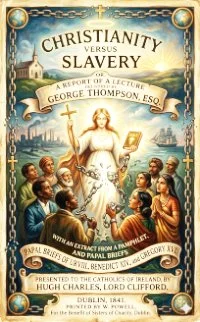
BY HUGH CHARLES, LORD CLIFFORD.
In a world still grappling with the echoes of systemic inequality, Christianity Versus Slavery (1841) emerges not merely as a historical relic, but as a prescient manifesto on human dignity and the moral imperatives of justice. This collection—comprising the fiery oratory of George Thompson, the strategic appeals of Lord Clifford to the Catholics of Ireland, and the authoritative weight of centuries of Papal Briefs—challenges the modern reader to confront the persistent "complicated interests" and "rotten politics" that continue to shape global structures of exploitation. At its heart, the work champions the "Scriptural doctrine of equality," asserting that the "innate dignity of man" is an immutable truth that transcends "complexion" or state borders. This 19th-century insistence that "God has made of one blood the varied tribes of man" serves as a foundational precursor to our modern concept of universal human rights.
The book’s relevance to the modern era is perhaps most striking in its sophisticated analysis of the intersection between global exploitation and domestic economic health. Lord Clifford’s address highlights how the "ruinous, than unchristian and inhuman traffic" of slavery in the colonies was inextricably linked to the "general distress" and "awful distress" of the manufacturing interests and the "starving workman" at home. This early critique of an "equally wicked and foolish policy" that prioritized "sordid lucre" over justice prefigures modern debates regarding ethical supply chains, globalized labor rights, and the hidden human costs of consumer goods. By linking the oppression of India and Ireland to the struggle for abolition, the text invites a contemporary audience to view justice as an indivisible, global pursuit.
Furthermore, the work offers a timeless strategy for social change through the "regeneration of public sentiment". In an age often dominated by digital echo chambers and a "venal press," the book’s emphasis on the "power of truth" and "moral power" as weapons "mightier than armies" remains a potent call to action. It warns that the struggle for justice is "slow and progressive," requiring a "struggle continued through a series of years" against "deep-seated prejudices" and "long-cherished pride". Ultimately, Christianity Versus Slavery serves as a rigorous moral compass, reminding the modern era that the "spiritual nature and affinity of the races" is the only legitimate basis for a sane and just civilization.
Read-Me.Org Inc. New York-Philadelphia-Australia. 2026. 100p.
