Open Access Publisher and Free Library
HUMAN RIGHTS.jpeg

HUMAN RIGHTS

Human Rights-Migration-Trafficking-Slavery-History-Memoirs-Philosophy

Posts tagged humanitarian crises
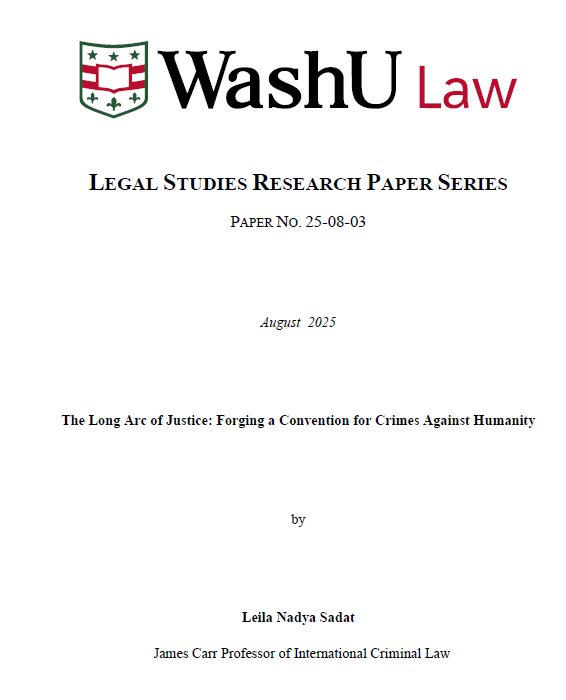
The Long Arc of Justice: Forging a Convention for Crimes Against Humanity

By Leila N. Sadat

This Article presents a comprehensive overview of the development, challenges, and future prospects of creating and ultimately negotiating a global treaty for crimes against humanity. It honors pioneers in the field and acknowledges the contributions of various individuals and entities to the Crimes Against Humanity Initiative the author established in 2007. It traces the historical context of atrocities such as slavery and the slave trade, linking them to the modern concept of crimes against humanity. The Article reviews the evolution of international criminal law, particularly under the Rome Statute of the International Criminal Court (ICC), emphasizing the necessity of a new treaty to fill gaps left by existing frameworks. Highlighting contemporary examples like the Syrian Civil War, it underscores the preventive power of prosecuting crimes against humanity as a move towards preventing the commission of atrocity cascades, before the descent into armed conflict and genocide. The Article describes the multi-decade effort to draft and promote a new treaty, including significant milestones, such as the adoption of the International Law Commission’s (ILC) 2019 Draft Articles, and the protracted and ultimately successful advocacy within the UN General Assembly’s Sixth (Legal) Committee to achieve a consensus resolution in 2022 that allows the process to move forward. The 2024 adoption of GA Resolution 79/122, which authorizes convening a United Nations Diplomatic Conference for crafting a comprehensive legal instrument, was a critical achievement, setting the stage for negotiations over the next several years. The Article reflects upon the enduring struggle for justice and the imperative to adopt, ratify, and enforce a new treaty, drawing historical parallels with the abolition of the transatlantic slave trade. It concludes with a call for continued dedication to ending impunity for crimes against humanity globally.


Washington University Global Studies Law Review, 2025, Vol 25, Issue 2, p302

Human Rights Watch World Report 2025: Events of 2024

By Human Rights Watch

This has been a year of elections, resistance, and conflict, testing the integrity of democratic institutions and the principles of international human rights and humanitarian law. Whether in response to heightened repression in Russia, India, and Venezuela, or catastrophic armed conflicts in Gaza, Sudan, and Ukraine, governments around the world are being called upon to demonstrate their commitment to human rights, democracy, and humanitarian action. Many have failed the test. But even outspoken and action-oriented governments have invoked human rights standards weakly or inconsistently, feeding global perceptions that human rights lack legitimacy. That is an irresponsible and dangerous conclusion, and conveniently absolves governments of their legal obligations to uphold international human rights law both at home and in their actions abroad. Reflecting on the events of 2024, this is not a moment to retreat from the protections needed by everyone everywhere. Instead, governments should respect and defend universal human rights with more rigor and urgency than ever, and people and civil society need to remain steadfast in holding them accountable. The Power of Popular Resistance Elections need to abide by human rights standards, but elections are never an end in themselves. While rigged and otherwise unfair elections are a sign of more rights violations to come, even free and fair elections don’t necessarily mean a rights-respecting future. Although over 70 countries conducted national elections in 2024, their full impact on human rights will only be felt in what follows. Racism, hate, and discrimination drove many elections in the past year. In the United States, Donald Trump won the presidency for a second time, raising concerns that his new administration would repeat and even magnify the serious rights violations of his first term. Likewise, in the European Parliament elections of 2024, far-right parties made significant gains, exploiting anti-immigrant sentiment and nationalist rhetoric to advance policies that threaten minority communities and undermine democratic norms. Yet elsewhere, there was meaningful democratic resilience, as voters proved unwilling to accept populist agendas and held leaders and their parties accountable. In India, Prime Minister Narendra Modi’s hate speech on the campaign trail did not win him the electoral majority he craved, showing that even in the face of systemic challenges, democracy can still put a check on power. Authoritarian leaders tightened their grip on power in countries such as Russia, El Salvador and the Sahel nations of Mali, Burkina Faso, and Niger, leveraging fear and misinformation to stifle dissent.

Our Annual Review Of Human Rights HumanRights Watch, 2025. 554p