Open Access Publisher and Free Library
HUMAN RIGHTS.jpeg

HUMAN RIGHTS

Human Rights-Migration-Trafficking-Slavery-History-Memoirs-Philosophy

Posts in Crime Prevention
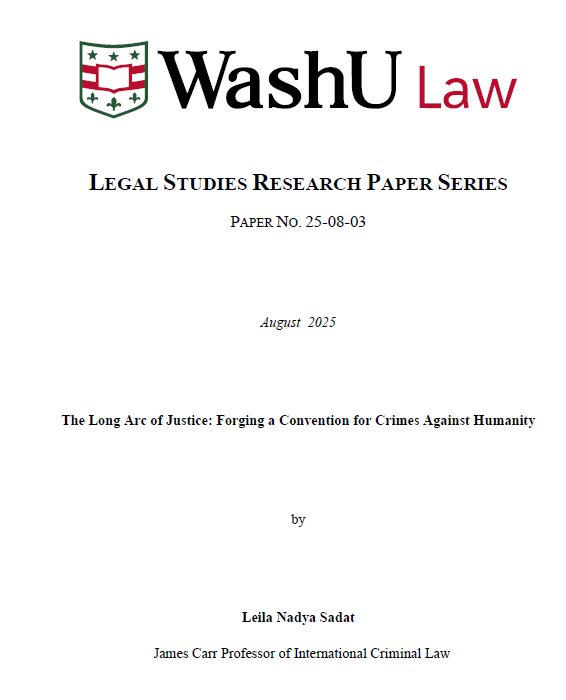
The Long Arc of Justice: Forging a Convention for Crimes Against Humanity

By Leila N. Sadat

This Article presents a comprehensive overview of the development, challenges, and future prospects of creating and ultimately negotiating a global treaty for crimes against humanity. It honors pioneers in the field and acknowledges the contributions of various individuals and entities to the Crimes Against Humanity Initiative the author established in 2007. It traces the historical context of atrocities such as slavery and the slave trade, linking them to the modern concept of crimes against humanity. The Article reviews the evolution of international criminal law, particularly under the Rome Statute of the International Criminal Court (ICC), emphasizing the necessity of a new treaty to fill gaps left by existing frameworks. Highlighting contemporary examples like the Syrian Civil War, it underscores the preventive power of prosecuting crimes against humanity as a move towards preventing the commission of atrocity cascades, before the descent into armed conflict and genocide. The Article describes the multi-decade effort to draft and promote a new treaty, including significant milestones, such as the adoption of the International Law Commission’s (ILC) 2019 Draft Articles, and the protracted and ultimately successful advocacy within the UN General Assembly’s Sixth (Legal) Committee to achieve a consensus resolution in 2022 that allows the process to move forward. The 2024 adoption of GA Resolution 79/122, which authorizes convening a United Nations Diplomatic Conference for crafting a comprehensive legal instrument, was a critical achievement, setting the stage for negotiations over the next several years. The Article reflects upon the enduring struggle for justice and the imperative to adopt, ratify, and enforce a new treaty, drawing historical parallels with the abolition of the transatlantic slave trade. It concludes with a call for continued dedication to ending impunity for crimes against humanity globally.


Washington University Global Studies Law Review, 2025, Vol 25, Issue 2, p302

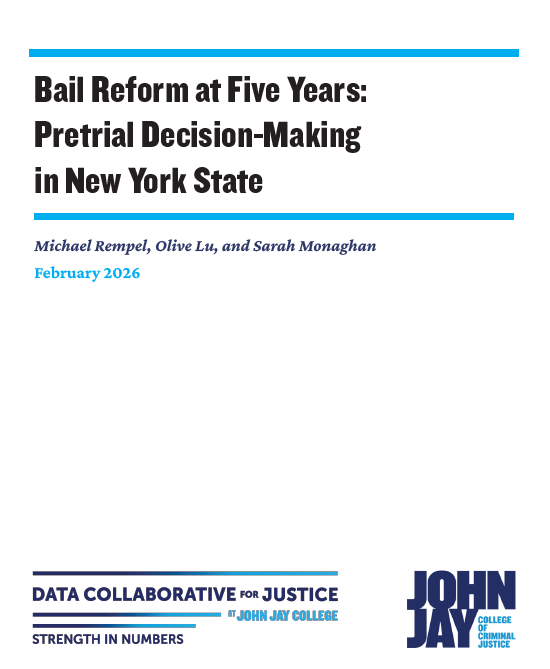
Bail Reform at Five Years: Pretrial Decision-Making in New York State

By Michael Rempel, Olive Lu, & Sarah Monaghan

In January 2020, New York’s landmark bail reform law went into effect. This report provides a definitive examination of how bail reform reshaped the pretrial landscape after five full years of implementation. Covering all regions of the state, and drawing on court data from 2018 to 2024 (spanning pre- and post-reform timeframes), the report examines bail reform’s impact on:

  • Pretrial Decision-Making at Arraignment: Rates of release on recognizance, supervised release, bail, and pretrial detention; and estimated numbers of cases not resulting in pretrial detention due to changing practices under bail reform.

  • Affordability of Bail: For cases that continue to be assigned bail, median bail amounts, bail posting rates, and judges’ use of “alternative” payment methods (partially secured bonds and unsecured bonds) that legislators intended to ease people’s ability to pay.

  • Racial and Ethnic Disparities: Disparities among Black, Hispanic, and white people in judges’ rates of continuing to set bail or remand people directly to jail.

  • Three Rounds of Bail Amendments: Effects of amendments respectively put into effect in July 2020, May 2022, and June 2023 (entailing a first-ever analysis of the 2022 and 2023 amendments).

New York: Data Collaborative for Justice, 2026. 47p.

Waste Crime and Trafficking Re-Punished for the Past: How Criminal Records Increase Prison Terms and Racial Injustice

By Nazgol Ghandnoosh, Bobby Boxerman and Celeste Barry
Prior criminal records account for a large share of already lengthy prison sentences, often adding years or even decades to sentences, without evidence of community safety benefits.

What’s new? Recruitment of children to fight in armed and criminal groups has boomed across Colombia over the last decade, with hundreds of minors lured into joining violent groups on false promises of wealth, status and protection. This war crime disproportionately affects Colombia’s ethnic communities and those who live in conflict zones.

Why does it matter? Armed groups rely on minors to maintain territorial control. Children carry out high-risk tasks, suffer abuse, and are punished with death if caught escaping. Recruitment shatters communities’ ability to resist armed groups because locals fear their own family members will be the targets of reprisals if they speak out.

What should be done? Colombia should act promptly to identify children at risk, boost protection at schools (where recruitment often happens) and strengthen its criminal investigations into the perpetrators. Foreign donors should support police efforts to track recruiters and help strengthen communities’ ability to prevent the crime from taking place.

International Crisis Group, 2026, 28p.

The Obligation To Prevent Genocide

By Patrick Butchard, Philip Loft

Genocide is a crime under international law, according to the United Nations General Assembly. The 1948 Genocide Convention, which has 153 parties requires party states to punish those responsible for genocide. The convention also requires states to prevent genocide from occurring. While it does not set out how they must do this, judgments on cases before the International Court of Justice (ICJ) have clarified some details of the obligation. What are a state’s obligations in international law? Judicial decisions from the International Court of Justice suggest that: • States are required to try to prevent genocide, but they do not breach their obligation if they fail. – They must still try even if they think their actions will not succeed

– What counts as a reasonable attempt at preventing genocide will depend on a state’s circumstances. • States must take action to prevent genocide as soon as they become aware there is a serious risk of it. • Genocide must actually occur for a state to be in breach of its obligation to prevent it. • Measures to prevent genocide might include engaging with bodies of the UN, such as the Security Council, or directly with other states. • States are unlikely to be allowed under international law to use military force against another state in an attempt to prevent genocide.

London: UK Parliament House of Commons Library, 2026. 25p.

A Randomized Controlled Trial of a Comprehensive, Research-Based Framework for Implementing School Based Law Enforcement Programs

By Brenda Scheuermann, Kathy Martinez-Prather, Anthony Petrosino,

The research tested the use of a multi-faceted, school-based law enforcement (SBLE) framework to determine how it contributes to multiple outcomes for 25 middle and high schools. Outcomes measured pertained to student victimization and delinquency, the use of exclusionary discipline practices, school climate, and student-officer interactions. Reliable findings were disseminated for implementation and further research in schools nationwide. The impact research questions are provided in this report. The framework for implementing school policing is provided.

San Marco, TX: Texas State University , 2022. 43p.