By Christine Mitchell, Renae A. Badruzzaman
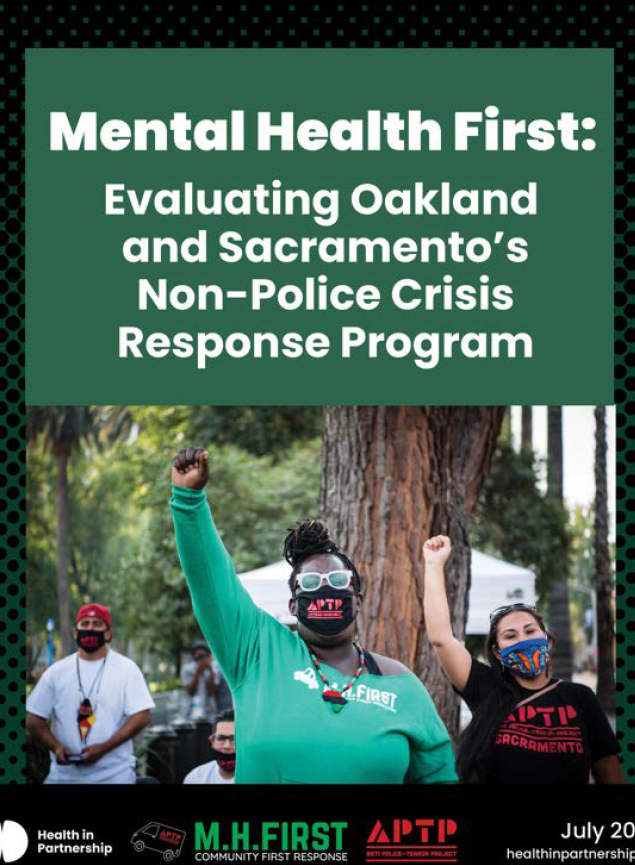
When you witness someone in crisis — a mental health emergency or other escalating situation — what are your options to intervene? For most, the only available option is to call 911. And in most places, the 911 system is directly tied to the police department, making police involvement essentially inevitable. But police are not a source of safety, especially for Black, Indigenous, disabled, and people with mental health needs. Policing in the US is a system rooted in violence and punishment, not care. Calling the police can escalate a crisis, turning calls for distress into arrest, violence, or death. Without trusted, community-led alternatives, we are left with a wrenching dilemma: stay silent and unsupportive in moments of crisis, or risk escalation, criminalization, and compounded trauma and violence. Because of this, many communities across the US are working to interrupt police violence against people with mental health needs by building up community-based, community-led, non-police crisis response programs. While more evaluations of each of these types of programs are needed, there is already a body of literature that suggests these alternative models are both more effective at meeting the needs of people in crisis and more trusted by the community. One such program is Mental Health First (MH First), a project of the Anti Police-Terror Project (APTP) launched in 2020 in Oakland and Sacramento, CA. MH First is a community-led crisis response hotline outside of the 911 and police system that community members can call when they, or someone in their community, is experiencing a crisis. The program’s guiding principles include autonomy, healing justice, abolition, intersectionality, disability justice, and harm reduction. This evaluation — conducted while the program is on a strategic planning hiatus — takes a close look at MH First’s first four years of operation to assess how the program is working, what impacts it’s had, and what is needed to grow its reach and deepen effectiveness. Using a mixed-methods process evaluation, we conducted 29 interviews with key stakeholders, and analyzed 167 survey responses from community members in Oakland and Sacramento. Our evaluation focuses on community perceptions of MH First, program strengths, and areas for growth. In particular, we examined the program’s current structure and operations, perceived impact, and potential for deepening and increased services to the Oakland and Sacramento communities Overall, interviewees and survey respondents were very positive about and appreciative of the program. Interviewees noted that the program is trusted by and rooted in the local communities it serves, an essential part of providing appropriate and accessible care to those who call. Trust is further increased by the clear, transparent values of community, autonomy, and abolition that guide MH First’s work. Importantly, MH First is building power and self-efficacy in the local and national community through their trainings, technical assistance, and volunteer recruitment — through which they have trained thousands of volunteers to staff the program. On the national level, interviewees named that MH First provides a strong model that indicates that non-police mental health crisis response programs are practical and possible. Relative to other forms of mental health crisis response, including police and co-response models, MH First is highlighted as more appropriate and more effective at meeting community needs. Our evaluation also identified areas where MH First could grow and improve to better serve the Oakland and Sacramento communities. Interviewees expressed a desire for MH First to increase reliability by expanding their hours of operation to 24/7, rather than during select hours of the week. Some also suggested that MH First transition from a volunteer-only service, to include at least some paid staff. Finally, interviewees felt that MH First should focus on preventative measures and follow-up care, not just crisis management and intervention. In order to be able to meet these areas of growth, interviewees offered suggestions for expanding the program’s reach, including through policy change, a clear narrative and communications strategy, more trainings to build community capacity, and long-term sustainable investment in the program. Two big picture questions remain for the program’s consideration: First, how can MH First avoid the co-optation of their principles and strategy by entities that dilute or stray from MH First’s values and purpose? Interviewees spoke of the inevitability of co-optation and shared strategies for how to reframe or leverage co-optation to expand the program, while still maintaining control over the narrative of the program’s practice. Second, should MH First remain an entity outside of local, county, or state government, or should it be housed under a governmental office or supported with government funds — or some combination of both? Our interviewees had strong opinions on this question, with some feeling that operating within the government and social safety net would allow MH First to be more sustainable and accessible, and others believing that moving under a government agency would cause the program to lose its current spirit and vision. Our evaluation concludes with six recommendations for MH First: 1: Continue to prioritize being deeply rooted in and led by community members in Oakland and Sacramento, particularly Black, Indigenous, Latine, and disabled community members who are most impacted by policing 2: Publicly share more stories of success, including robust qualitative and quantitative data analysis 3: Provide preventative care in order to interrupt pathways to crisis situations and follow-up care in order to ensure people have what they need following crisis 4: Expand hours of operation as much as possible to ensure the hotline is accessible and reliable 5: Increase resources and funding for the program, including considerations of whether MH First is willing and able to receive government funding 6: Pass policy and budget allocations that shift money from the carceral state to non-police grassroots response, including to MH First
Berkeley, CA: Mental Health First, July 2025. 72p.