Open Access Publisher and Free Library
HUMAN RIGHTS.jpeg

HUMAN RIGHTS

Human Rights-Migration-Trafficking-Slavery-History-Memoirs-Philosophy

Posts tagged minority communities
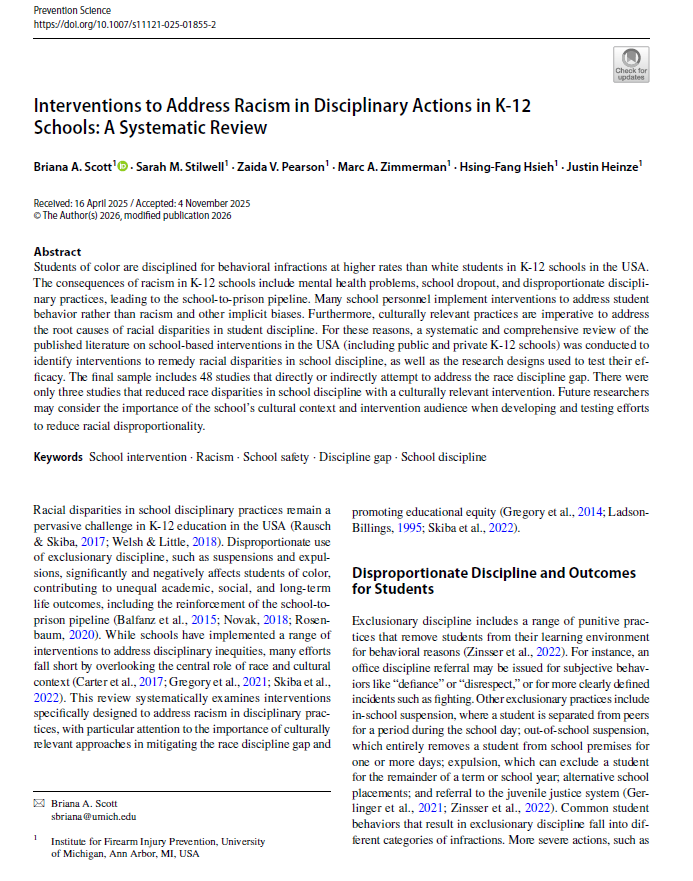
Interventions to Address Racism in Disciplinary Actions in K-12 Schools: A Systematic Review

By Briana A. Scott, Sarah M. Stilwell, Zaida V. Pearson, Marc A. Zimmerman


Students of color are disciplined for behavioral infractions at higher rates than white students in K-12 schools in the USA. The consequences of racism in K-12 schools include mental health problems, school dropout, and disproportionate disciplinary practices, leading to the school-to-prison pipeline. Many school personnel implement interventions to address student behavior rather than racism and other implicit biases. Furthermore, culturally relevant practices are imperative to address the root causes of racial disparities in student discipline. For these reasons, a systematic and comprehensive review of the published literature on school-based interventions in the USA (including public and private K-12 schools) was conducted to identify interventions to remedy racial disparities in school discipline, as well as the research designs used to test their efficacy. The final sample includes 48 studies that directly or indirectly attempt to address the race discipline gap. There were only three studies that reduced race disparities in school discipline with a culturally relevant intervention. Future researchers may consider the importance of the school’s cultural context and intervention audience when developing and testing efforts to reduce racial disproportionality
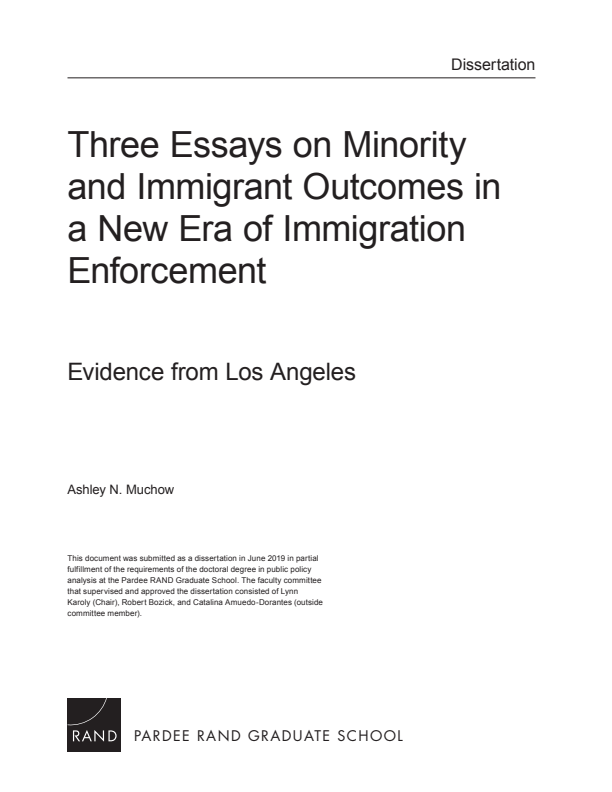
Three Essays on Minority and Immigrant Outcomes in a New Era of Immigration Enforcement: Evidence from Los Angeles

By Ashley N. Muchow

Toward the end of the 20th century, the U.S. witnessed a wave of immigration made up of both legal residents and a large undocumented population that have since settled, started families, and developed strong community ties. Modern immigration policy has concentrated heavily on enforcement in the absence of comprehensive immigration reform, and a growing body of research suggests these escalations may carry unintended social consequences.

This dissertation consists of three interrelated studies that seek to disentangle the structural factors that affect levels of economic and social integration of minority and immigrant populations. Using data from Los Angeles, this dissertation focuses on two aspects of public life critical to productive and healthy living: the labor market and public safety. The first chapter considers how undocumented immigrants fare in the labor market. The second examines whether recent escalations in immigration enforcement influenced the willingness of Latino immigrants to engage with the police. Finally, the third chapter evaluates the effectiveness of community policing in reducing crime and increasing police engagement in predominately-Latino neighborhoods.

Overall, this dissertation suggests that enforcement-focused immigration policy intensifies barriers to integration and may jeopardize public safety, but there are tools localities can use to improve conditions in affected communities. I find both real and perceived exclusions limit immigrants' access to the formal labor market and law enforcement, and conclude with evidence of a promising approach to improve public safety in minority communities. These findings stress the need for federal immigration policies that balance enforcement with maintaining resident confidence in public institutions and encouraging the well-being and advancement of vulnerable populations.

Santa Monica, CA: RAND, 2019. 122p.