Open Access Publisher and Free Library
HUMAN RIGHTS.jpeg

HUMAN RIGHTS

Human Rights-Migration-Trafficking-Slavery-History-Memoirs-Philosophy

Posts tagged Diversity
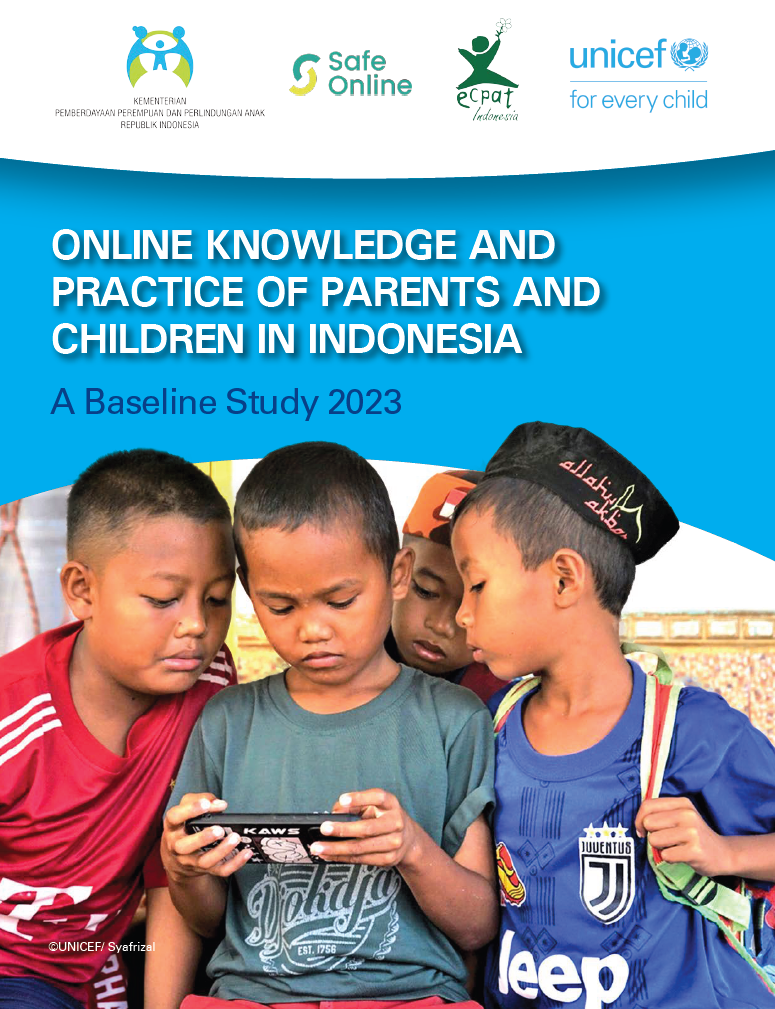
ONLINE KNOWLEDGE AND PRACTICE OF PARENTS AND CHILDREN IN INDONESIA

By Karen Muller,  Astrid Gonzaga Dionisio, Sanghyun Park

The “Online Knowledge and Practice of Children and Parents in Indonesia: Baseline Study 2023” highlights that most children in Indonesia use the internet daily, primarily for socializing and entertainment. However, they face significant risks, including exposure to inappropriate content, cyberbullying, and online sexual exploitation and abuse. The study reveals that many children and parents lack adequate online safety education, with only 37.5% of children having received information on how to stay safe online. Additionally, 42% of children have felt uncomfortable or scared due to online experiences, and 50.3% have seen sexual images on social media.UNICEF Indonesia is actively addressing these issues by supporting the government in strengthening the legal framework for child online protection and enhancing integrated services for victim support. UNICEF empowers children, parents, and teachers to promote safe online behavior and strengthen law enforcement capabilities to detect, investigate, and prosecute cases of online child exploitation. UNICEF also focuses on generating evidence to inform policies and practices, aiming to create a safer online environment for children in Indonesia. Their efforts include co-creating campaigns with children and youth to raise awareness about online risks and engaging with businesses to promote responsible conduct for the rights and well-being of children, 202

Mental health and experiences of violence. Children, violence and vulnerability 2025 Report 3

By The Youth Endowment Fund

The Youth Endowment Fund (YEF) surveyed nearly 11,000 children aged 13–17 in England and Wales to hear directly about their experiences of violence. The findings are being shared across several reports, each exploring a different theme. This third report focuses on mental health and experiences of violence. For the first time, we asked detailed questions about mental health, including using the Strengths and Difficulties Questionnaire (SDQ), a 25-item questionnaire that measures the scale of children’s struggles. Combined with data on victimisation and perpetration, this provides an unprecedented picture of how violence and mental health are linked — and the complex ways they shape young people’s lives. Here’s what we found. Teenage children affected by serious violence face a dramatically higher risk of mental health problems. The scale of poor mental health among teenagers is alarming. More than one in four 13-17-year-olds reported high or very high levels of mental health difficulties, as measured by the SDQ — the equivalent of nearly a million teenage children struggling with their well-being. Behind this figure lie serious and often complex needs. A quarter of teenage children reported a diagnosis of at least one mental health or neurodevelopmental condition, such as depression, attention deficit hyperactivity disorder or speech and communication difficulties. A further 21% suspected they had a condition but had not been formally diagnosed — suggesting large numbers of teenage children are facing difficulties without recognition or support

Children, violence and vulnerability 2025 . Exploitation and gangs

By The Youth Endowment Fund

The Youth Endowment Fund asked nearly 11,000 children aged 13–17 across England and Wales to share their experiences of violence. The findings are set out in separate reports, each exploring a different theme. This one focuses on teenage children’s experiences of exploitation and ‘gangs’. When we asked teenage children whether they had been in a ‘gang’, we defined a ‘gang’ as: “A group of young people who think of themselves as a ‘gang’, probably with a name, who are involved in violence or other crime.” We used the word ‘gang’ because it is one that many young people recognise and use themselves, more than phrases such as group-based criminality. But we also recognise its limitations: the term oversimplifies a complex issue and can reinforce harmful stereotypes. To reflect these sensitivities, we use inverted commas when referring to ‘gangs’. At several points in this report, we share the words of James (whose name has been changed to protect his identity), who, from ages 12 to 18, was criminally exploited. His story lays bare the reality

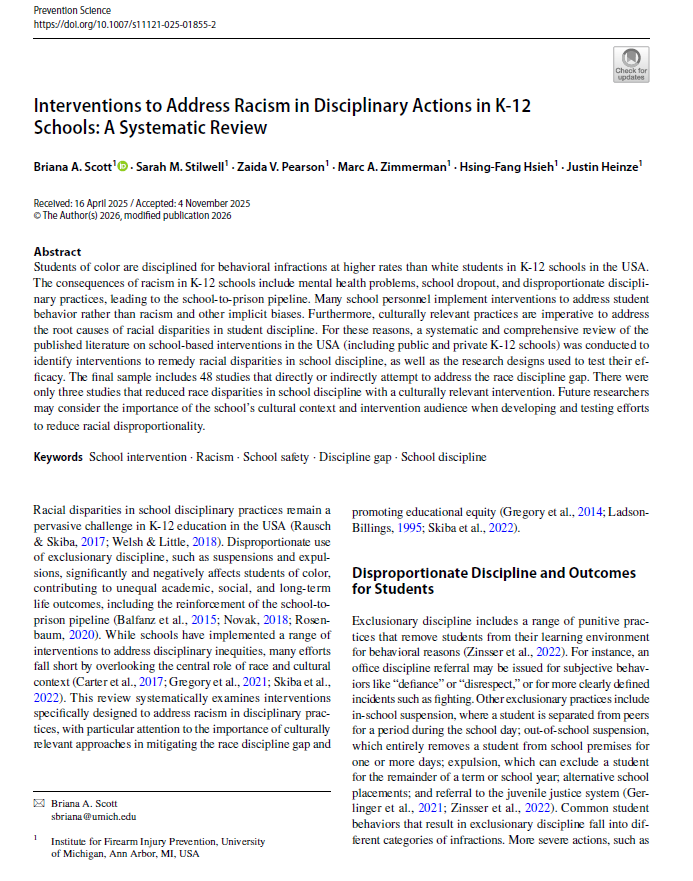
Interventions to Address Racism in Disciplinary Actions in K-12 Schools: A Systematic Review

By Briana A. Scott, Sarah M. Stilwell, Zaida V. Pearson, Marc A. Zimmerman


Students of color are disciplined for behavioral infractions at higher rates than white students in K-12 schools in the USA. The consequences of racism in K-12 schools include mental health problems, school dropout, and disproportionate disciplinary practices, leading to the school-to-prison pipeline. Many school personnel implement interventions to address student behavior rather than racism and other implicit biases. Furthermore, culturally relevant practices are imperative to address the root causes of racial disparities in student discipline. For these reasons, a systematic and comprehensive review of the published literature on school-based interventions in the USA (including public and private K-12 schools) was conducted to identify interventions to remedy racial disparities in school discipline, as well as the research designs used to test their efficacy. The final sample includes 48 studies that directly or indirectly attempt to address the race discipline gap. There were only three studies that reduced race disparities in school discipline with a culturally relevant intervention. Future researchers may consider the importance of the school’s cultural context and intervention audience when developing and testing efforts to reduce racial disproportionality

Human Rights Politics: An Introduction

By Michael Krennerich

The book offers a comprehensive and clear introduction for students and those interested in human rights, written by a renowned human rights expert. It not only provides an introduction to the diversity of issues, actors, and institutions in human rights policy and politics but also offers assistance and suggestions on how the complex reality of human rights politics can be described and analyzed with the help of political science and related disciplines. It deals with civil society engagement in human rights as well as state obligations and international efforts to protect human rights. This is an open-access book.

Cham: Springer Nature, 2024. 180p.

Advancing Antiracism, Diversity, Equity, and Inclusion in STEMM Organizations: Beyond Broadening Participation

By National Academies of Sciences, Engineering, and MedicineNational Academies of Sciences, Engineering, and Medicine

Individuals from minoritized racial and ethnic groups continue to face systemic barriers that impede their ability to access, persist, and thrive in science, technology, engineering, mathematics, and medicine (STEMM) higher education and workforce. Without actively dismantling policies and practices that disadvantage people from minoritized groups, STEMM organizations stand to lose much needed talent and innovation as well as the ideas that come from having a diverse workforce. A new report from the Board on Behavioral, Cognitive, and Sensory Sciences examines the backdrop of systemic racism in the United States that has harmed and continues to harm people from minoritized groups, which is critical for understanding the unequal representation in STEMM. The report outlines actions that top leaders and gatekeepers in STEMM organizations, such as presidents and chief executive officers, can take to foster a culture and climate of antiracism, diversity, equity, and inclusion that is genuinely accessible and supportive to all.

Washington, DC: National Academies of Sciences, Engineering, and Medicine, 2023. 342p

Excluding Diversity Through Intersectional Borderings: Politics, Policies and Daily Lives

Edited by: Laura Merla, Sarah Murru, Giacomo Orsini , Tanja Vuckovic Juros 

This open access book critically examines how discourses and policies target and exclude migrants and their families in Europe and North America along racial, gender and sexuality lines, and how these exclusions are experienced and resisted. Building on the influential notion of intersectional borderings, it delves deep into how these discourses converge and diverge, highlighting the underlying normative constructs of family, gender, and sexuality. First, it examines how radical-right and conservative political movements perpetuate exclusionary practices and how they become institutionalized in migration, welfare, and family policies. Second, it examines the dynamic responses they provoke—both resistance and reinforcement—among those affected in their everyday lives. Bringing together studies from political and social sciences, it offers a vital contribution to the expanding field of migrant family governance and exclusion and is essential for understanding the complex processes of exclusion and the movements that challenge and sustain them. It expands academic discussions on populism and the politics of exclusion by linking them to the politicization of intimacy and family life. With diverse case studies from Europe, North, and Central America, it appeals to students, academics, and policymakers, informing future mobilizations against discriminatory and exclusionary tendencies in politics and society.

IMISCOE Research Series Cham: Springer Nature, 2024. 183p.

When Protest Makes Policy: How Social Movements Represent Disadvantaged Groups

By Sirje Laurel Weldon

A must-read for scholars across a broad sweep of disciplines. Laurel Weldon weaves together skillfully the theoretical strands of gender equality policy, intersectionality, social movements, and representation in a multimethod/level comparative study that unequivocally places women's movements at the center of our understanding of democracy and social change."" ---Amy G. Mazur, Washington State University "Laurel Weldon's When Protest Makes Policy expands and enriches our understanding of representation by stressing social movements as a primary avenue for the representation of marginalized groups. With powerful theory backed by persuasive analysis, it is a must-read for anyone interested in democracy and the representation of marginalized groups." ---Pamela Paxton, University of Texas at Austin ""This is a bold and exciting book. There are many fine scholars who look at women's movements, political theorists who make claims about democracy, and policy analysts who do longitudinal treatments or cross-sectional evaluations of various policies. I know of no one, aside from Weldon, who is comfortable with all three of these roles."" ---David Meyer, University of California, Irvine What role do social movements play in a democracy? Political theorist S. Laurel Weldon demonstrates that social movements provide a hitherto unrecognized form of democratic representation, and thus offer a significant potential for deepening democracy and overcoming social conflict. Through a series of case studies of movements conducted by women, women of color, and workers in the United States and other member nations of the Organisation for Economic Co-operation and Development (OECD), Weldon examines processes of representation at the local, state, and national levels. She concludes that, for systematically disadvantaged groups, social movements can be as important---sometimes more important---for the effective articulation of a group perspective as political parties, interest groups, or the physical presence of group members in legislatures. When Protest Makes Policy contributes to the emerging scholarship on civil society as well as the traditional scholarship on representation. It will be of interest to anyone concerned with advancing social cohesion and deepening democracy and inclusion as well as those concerned with advancing equality for women, ethnic and racial minorities, the working class, and poor people.

Ann Arbor: University of Michigan Press, 2011. 244p.

Not Guilty: Twelve Black Men Speak Out on Law, Justice, and Life

USED BOOK. MAY CONTAIN MARK-UP

Edited by Jabari Asim

FROM THE INTRODUCTION: “In the course of completing this book, I have on more than one occasion fielded well-intentioned queries regarding the progress of "Twelve Angry Men," although I have never burdened this project with such a broad and inaccurate title. I realize that misperceptions of this sort can be seen as illustrating the extent to which Reginald Rose's play has penetrated American imaginations, but they more likely result from people of various ethnicities quickly assuming that any black man's contribution to discussions of justice will inevitably be angry. It's ironic that no matter what subject is being addressed, convenient categorization becomes a trap that we black men must evade if we want to be heard, much less understood. Our fellow citizens' inability (or, in some cases, unwillingness) to recognize our true selves accompanies our struggle across widely disparate contexts. It is as easy to see us as angry as it is to assume that we are criminal-minded. While anger is certainly expressed in these pages, it is merely one of a host of responses, as varied and eloquent as the men who have written them….”

NY. Harper Collins. 2001. 185p.

Scholarship of education and human rights in diversity: Engaging discourses from the South

Edited by Erika Serfontein, Charl C. Wolhuter and Shantha Naidoo

The objective of this book is to highlight the need and value of imbuing the dynamic intersections between education, human rights and diversity with perspectives from the Global South. The chapters approach key intellectual conundrums of the day from a Global South perspective to reflect a credible scholarly footprint in Africa and in the SADC region. This is deemed timely considering that the field is deeply embedded in western, Eurocentric and overall Global North dominance. This book will provide a Southern perspective on education and human rights in diversity by unpacking each of the following key areas in the intersection between education, human rights and diversity from a Southern perspective: comparative international perspectives, citizenship education, human rights literacies, human rights education pedagogy, learner discipline in schools, aggression and bullying in schools, addressing human trafficking by means of human rights education, social justice, and the decolonisation of human rights and human rights education.

Cape Town, South Africa: AOSIS Books, 2022. 318p.

Revising the Integration-Citizenship Nexus in Europe

Roxana Barbulescu, Sara Wallace Goodman, Luicy Pedroza

This open access book critically re-examines the theoretical and empirical interconnections between integration and citizenship, specifically, naturalisation. With new, empirical-grounded analyses of what we term 'citizenship-integration nexus' the central, shared contribution is showcasing how membership is informally achieved through everyday integration —usually around, but sometimes in spite of, formal citizenship requirements. By providing evidence of a nexus disjuncture, the book contributes to critical dialogues on immigrant integration and political incorporation, relevant for policymakers, civil society actors, and academics alike.

Springer Cham