
Open Access Publisher and Free Library
HUMAN RIGHTS.jpeg

HUMAN RIGHTS

Human Rights-Migration-Trafficking-Slavery-History-Memoirs-Philosophy

Posts tagged standards of care
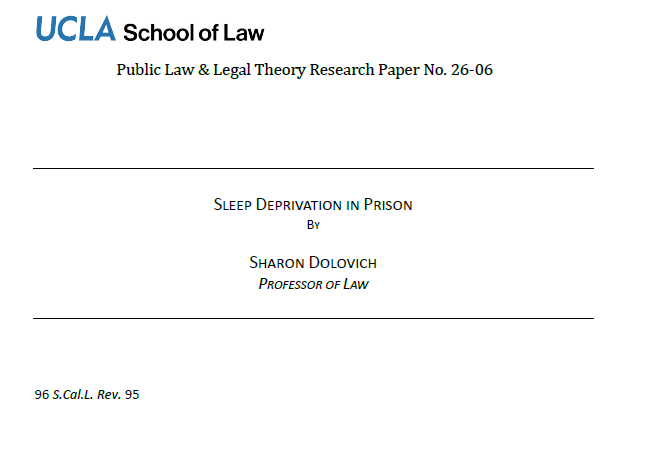
Sleep Deprivation in Prison

By Sharon Dolovich

This Article is the first scholarly work to identify and describe the experience of sleep deprivation in prison—an experience that, although an inherent feature of prison life, has gone almost entirely unnoticed even by those legal scholars, advocates, and policymakers committed to ensuring humane carceral conditions. Drawing on original data from interviews with people who served time in prisons all over the country, it maps the multiple overlapping conditions that routinely prevent the incarcerated from getting anything close to adequate sleep. Sleep is a basic human need, as fundamental to human survival and adequate human functioning as access to food, water, and shelter. Yet this Article’s findings are unambiguous: chronic sleep deprivation is an intrinsic part of prison life, as constitutive of the carceral penalty as are crowded conditions, grossly inadequate medical care, inedible food, and the ongoing risk of physical and sexual assault. After providing a brief overview of the sleep science, the findings of which make plain the physical and psychological damage caused by insufficient sleep, the Article provides a rich sociological account of the experience of trying to sleep in prison. Drawing on the accounts of interview subjects, it identifies ten distinct causes of sleep deprivation inside: five concrete conditions (fiercely uncomfortable beds, hunger, extremes of heat and cold, noise, and excessive light) and five “meta-conditions” (fear of violence, trauma, poverty, overly intrusive rules enforcement, and daily humiliation). This Article then considers some of the normative implications of the phenomenon explored here, including what the reality of sleep deprivation in prison means for our understanding of prisons and of carceral punishment, the prospects for Eighth Amendment conditions claims grounded in sleep deprivation, and the policy challenges likely to confront efforts to address this problem.

 96 S.Cal.L. Rev. 95, UCLA School of Law, Public Law Research Paper No. 26-06
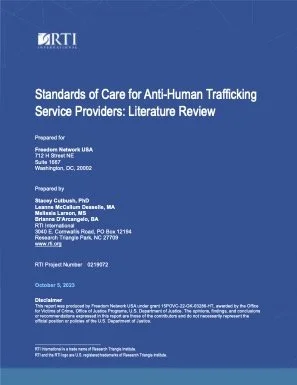
Standards of Care for Anti-Human Trafficking Service Providers: Literature Review

By Stacey Cutbush, Leanne McCallum Desselle, Melissia Larson, Brianna D’Arcangelo

The past decade has seen a rapid increase in efforts to combat human trafficking. This rush has led to disparate approaches when developing programs and providing service, creating a fragmented landscape in which service providers have varying levels of preparedness and capacity. Subsequently, the services rendered to survivors of human trafficking are varied and uneven. To remedy this, there is a pressing need for a landscape analysis of existing standards in the field to inform the creation and adoption of unified standards of care (SOCs), ensuring a cohesive, consistent, and robust service response to survivors of human trafficking.

In recent years, there has been a growing demand from practitioners, evaluators, and researchers for unified SOCs in the anti-trafficking field. These stakeholders have expressed a need to establish principles, guidelines, or frameworks for service delivery to support their efforts. Establishing a cohesive, consistent, and robust framework that can be utilized across the field will benefit anti-trafficking efforts. Building on this momentum, the Office for Victims of Crime (OVC) and the Office of Trafficking in Persons (OTIP) have issued a call to action to develop unified SOCs for human trafficking service providers. As part of this multi-phase initiative, Freedom Network USA received a competitive award to the lead the development of SOCs and will convene an SOCs Technical Working Group (SOC TWG) to identify, adopt, adapt, and/or develop SOCs for human trafficking service providers.

RTI’s purpose in this project is to conduct a literature review by reviewing and synthesizing all existing literature related to human trafficking SOCs. This literature review will provide the SOC TWG with a foundational understanding of the current state of the field. Additionally, the insights derived from the literature review will guide the process and criteria for the TWG’S identification, adoption, adaptation, and/or development of SOCs in response to OVC-OTIP’s call to action. 

Research Triangle Park, NC: RTI, 2023. 20p.