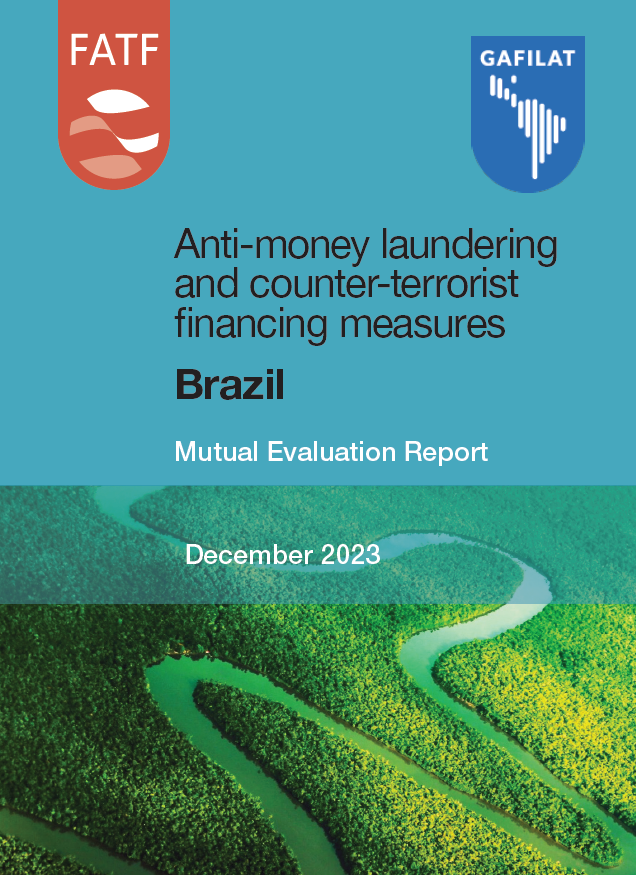
By FATF/OECD - GAFILAT
This report summarises the AML/CFT measures in place in Brazil as at the date of the on-site visit, 13-31 March 2023. It analyses the level of compliance with the FATF 40 Recommendations and the level of effectiveness of Brazil’s AML/CFT system, and provides recommendations on how the system could be strengthened. Key Findings a) Brazil has a strong domestic coordination mechanism to address risks from money laundering, ENCCLA. Brazil has built a legal and structural framework largely enabling competent authorities to prevent and combat ML. More recently, Brazil has also improved its framework to fight terrorist financing (TF) by passing legislation criminalising the offence and enabling implementation of targeted financial sanctions (TFS). Informed by the longstanding coordination within ENCCLA and a National Risk Assessment conducted in 2021, authorities have shared and robust understanding of national ML threats, namely, corruption, drug trafficking and organised crime, environmental crimes, and tax crimes. There is a precise understanding of the ML risks and vulnerabilities linked to most threats— including informal and illicit value transfers, misuse of cash, and front companies—however, there is a lack of depth in the understanding of financial flows linked to environmental crimes. b) Through ENCCLA, since 2003, Brazil has developed and refined policies to tackle many of its higher ML risks, particularly those stemming from corruption. Brazil has taken many steps to address other higher risk areas, however, these actions are taken without longer-term, comprehensive strategies, which results in occasional disjointed efforts and misalignment of objectives and priorities (such as ML from environmental crimes where interagency cooperation is growing but limited, and where some keyauthorities lack sufficient resources). At times, structural issues inhibit effective coordination in combatting ML/TF, including cooperation between police and prosecution offices and resources to handle the complex criminal justice system. In addition, the tax authority (RFB) has a central role in the AML/CFT system given that it controls access to many pieces of relevant information, but legal obstacles frustrate its full ability to assist other authorities in tackling ML/TF and its own AML/CFT activities are not adequately prioritised. c) Brazil has successfully prosecuted high-end cases of ML, including from corruption, reflecting the capacity to conduct financial investigations and the development of supportive institutional structures. Despite important successes, there is a mismatch between the investigative input and the results seen in terms of prosecutions and convictions. Structural issues have a major impact. Among other things, ML proceedings take too long due to appeals and when convictions are obtained, sometimes a decade or more after charges, and the sanctioning regime needs major improvements. Criminal assets are generally identified and temporarily seized, and in some major cases Brazil was able to recuperate large sums of criminal money; however, there was not sufficient evidence of final confiscation and asset recovery is mainly accomplished through agreements. While there is highlevel commitment to fighting ML/TF, the resources available to competent authorities are largely insufficient, particularly those of COAF and prosecutors. Lack of resources hinders the production of deeper financial intelligence to identify a larger number of complex ML schemes and frustrate efforts to trace criminal financial networks. d) Brazil is committed to fighting terrorism and terrorist financing and has an improving understanding of its TF risks including those stemming from farright extremism. While it has expertise to investigate TF activity, the legal framework in place and the corresponding view of the authorities hinder successful prosecutions. The authorities are not always well coordinated to identify, prosecute, or prevent TF. The framework to implement targeted financial sanctions without delay for TF and proliferation financing is in place, although it remains largely untested at the time of the onsite visit as no designations had been made by Brazil and no funds or assets were frozen. Sanctions implementation by the private sector is improving particularly in the financial sector, thanks to the supervisory activity of the Central Bank of Brazil (BCB), and more slowly in other sectors. There is a lack of interagency coordination on issues related to the financing of proliferation and guidance is needed for the private sector. NPOs are not yet subject to risk-based measures specifically to prevent TF. e) As a major regional and global economy, Brazil has a large and diverse universe of financial and non-financial sectors with increasing sophistication. BCB is the key supervisor for the most material financial institutions and its long-standing risk-based activities have contributed to significantly improve the ability of financial institutions to detect and prevent ML and TF, particularly the largest ones. With few exceptions, other supervisors have not been able yet to take sufficient measures to ensure sufficient implementation of the AML/CFT framework. At the time of the on-site visit, some activities remained unregulated, notably those of lawyers and virtual asset service providers, leaving serious vulnerabilities. f) The misuse of companies is a feature in many ML schemes and Brazil has been able to detect abusers in many cases by using the information available through REDESIM to map out the company structure. Brazil has also created a requirement for companies to provide beneficial ownership (BO) information to RFB, however, this database is largely unpopulated. Moreover, declaratory BO information is considered by law to be “tax secret,” which means that LEAs need to request a court order to obtain it and that COAF and other administrative authorities (including those involved in the fight against corruption) cannot access it for their analysis. g) Brazil generally cooperates well in ML/TF areas with its international partners. As many ML schemes include the sending of money abroad, LEAs and COAF are very proactive in seeking assistance to obtain information and restrain criminal assets. As a major financial centre, Brazil also receives requests for cooperation from abroad, and competent authorities provide high quality assistance, with soon-site visit, some activities remained unregulated, notably those of lawyers and virtual asset service providers, leaving serious vulnerabilities. f) The misuse of companies is a feature in many ML schemes and Brazil has been able to detect abusers in many cases by using the information available through REDESIM to map out the company structure. Brazil has also created a requirement for companies to provide beneficial ownership (BO) information to RFB, however, this database is largely unpopulated. Moreover, declaratory BO information is considered by law to be “tax secret,” which means that LEAs need to request a court order to obtain it and that COAF and other administrative authorities (including those involved in the fight against corruption) cannot access it for their analysis. g) Brazil generally cooperates well in ML/TF areas with its international partners. As many ML schemes include the sending of money abroad, LEAs and COAF are very proactive in seeking assistance to obtain information and restrain criminal assets. As a major financial centre, Brazil also receives requests for cooperation from abroad, and competent authorities provide high quality assistance, with so on-site visit, some activities remained unregulated, notably those of lawyers and virtual asset service providers, leaving serious vulnerabilities. f) The misuse of companies is a feature in many ML schemes and Brazil has been able to detect abusers in many cases by using the information available through REDESIM to map out the company structure. Brazil has also created a requirement for companies to provide beneficial ownership (BO) information to RFB, however, this database is largely unpopulated. Moreover, declaratory BO information is considered by law to be “tax secret,” which means that LEAs need to request a court order to obtain it and that COAF and other administrative authorities (including those involved in the fight against corruption) cannot access it for their analysis. g) Brazil generally cooperates well in ML/TF areas with its international partners. As many ML schemes include the sending of money abroad, LEAs and COAF are very proactive in seeking assistance to obtain information and restrain criminal assets. As a major financial centre, Brazil also receives requests for cooperation from abroad, and competent authorities provide high quality assistance, with some improvements needed in extradition and the speed of responses.
Paris, FATF, 2023. 354p.