Open Access Publisher and Free Library
HUMAN RIGHTS.jpeg

HUMAN RIGHTS

Human Rights-Migration-Trafficking-Slavery-History-Memoirs-Philosophy

Posts tagged Challenges
Washington, DC: Council on Criminal Justice., 2025. 7p.

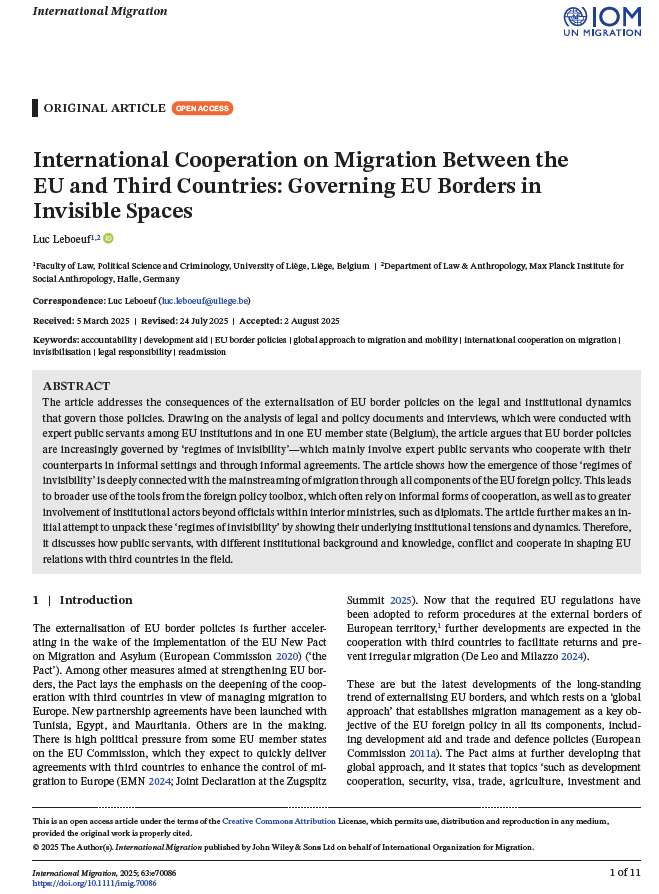
By Luc Leboeuf

The article addresses the consequences of the externalisation of EU border policies on the legal and institutional dynamics that govern those policies. Drawing on the analysis of legal and policy documents and interviews, which were conducted with expert public servants among EU institutions and in one EU member state (Belgium), the article argues that EU border policies are increasingly governed by ‘regimes of invisibility’—which mainly involve expert public servants who cooperate with their counterparts in informal settings and through informal agreements. The article shows how the emergence of those ‘regimes of invisibility’ is deeply connected with the mainstreaming of migration through all components of the EU foreign policy. This leads to broader use of the tools from the foreign policy toolbox, which often rely on informal forms of cooperation, as well as to greater involvement of institutional actors beyond officials within interior ministries, such as diplomats. The article further makes an initial attempt to unpack these ‘regimes of invisibility’ by showing their underlying institutional tensions and dynamics. Therefore, it discusses how public servants, with different institutional background and knowledge, conflict and cooperate in shaping EU relations with third countries in the field.


International Migration, Volume 63, Issue 5Sep 2025
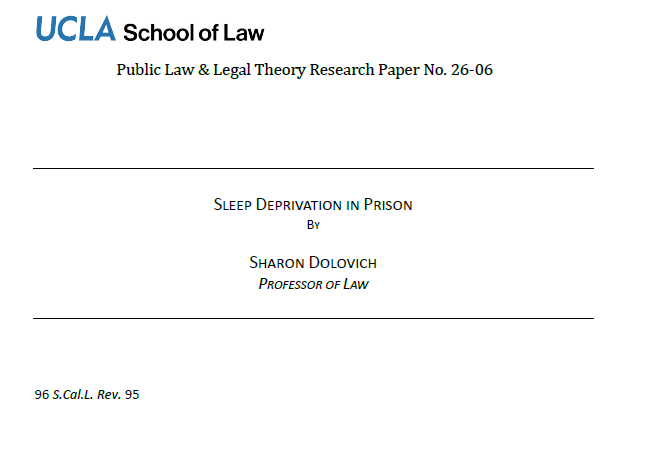
Sleep Deprivation in Prison

By Sharon Dolovich

This Article is the first scholarly work to identify and describe the experience of sleep deprivation in prison—an experience that, although an inherent feature of prison life, has gone almost entirely unnoticed even by those legal scholars, advocates, and policymakers committed to ensuring humane carceral conditions. Drawing on original data from interviews with people who served time in prisons all over the country, it maps the multiple overlapping conditions that routinely prevent the incarcerated from getting anything close to adequate sleep. Sleep is a basic human need, as fundamental to human survival and adequate human functioning as access to food, water, and shelter. Yet this Article’s findings are unambiguous: chronic sleep deprivation is an intrinsic part of prison life, as constitutive of the carceral penalty as are crowded conditions, grossly inadequate medical care, inedible food, and the ongoing risk of physical and sexual assault. After providing a brief overview of the sleep science, the findings of which make plain the physical and psychological damage caused by insufficient sleep, the Article provides a rich sociological account of the experience of trying to sleep in prison. Drawing on the accounts of interview subjects, it identifies ten distinct causes of sleep deprivation inside: five concrete conditions (fiercely uncomfortable beds, hunger, extremes of heat and cold, noise, and excessive light) and five “meta-conditions” (fear of violence, trauma, poverty, overly intrusive rules enforcement, and daily humiliation). This Article then considers some of the normative implications of the phenomenon explored here, including what the reality of sleep deprivation in prison means for our understanding of prisons and of carceral punishment, the prospects for Eighth Amendment conditions claims grounded in sleep deprivation, and the policy challenges likely to confront efforts to address this problem.

 96 S.Cal.L. Rev. 95, UCLA School of Law, Public Law Research Paper No. 26-06