
Open Access Publisher and Free Library
PUNISHMENT.jpeg

PUNISHMENT

PUNISHMENT-PRISON-HISTORY-CORPORAL-PUNISHMENT-PAROLE-ALTERNATIVES. MORE in the Toch Library Collection

Posts tagged higher education for incarcerated individuals
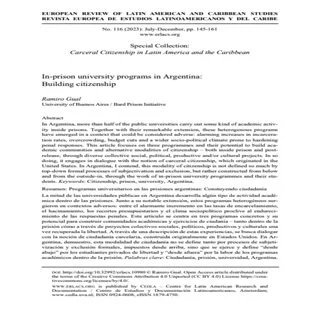
In-Prison University Programs in Argentina: Building Citizenship 

By Ramiro Gual 

In Argentina, more than half of the public universities carry out some kind of academic activity inside prisons. Together with their remarkable extension, these heterogenous programs have emerged in a context that could be considered adverse: alarming increases in incarceration rates, overcrowding, budget cuts and a wider socio-political climate prone to hardening penal responses. This article focuses on three programmes and their potential to build academic communities and alternative modalities of citizenship – both inside prison and postrelease, through diverse collective social, political, productive and/or cultural projects. In so doing, it engages in dialogue with the notion of carceral citizenship, which originated in the United States. In Argentina, I contend, this modality of citizenship is not defined so much by top-down formal processes of subjectivation and exclusion, but rather constructed from below and from the outside-in, through the work of in-prison university programmes and their students.

EUROPEAN REVIEW OF LATIN AMERICAN AND CARIBBEAN STUDIES, No. 116 (2023): July-December, pp. 145-161
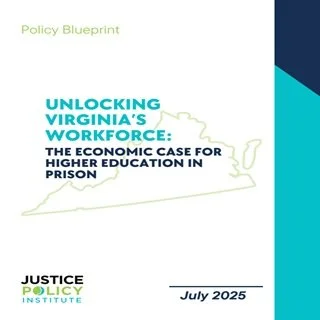
Unlocking Virginia’s Workforce: The Economic Case for Higher Education in Prison

By The Justice Policy Institute

As Virginia faces a critical labor shortage and rising incarceration costs, the state also sits on an untapped resource: thousands of incarcerated individuals eligible for federal Pell Grants who are eager to learn, work, and contribute to their communities. Unlocking Virginia’s Workforce makes the economic and moral case for expanding access to higher education in Virginia’s prisons and offers a comprehensive policy blueprint for reform.

This report outlines the high cost inaction, presenting data-driven arguments for how postsecondary education reduces recidivism, strengthens families, and helps meet the state’s urgent workforce needs. It highlights policy gaps and systemic barriers – from outdated technology infrastructure to racial, gender, and geographic inequities – and offers concrete recommendations for Virginia’s elected officials, education institutions, employers, and corrections leaders.

Drawing on lessons from across the country and the lived experience of incarcerated learners, Unlocking Virginia’s Workforce shows how aligning prison education with the state’s economic priorities can reduce public spending, grow the talent pipeline, and build a more inclusive Commonwealth.

Washington, DC: Justice Policy Institute, 2025. 59p.

POSTSECONDARY EDUCATION IN MICHIGAN PRISONS

By Emily Mooney, Jesse Kelley and Nila Bala

Approximately 39,000 individuals are held in Michigan prisons, and the overwhelming majority of these will return to society after their sentence is completed. For this reason, Michigan residents and policymakers must be concerned with their ability to be productive, contributing members of society upon their return. However, research suggests that a lack of education may increasingly limit the employment options of formerly incarcerated individuals and may promote their return to crime. Accordingly, the present brief provides a short history of postsecondary education within prisons and then explains why it is an important part of the solution to this problem, as well as a benefit to society as a whole.

R STREET SHORTS NO. 65 January 2019

Washington, DC: R Street, 2019. 3p.