Open Access Publisher and Free Library
PUNISHMENT.jpeg

PUNISHMENT

PUNISHMENT-PRISON-HISTORY-CORPORAL-PUNISHMENT-PAROLE-ALTERNATIVES. MORE in the Toch Library Collection

Posts tagged carceral citizenship
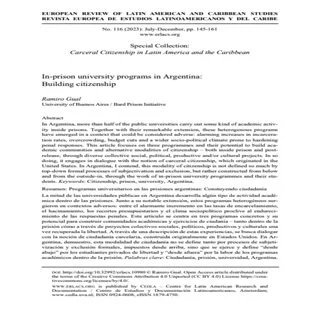
In-Prison University Programs in Argentina: Building Citizenship 

By Ramiro Gual 

In Argentina, more than half of the public universities carry out some kind of academic activity inside prisons. Together with their remarkable extension, these heterogenous programs have emerged in a context that could be considered adverse: alarming increases in incarceration rates, overcrowding, budget cuts and a wider socio-political climate prone to hardening penal responses. This article focuses on three programmes and their potential to build academic communities and alternative modalities of citizenship – both inside prison and postrelease, through diverse collective social, political, productive and/or cultural projects. In so doing, it engages in dialogue with the notion of carceral citizenship, which originated in the United States. In Argentina, I contend, this modality of citizenship is not defined so much by top-down formal processes of subjectivation and exclusion, but rather constructed from below and from the outside-in, through the work of in-prison university programmes and their students.

EUROPEAN REVIEW OF LATIN AMERICAN AND CARIBBEAN STUDIES, No. 116 (2023): July-December, pp. 145-161
download
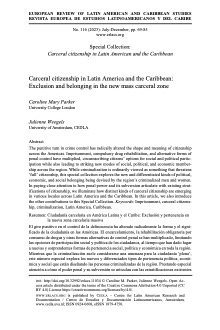
Carceral citizenship in Latin America and the Caribbean: Exclusion and Belonging in the New Mass Carceral Zone

By Caroline Mary Parker and  Julienne Weegels 

 The punitive turn in crime control has radically altered the shape and meaning of citizenship across the Americas. Imprisonment, compulsory drug rehabilitation, and alternative forms of penal control have multiplied, circumscribing citizens’ options for social and political participation while also leading to striking new modes of social, political, and economic membership across the region. While criminalization is ordinarily viewed as something that threatens ‘full’ citizenship, this special collection explores the new and differentiated kinds of political, economic, and social belonging being devised by the region’s criminalized men and women. In paying close attention to how penal power and its subversion articulate with existing stratifications of citizenship, we illuminate how distinct kinds of carceral citizenship are emerging in various locales across Latin America and the Caribbean. In this article, we also introduce the other contributions to this Special Collection. Keywords: Imprisonment, carceral citizenship, criminalization, Latin America, Caribbean.

EUROPEAN REVIEW OF LATIN AMERICAN AND CARIBBEAN STUDIES REVISTA EUROPEA DE ESTUDIOS LATINOAMERICANOS Y DEL CARIBE No. 116 (2023): July-December, pp. 69-85 

download
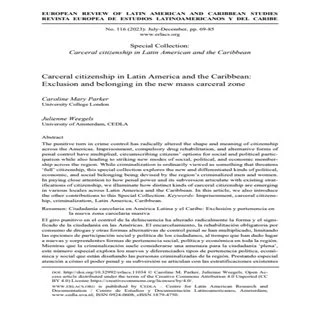
Carceral citizenship in Latin America and the Caribbean: Exclusion and belonging in the new mass carceral zone

By Caroline Mary Parker and Julienne Weegels

The punitive turn in crime control has radically altered the shape and meaning of citizenship across the Americas. Imprisonment, compulsory drug rehabilitation, and alternative forms of penal control have multiplied, circumscribing citizens’ options for social and political participation while also leading to striking new modes of social, political, and economic membership across the region. While criminalization is ordinarily viewed as something that threatens ‘full’ citizenship, this special collection explores the new and differentiated kinds of political, economic, and social belonging being devised by the region’s criminalized men and women. In paying close attention to how penal power and its subversion articulate with existing stratifications of citizenship, we illuminate how distinct kinds of carceral citizenship are emerging in various locales across Latin America and the Caribbean. In this article, we also introduce the other contributions to this Special Collection.

EUROPEAN REVIEW OF LATIN AMERICAN AND CARIBBEAN STUDIES REVISTA EUROPEA DE ESTUDIOS LATINOAMERICANOS Y DEL CARIBE DOI:CEDLA - ISSN 0924-0608, eISSN 1879-4750. No. 116 (2023): July-December, pp. 69-85

download