Open Access Publisher and Free Library
PUNISHMENT.jpeg

PUNISHMENT

PUNISHMENT-PRISON-HISTORY-CORPORAL-PUNISHMENT-PAROLE-ALTERNATIVES. MORE in the Toch Library Collection

Posts tagged substance use
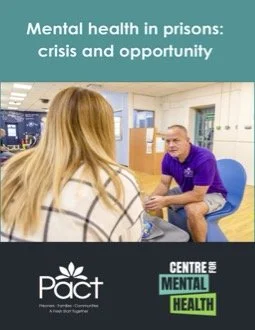
Mental Health in Prisons: Crisis and Opportunity

By The Centre for Mental Health and the Prison Advice and Care Trust (Pact)

Summary Nine out of ten people in prison have at least one mental health, neurodevelopmental or substance use problem, and rates of severe mental illness are ten times those in the general population Rates of self-harm in prisons are high and rising, with the highest rates in women’s prisons. Prison mental health services currently support one person in seven in the prison population. They provide vital care and support but are often overstretched because of high levels of need and complexity. Involving family members in providing mental health support in prisons can be beneficial but is often limited. Transfers from prison to hospital for urgent treatment are still too often delayed, sometimes by weeks and months. Community sentences with mental health treatment can divert some people from custody. This reduces pressure on prisons and enhances their chances of successful rehabilitation. We urge the Government to invest in community-based options, in line with the Sentencing Review and the NHS 10-year plan for healthcare in England, as an alternative to prison expansion.

London: Centre for Mental Health, 2025. 14p.

download
“You can’t incarcerate yourself out of the drug problem in America:” A qualitative examination of Colorado’s 2022 Fentanyl criminalization law

By Katherine LeMasters, Samantha Nall, Cole Jurecka, Betsy Craft, Paul Christine, Ingrid Binswanger & Joshua Barocas

In response to the U.S. overdose crisis, many states have increased criminal penalties for drug possession, particularly fentanyl. This study sought to qualitatively explore diverse community perspectives on increasing criminal legal penalties in Colorado for fentanyl possession (House Bill 22-1326) and the broader role of the criminal legal system in addressing substance use and overdose prevention. We conducted 31 semi-structured interviews in 2023 with community leaders directly working with people who use drugs, individuals with lived experience with drug use and the criminal legal system, and law enforcement throughout Colorado. Interviewees were asked about the perceived impact of House Bill 22-1326 on their communities and agencies. After interviews were complete, we created templated summaries and matrix analyses to conduct rapid qualitative analysis, an action-oriented approach to qualitative data analysis.

Results

Respondents included peer support specialists (n = 7), policymakers (n = 6), community behavioral health/harm reduction providers (n = 6), criminal legal program staff (n = 8), and law enforcement (n = 4), with nine participants from rural counties. Analysis revealed that participants found increasing criminal penalties for fentanyl possession to be misguided: “And the felony [of HB-1326] is such a good example of a policy being led by feelings rather than evidence.” This was in the context of participants’ divergent views on police as conduits to treatment and punishment and perceiving jail as an (in)appropriate response for substance use disorder treatment.

Conclusions

All participants supported policy efforts to prevent fatal fentanyl overdoses, yet, most thought that increased use of police and incarceration as avenues to prevent overdose was misguided. This study highlights a diverse array of community perspectives that can inform policy decisions concerning criminal penalties for fentanyl possession and distribution and can inform policies that affect people who use drugs broadly.

Health & Justice volume 13, Article number: 26 (2025)

download