
Open Access Free Library
SOCIAL SCIENCES.jpeg

SOCIAL SCIENCES

Social sciences examine human behavior, social structures, and interactions in various settings. Fields such as sociology, psychology, anthropology, and economics study social relationships, cultural norms, and institutions. By using different research methods, social scientists seek to understand community dynamics, the effects of policies, and factors driving social change. This field is important for tackling current issues, guiding public discussions, and developing strategies for social progress and innovation.

Posts in Racism
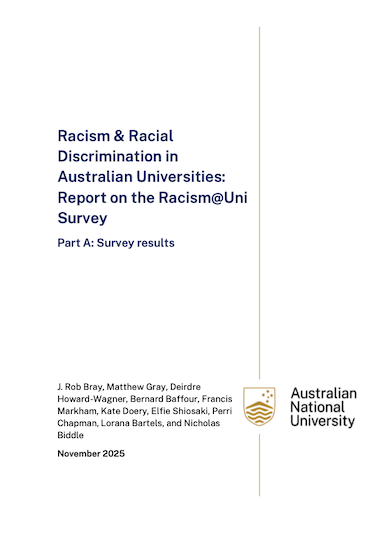
Racism & racial discrimination in Australian universities: report on the Racism@Uni survey  Part A

By J. Rob Bray, Matthew Gray, Deirdre Howard-Wagner Bernard Baffour, Francis Markham, Kate Doery, Elfie Shiosaki, Perri Chapman, Lorana Bartels, Nicholas Biddle

A presentation of the Racism@Uni survey, conducted in August and September 2025, as part of a broader study into racism at Australian universities being undertaken by the Australian Human Rights Commission. The survey asked whether people had experienced racism in the past two years, and if so where. It asked about student and staff experiences of, and perceptions about, their university, their knowledge of policies to address racism, and whether they took precautionary actions to guard against racism. 42 out of the 43 Australian universities participated in the survey. From the 1.65 million invitations sent to Australian university staff and students 76,131 responses were obtained. There are key areas of the study environment at universities which need to be addressed, including the management of small group learning environments, and placements and internships. While some university policies are seen as effective, others, such as the management of complaints, were not, and some policies were seen as being performative, rather than substantive. This is Part A of a two-part report. Part B is Thematic analysis of qualitative responses to question F12.

Key findings

The high levels of interpersonal racism reported at universities reflect wider racism across the Australian community, rather than simply being specific to universities. Some dimensions of reported racism reflect wider conflicts, including in this survey, conflict in the Middle East. A recurrent element of the experience of racism for many staff and students were constraints on being able to speak freely. Aboriginal and Torres Strait Islander staff and students reported high levels of racism and expressed mixed views about university policies and practices. Racism at university impacts negatively on students’ study, staff careers, and on staff and student mental health. It is also deleterious to people’s participation at university and their sense of belonging.
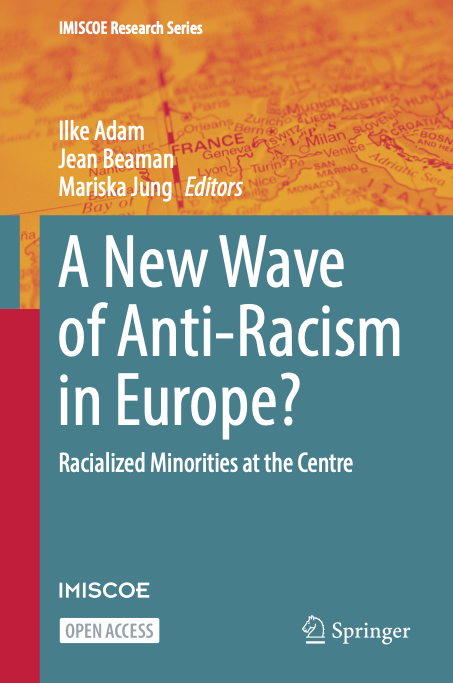
A New Wave of Anti-Racism in Europe?

By: Ilke Adam, Jean Beaman, Mariska Jung
This open access book provides a way to understand the current manifestations of anti-racism in Europe, including changes that became particularly visible with the Black Lives Matter related protests beginning in May 2020. The so-called ‘new' anti-racism is often described as being led by racialized minorities themselves, foregrounding structural racism, and drawing connections between contemporary racism and the colonial past. But are these features truly new? And can we speak of a new 'wave' of anti-racism, and what does wave-thinking clarify or obscure? The chapters in this volume explore anti-racist struggles and practices across a range of European contexts, tracing both change and continuity over time. They illuminate how several features of antiracism, now considered distinctive -  including the leadership by racialized minorities, have deep roots, though they were pushed to the margins, unrecorded or silenced by the mainstream. Today, these voices are beginning to rise, echoing -sometimes modestly - in the centre.  By providing a solid empirical portrait of current and past anti-racist movements in different parts of Europe, this book is a vital resource for students and scholars of race, anti-racism and migration in Europe, as well as for activists and policy-makers navigating the evolving terrain of anti-racist thought and action.