Open Access Free Library
SOCIAL SCIENCES.jpeg

SOCIAL SCIENCES

Social sciences examine human behavior, social structures, and interactions in various settings. Fields such as sociology, psychology, anthropology, and economics study social relationships, cultural norms, and institutions. By using different research methods, social scientists seek to understand community dynamics, the effects of policies, and factors driving social change. This field is important for tackling current issues, guiding public discussions, and developing strategies for social progress and innovation.

Posts in Europe
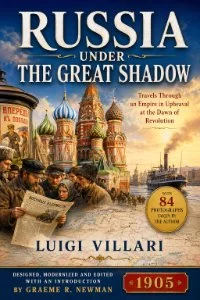
Russia Under the Great Shadow

by Luigi Villari (Author), Graeme Newman (Introduction)

In 1905, a young Italian journalist and future diplomat set out across the Russian Empire in the immediate aftermath of a war that had just humiliated a great power and cracked open a century of imperial certainty. What he found — and photographed — became this book.

Luigi Villari traveled from the drawing rooms of St. Petersburg to the bazaars of Moscow, from the great fair at Nizhny Novgorod to the ironworks of the Donets basin, from monasteries outside Kiev to the tenements of factory towns, capturing a country lurching between old-world autocracy and the raw pressures of industrial change. He wrote about labor unrest and railway barons, about corrupt charity and courageous doctors, about the peasant's world and the aristocrat's, without ever losing the outsider's eye for telling detail. His account of Russian public opinion after the war — written before anyone could know how the story would end — reads today as a snapshot of a future still genuinely undecided.

This Read-Me.Org edition brings Villari's 1905 classic back into print for modern readers: fully re-edited and corrected, with US spelling and punctuation modernized throughout, Russian place and personal names standardized to current usage, and all 84 of Villari's original photographs restored in their original positions. A new introduction by Graeme R. Newman situates the book within the Russo-Japanese War, the 1905 Revolution, and the wave of foreign travel writing that tried to make sense of an empire already sliding toward collapse.

For readers of Russian history, travel literature, and the long run-up to 1917 — a firsthand report from a country that didn't yet know what was coming.

Read-Me.Org Inc. New York-Philadelphia-Australia. 2026. p.
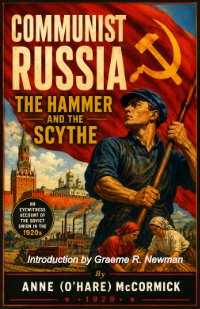
Communist Russia: Hammer and Scythe

Communist Russia: The Hammer and the Scythe is Anne O'Hare McCormick's vivid firsthand account of the Soviet Union a decade after the Russian Revolution. Based on a series of articles originally written for The New York Times, the book chronicles her travels through Moscow, Leningrad, the countryside, factories, collective farms, and government institutions as she sought to understand the world's first communist state. McCormick emphasizes that her work is not a theoretical study or political manifesto but an eyewitness exploration of a nation undergoing immense and often bewildering transformation.

Published in 1929, the book examines the emergence of the Soviet ruling class, the lives of workers and peasants, the role of women, religion, art, education, and the growing influence of Communist ideology. Rather than offering simple praise or condemnation, McCormick presents Soviet Russia as a vast social experiment whose ultimate outcome remained uncertain. Her perceptive observations, balanced prose, and willingness to question both Soviet claims and Western assumptions make Communist Russia: The Hammer and the Scythe an important contemporary record of one of the twentieth century's most significant political revolutions.

Read-Me.Org Inc. New York-Philadelphia-Australia. 2026. 233p.

A New Wave of Anti-Racism in Europe?

By: Ilke Adam, Jean Beaman, Mariska Jung
This open access book provides a way to understand the current manifestations of anti-racism in Europe, including changes that became particularly visible with the Black Lives Matter related protests beginning in May 2020. The so-called ‘new' anti-racism is often described as being led by racialized minorities themselves, foregrounding structural racism, and drawing connections between contemporary racism and the colonial past. But are these features truly new? And can we speak of a new 'wave' of anti-racism, and what does wave-thinking clarify or obscure? The chapters in this volume explore anti-racist struggles and practices across a range of European contexts, tracing both change and continuity over time. They illuminate how several features of antiracism, now considered distinctive -  including the leadership by racialized minorities, have deep roots, though they were pushed to the margins, unrecorded or silenced by the mainstream. Today, these voices are beginning to rise, echoing -sometimes modestly - in the centre.  By providing a solid empirical portrait of current and past anti-racist movements in different parts of Europe, this book is a vital resource for students and scholars of race, anti-racism and migration in Europe, as well as for activists and policy-makers navigating the evolving terrain of anti-racist thought and action.