Open Access Publisher and Free Library
SOCIAL SCIENCES.jpeg

SOCIAL SCIENCES

Social sciences examine human behavior, social structures, and interactions in various settings. Fields such as sociology, psychology, anthropology, and economics study social relationships, cultural norms, and institutions. By using different research methods, social scientists seek to understand community dynamics, the effects of policies, and factors driving social change. This field is important for tackling current issues, guiding public discussions, and developing strategies for social progress and innovation.

Antisemitism on Twitter Before and After Elon Musk's Acquisition

By Carl Miller, David Weir, Shaun Ring, Oliver Marsh, Chris Inskip, Nestor Prieto Chavana

New research from CASM Technology and ISD has found a major and sustained spike in antisemitic posts on Twitter since the company’s takeover by Elon Musk on October 27, 2022.

Powered by the award-winning digital analysis technology Beam – and based on a powerful hate speech detection methodology combining over twenty leading machine-learning models – researchers found that the volume of English-language antisemitic Tweets more than doubled in the period following Musk’s takeover.

In total, analysts detected 325,739 English-language antisemitic Tweets in the 9 months from June 2022 to February 2023, with the weekly average number of antisemitic Tweets increasing by 106% (from 6,204 to 12,762), when comparing the period before and after Musk’s acquisition.

Amman | Berlin | London | Paris | Washington DC: Institute for Strategic Dialogue, 2023. 32p.

read/ download
Hate in Plain Sight: Abuse Targeting Women Ahead of the 2022 Midterm Elections on TikTok and Instagram

By Cécile Simmons and Zoé Fourel

Online abuse has a profound impact on the health of democratic societies, threatening progress on diversity and representation in politics. Research has shown that abuse can deter women and individuals from minority groups from pursuing careers in politics, and drive those already engaged to step down from political life. The 2022 midterm elections in the US saw a growing number of candidates from minority backgrounds running for office. Faced with growing public pressure, social media companies took steps to amend their policies and community standards to address illegal and harmful content and behavior on their platforms. Evidence has shown, however, that abusive image and video-based content can fall through the cracks of content moderation, pointing to a lack of adequate response from social media platforms. In the run-up to the November 2022 midterm elections, ISD investigated abusive content on Instagram and TikTok targeting prominent women in US politics. Researchers analyzed hashtag recommendations served to users on both platforms when searching for content related to several key women in US politics in the days before the election. This report finds that platforms recommend abusive hashtags when people search for the names of these female political figures, and also promote abusive content that violate their own terms of service, showing that harmful and abusive content targeting women running for, and in-, office remains in plain sight of the platforms.

Amman | Berlin | London | Paris | Washington DC: Institute for Strategic Dialogue, 2022. 36p.

read / download
Auditing Elon Musk’s Impact on Hate Speech and Bots

By Daniel Hickey, Matheus Schmitz, Daniel Fessler, Paul E. Smaldino, Goran Muric, Keith Burghardt

On October 27th, 2022, Elon Musk purchased Twitter, becoming its new CEO and firing many top executives in the process. Musk listed fewer restrictions on content moderation and removal of spam bots among his goals for the platform. Given findings of prior research on moderation and hate speech in online communities, the promise of less strict content moderation poses the concern that hate will rise on Twitter. We examine the levels of hate speech and prevalence of bots before and after Musk’s acquisition of the platform. We find that hate speech rose dramatically upon Musk purchasing Twitter and the prevalence of most types of bots increased, while the prevalence of astroturf bots decreased.

Pre-publication: 2023. 6p.

Read/ Download
State Hate - How Iran’s Press TV uses social media to promote anti-Jewish hatred

By The Center for Countering Digital Hate; Anti-Defamation League


  Press TV, a broadcasting brand founded by Iran’s state-controlled media corporation, is a platform used to promote the Iranian state’s hateful views of Jewish people, Holocaust denial, and LGBTQ+ and women’s rights to the rest of the world. Founded in 2007, the network’s self-professed aim was to break “the global media stranglehold of Western outlets”. Press TV uses social media to promote ‘Palestine Declassified’, a video series which focuses its hatred towards British Jews, but spreads hateful narratives and lies about Jewish people as a whole. We argue this constitutes a ‘foreign state hate operation’, that is, a foreign influence campaign by one state designed to sow division among audiences abroad, this time with an overt strategy that uses the enormous audiences and algorithmic biases towards contentious material on social media to maximize visibility. Palestine Declassified’s hosts, British ‘useful idiots’ who have previously faced allegations of antisemitism, perpetuate what the Anti-Defamation League has called the antisemitic myths of “power” and “antiZionism” to their followers. The project’s episodes, promoted through social media channels operated by Press TV, target Jewish people with antisemitic tropes and attack charities, schools, journalists, academics, and individuals by promoting the conspiracy that they are part of a coordinated “Zionist movement” – one of a number of phrases used indiscriminately with the aim to homogenize and flatten an otherwise ideologically nuanced and diverse set of people, groups, and communities. Half of the programme’s episodes promote antisemitic narratives – purporting antisemitic myths that “Zionists’’ control world events, “groom” young people in schools and universities, and the well-worn conspiracy that “Zionists” exercise a network of control in the world, specifically in the UK. Its comment section is rife with antisemitism, ranging from abuse to inciting violence against Jews. Banned by regulators from television networks, its .com domain seized by US authorities, and removed from YouTube, Press TV relies on the indifference of social media executives to the spread of hate on their platforms, to funnel traffic to its website. This research clearly demonstrates that social media platforms are providing the Iranian state with the infrastructure to spread its propaganda to millions globally. While platforms claim to have rules against antisemitism, time and time again Big Tech have proven that they will only enforce their rules when convenient. In 2021, CCDH found that major social media platforms failed to remove 84% of antisemitic content reported using platforms’ own tools – ranging from Holocaust denial to conspiracies fueled by anti-Jewish hatred. Thanks to social media platforms, Press TV’s vitriol has gained new ground in the West: the US, the UK, Canada, France and Australia make up 51% of Press TV’s total web traffic, according to data from Similarweb. Palestine Declassified has leveraged social media audiences to disseminate dangerous hate to up to 11.5 million followers, the majority on Twitter and Facebook. Social media companies allow it – and profit from its popularity.  

 New York: The Center for Countering Digital Hate; Anti-Defamation League, 2023. 49p. 

Read/ Download
Artificial Intelligence Index Report 2023

By Stanford University. Human-Centered Artificial Intelligence

From the document: "Welcome to the sixth edition of the AI [artificial intelligence] Index Report! This year, the report introduces more original data than any previous edition, including a new chapter on AI public opinion, a more thorough technical performance chapter, original analysis about large language and multimodal models, detailed trends in global AI legislation records, a study of the environmental impact of AI systems, and more. The AI Index Report tracks, collates, distills, and visualizes data related to artificial intelligence. Our mission is to provide unbiased, rigorously vetted, broadly sourced data in order for policymakers, researchers, executives, journalists, and the general public to develop a more thorough and nuanced understanding of the complex field of AI. The report aims to be the world's most credible and authoritative source for data and insights about AI."

Stanford University. 2023. 386p.

download
Antisemitism Worldwide Report for 2022

By Anti-Defamation League

From the document: "The Antisemitism Worldwide Report for 2022 informs of both increases and decreases, some more meaningful than others, in the number of antisemitic incidents in different countries. The United States, where the largest Jewish minority in the world lives, saw a particularly alarming rise in anti-Jewish violence and slander. These data are not encouraging. The record-levels of 2021 were attributed in part to the exceptional social tensions created by the Covid-19 epidemic and the political tensions created by the Guardian of the Walls operation in Gaza. The data for 2022 suggest that the motivations for present-day antisemitism are not transient as some may have hoped. Despite the investment of substantial legal, educational, and political efforts, thousands of antisemitic incidents took place across the globe in 2022, including hundreds of physical assaults. Everyone who cares about human dignity and justice must recognize the need to prevent this reality from becoming normalized."

Tel-Aviv. University. Kantor Center For The Study Of Contemporary European Jewry; 2023. 86p.

download
Catharsis in Healing, Ritual and Drama

By T.J. Scheff

From the preface: “About nine years ago, after a decade of research on mental hospitals, I became convinced by the flaws I saw in existing programs that any system of treatment would be incomplete if it were based entirely upon professional therapists. Such a system, I thought, would need to be augmented by the development of a large group of lay therapists. These therapists would be trained and supervised by professionals. I had in mind relatively brief, simple training and supervision. My thought was that lay therapists coulddeal with many of the most frequently occurring types of emotional crises. Under these conditions, mental health professionals could be used as specialists, particularly as trainers and supervisors, and as therapists only for complex, difficult, or intractable cases…”

Berkeley. University Of California Press . 1979. 246p. This book contains mark-up

read
Gill's Journey: The Tattooist of Auschwitz

By Heather Morris

London. Echo Publishing. 2019. 441p.

The novel tells the story of Gill, a young woman who is transported to Auschwitz along with her family. While in the camp, she meets Lale, who becomes her tattooist and develops a romantic relationship with her. The novel follows Gill and Lale's struggles to survive in the harsh conditions of the camp, as well as their efforts to maintain their humanity and hold on to hope in the face of unimaginable suffering.

Through the character of Gill, the novel explores the experiences of women in the concentration camp system, including their vulnerability to sexual violence and exploitation. It also highlights the role of resistance and solidarity among prisoners, as well as the courage and resilience of those who fought for survival and dignity in the face of extreme adversity.

read
Endeavour: The ship and the attitude that changed the world.

By Peter Moore.

Sydney. Penguin. 2018. 438p.

Moore provides a detailed account of the construction and design of the Endeavour, as well as the scientific instruments and equipment carried on board. He describes Cook's journey to Tahiti to observe the transit of Venus, and his subsequent exploration of the Pacific, including the discovery of New Zealand and the east coast of Australia.

The book also explores the social and cultural dimensions of Cook's voyage, including the encounters between European explorers and the indigenous peoples of the Pacific. Moore discusses the impact of Cook's voyage on European perceptions of the world and the development of scientific knowledge, including the study of botany, astronomy, and geography.

Throughout the book, Moore emphasizes the importance of the Endeavour as a symbol of the scientific and technological advances of the 18th century, and the spirit of curiosity and exploration that drove Cook and his crew. He also discusses the legacy of Cook's voyage and its impact on the history of the Pacific region.

read
Fall of the Ottomans: The great war in the Middle East

By Eugene Rogan

NY. Basic Books. 2015. 504p.

Rogan begins by describing the state of the Ottoman Empire on the eve of World War I, including its political, economic, and military weaknesses. He then examines the Ottoman Empire's decision to enter the war on the side of Germany, and the subsequent military campaigns in the Middle East, including the battles of Gallipoli, Kut, and Gaza.

The book also explores the political and social consequences of the war in the Middle East, including the emergence of nationalist movements and the rise of new states such as Turkey, Iraq, and Syria. Rogan discusses the impact of the war on religious and ethnic minorities in the region, including the Armenians, Assyrians, and Kurds, who suffered greatly during the conflict.

Throughout the book, Rogan emphasizes the complexity of the Middle Eastern theater of World War I, including the diverse range of actors involved and the multiple layers of conflict and rivalry. He also highlights the impact of the war on the wider geopolitical landscape of the region, including the role played by European powers such as Britain and France in shaping the post-war order.

read
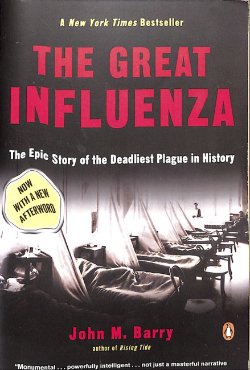
The Great Influenza: The epic story of the deadliest plague in history

By John M. Barry

London.. Penguin. 2005. 554p.

Barry provides a detailed account of the pandemic, including its origins, spread, and impact on various parts of the world. He explores the scientific and medical aspects of the pandemic, including the efforts of doctors and researchers to understand and control the disease.

The book also examines the social and political dimensions of the pandemic, including the ways in which it affected the course of World War I and the response of governments and public health officials to the crisis. Barry discusses the role of media coverage in shaping public perceptions of the pandemic and the response to it.

Throughout the book, Barry emphasizes the human toll of the pandemic, highlighting the stories of individual victims and their families. He also explores the long-term impact of the pandemic on society, including its influence on medical research, public health policy, and the development of the modern healthcare system.

read
On Pandemics: Deadly diseases from Bubonic Plague to Coronavirus

By Daic Walter-Toews

Carlton Aus. Schwartz Books. 2020. 270p

Waltner-Toews argues that pandemics are not just medical crises, but also social, economic, and political events that have profound effects on human societies. He examines the ways in which pandemics have shaped human history, from the Black Death in the 14th century to the Spanish Flu in the early 20th century.

The book also explores the scientific and medical aspects of pandemics, including the biology of the viruses and bacteria that cause them, as well as the challenges of developing effective treatments and vaccines. Waltner-Toews discusses the role of public health interventions, such as quarantine and social distancing measures, in controlling the spread of pandemics.

In addition, the book examines the social and cultural responses to pandemics, including the ways in which they have been represented in art, literature, and popular culture. Waltner-Toews also explores the political and economic dimensions of pandemics, including the impact of pandemics on trade, travel, and global politics.

Throughout the book, Waltner-Toews emphasizes the need for a One Health approach to pandemics, which recognizes the interconnectedness of human, animal, and environmental health. He argues that pandemics are a reminder of the importance of protecting and promoting the health of all living beings, and that we must work together to prevent and control future pandemics.

read
The Fatal Impact: An account of the invasion of the South Pacific 1767-1840

By Alan Moorehead

London. Penguin. 1966. 289p.

Moorehead argues that the arrival of Europeans had a catastrophic impact on the indigenous peoples of the South Pacific, leading to the destruction of traditional cultures, the loss of land and resources, and widespread disease and violence. He examines the motivations of the European explorers and colonizers, as well as the impact of their actions on the people and societies they encountered.

The book begins with the arrival of the British navigator Samuel Wallis in Tahiti in 1767, and follows the subsequent voyages of other explorers, including James Cook, Jean-Francois de La Perouse, and William Bligh. Moorehead describes how these explorers brought with them new technologies, ideas, and diseases, and how they often saw the indigenous peoples they encountered as primitive and inferior.

Moorehead also explores the impact of European colonization on the South Pacific, focusing on the experiences of the Maori people in New Zealand and the Aborigines in Australia. He describes how these peoples were forced to adapt to a new way of life, and how they often suffered from violence, disease, and displacement as a result of European settlement.

read
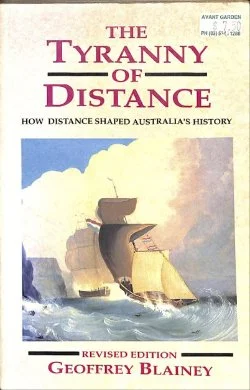
The Tyranny of Distance: How distance shaped Australian history.

By Geoffrey Blainey

Australia. Sun Books. 1966. 206p.

Blainey argues that the tyranny of distance has been a defining characteristic of Australian history, impacting everything from exploration and settlement to politics and economics. He notes that Australia is the most isolated continent on earth, and that its distance from other major world powers has both insulated it from external threats and limited its opportunities for growth and development.

The book traces the history of Australia from its earliest days as a British penal colony to its emergence as a modern, prosperous nation. Blainey examines the challenges that early settlers faced in adapting to a harsh and unfamiliar landscape, as well as the role that transportation and communication technologies played in bridging the vast distances between Australia and the rest of the world.

Blainey also explores how distance has shaped Australian identity and culture, arguing that it has fostered a sense of self-reliance and resilience in the face of adversity. He notes that Australians have often had to rely on their own ingenuity and resourcefulness to overcome the challenges posed by their isolation, and that this has helped to forge a distinct national character.

Overall, "The Tyranny of Distance" is a thought-provoking and insightful exploration of how geography has influenced the course of Australian history. It offers a unique perspective on the challenges and opportunities that come with living in a remote and isolated part of the world, and sheds light on the ways in which these factors have shaped Australian society and culture over time.

read
What happened on the Bounty

By Bengt Danielsson. Trans. Alan Topull

London. Allen and Unwin. 1962. 221p.

In April 1789, the Bounty left Tahiti to begin its journey back to England. However, just a few weeks into the voyage, the crew mutinied against Captain Bligh. The reasons for the mutiny are complex and have been the subject of much debate and speculation over the years. Some have suggested that it was due to Bligh's harsh treatment of the crew, while others have argued that it was a result of tensions between the officers and the lower-ranked crew members.

Regardless of the reasons, the mutiny was successful, and Bligh and a small group of loyal crew members were set adrift in a small boat while the mutineers, led by Fletcher Christian, took control of the ship. Bligh and his companions were eventually rescued after a harrowing journey across thousands of miles of open ocean.

Danielsson's book provides a first-hand account of the events leading up to the mutiny, as well as the aftermath. He describes the tensions between the crew members and the officers, and the growing discontent that eventually boiled over into mutiny. He also offers insights into the culture and customs of the Tahitian people, who were encountered by the crew during their stay on the island.

Overall, "On the Bounty" is a fascinating and engaging account of one of the most famous episodes in maritime history, written by someone who was there to witness it firsthand.

read
Reducing Racial Inequality in Crime and Justice: Science, Practice, and Policy

Edited by Muhammad, Khalil Gibran, Bruce Western, Yamrot Negussie, and Emily Backes, eds.

Reducing Racial Inequality in Crime and Justice: Science, Practice, and Policy synthesizes the evidence on community-based solutions, noncriminal policy interventions, and criminal justice reforms, charting a path toward the reduction of racial inequalities by minimizing harm in ways that also improve community safety. Reversing the effects of structural racism and severing the close connections between racial inequality, criminal harms such as violence, and criminal justice involvement will involve fostering local innovation and evaluation, and coordinating local initiatives with state and federal leadership. This report also highlights the challenge of creating an accurate, national picture of racial inequality in crime and justice: there is a lack of consistent, reliable data, as well as data transparency and accountability. While the available data points toward trends that Black, Latino, and Native American individuals are overrepresented in the criminal justice system and given more severe punishments compared to White individuals, opportunities for improving research should be explored to better inform decision-making.

Washington, DC: National Academies Press, 2022.

read
The Symbolic Species: The co-evolution of Language and the Brain.

By Terrence W. Deacon.

From Chapter 1: An Evolutionary Anomaly. “As our species designation--sapiens-suggests, the defining attribute of human beings is an unparalleled cognitive ability. We think differtently from all other creatures on earth, and we can share those thoughts with one another in ways that no other species even approaches. In comparison, the rest of our biology is almost incidental. Hundreds of millions of years of evolution have produced hundreds of thousands of species with brains, and tens of thousands with complex behavioral, perceptual, and learning abilities. Only one of these has ever wondered about its place in the world, because only one evolved the ability to do so….”

NY. W.W.Norton.1997. 5128p.

read
Read-Me.Org
Our Epidemic of Loneliness and Isolation

By United States. Public Health Service. Office Of The Surgeon General

From the document: "As this advisory has shown, fulfilling connections are a critical and often underappreciated contributor to individual and population health and longevity, safety, prosperity, and well-being. On the other hand, social disconnection contributes to many poor health outcomes, and even to premature death. Sadly, around 50% of adults in the U.S. reported being lonely in recent years -- and that was even before COVID-19 separated so many of us from our friends, loved ones, and support systems. Our bonds with others and our community are also part of this equation. Research has shown that more connected communities enjoy higher levels of well-being. The converse is also true. How do we put this important information to practical use in our society? What actionable steps can we take to enhance social connection so that we can all enjoy its benefits? A National Strategy to Advance Social Connection is the critical next step to catalyze action essential to our nation's health, safety, and prosperity. The strategy includes six foundational pillars and a series of key recommendations, organized according to stakeholder group, to support a whole-of-society approach to advancing social connection. Individuals and organizations can use this framework to propel the critical work of reversing these worrisome trends and strengthening social connection and community."

United States. Public Health Service. Office of the Surgeon General. 2023.

download
Race and Prosecution in Broward County, Florida

By R.R. Dunlea, Besiki Luka Kutateladze. Melba Pearson. Don Stemen and Lin Liu (Prosecutorial Performance Indicators)

This report measures the scope and magnitude of racial and ethnic disparities in prosecutorial outcomes in the Broward State Attorney’s Office, Florida, during 2021. The data suggest that, compared to Hispanic and White defendants, Black defendants are: • Least likely to have their case filed for prosecution, especially for felony charges; • Most likely to have their top charge reduced in severity at filing, as well as increased in severity; • Most likely to have their case dismissed, whether charged with a felony or a misdemeanor; • Least likely to have their felony charge reduced after filing; and • Most likely to receive custodial and time-served-only sentences upon conviction, as compared to non-custodial sentences. • Especially more likely to receive custodial sentences than White defendants in negotiated pleas, as compared to open pleas. Compared to similarly situated Black and White defendants, Hispanic defendants are: • Least likely to experience charge changes at filing; • Most likely to have their case pursued for prosecution; • Most likely to have their felony charges reduced at disposition; and • Least likely to receive jail and prison sentences upon conviction.

Miami: Florida International University, 2022. 27p.

download
Building the Table: Advancing Race Equity in the Criminal Legal System

By JustLeadership USA and the Association of Prosecuting Attorneys (APA)

JustLeadership USA and the Association of Prosecuting Attorneys (APA) released a new report, Building the Table: Advancing Race Equity in the Criminal Legal System, which provides a historic roadmap of strategies to advance race equity in the criminal legal system.

The report’s findings are the result of an unprecedented convening between representatives from all components of the justice system alongside community members, in particular those with lived experience, their families, and survivors of crime. This collaboration builds a foundation for policies that will successfully advance race equity, improve our approach to justice, and promote community safety and well-being.

“As people who are directly impacted and hurt by the criminal legal system, it is extremely important that our voices and leadership are a core part of any transformation that impacts our lives and those of our communities,” said DeAnna Hoskins, president and CEO of JustLeadershipUSA. “True authentic engagement is more than seeking our support at the end of systematic redesign, it occurs when the concepts of reimagining are led by those most affected, because our experience is our expertise. Our leadership as we ‘Build the Table’ is critical to advancing race equity and improving the system’s capacity to administer justice and promote community safety and well-being.”

This report and initiative were made possible through the support of the John D. and Catherine T. MacArthur Foundation and the efforts of those who volunteered their time and insights to produce this document.

“As we strive to advance racial and ethnic equity in the criminal justice system, it is critical that we elevate the leadership role of people with lived experience to ensure that their first-hand perspectives shape the creation of effective and meaningful solutions,” said Laurie Garduque, director of criminal justice at the MacArthur Foundation. “This report offers a framework for communities looking to advance community safety and wellbeing, and it starts with authentic community engagement and acknowledging the expertise of people with lived experience.”

This report is intended to equip federal, state and local legal system stakeholders to pursue new approaches to building stronger relationships with communities and the broader legal system. This consensus contains a unified statement of principles, policies and practical guidance to advance race equity in the criminal legal system, as well as recent real-world examples of policies and practices implemented by a variety of system stakeholders and community organizations throughout the country.

Washington, DC: Association of Prosecuting Attorneys, 2023. 27p.

download