
Open Access Free Library
CRIME+CRIMINOLOGY.jpeg

CRIME

Violent-Non-Violent-Cyber-Global-Organized-Environmental-Policing-Crime Prevention-Victimization

Posts in Health disparities
The destruction of healthcare in armed conflict: policy implications and accountability

Athena Madan

This Perspective examines how the destruction of healthcare systems in armed conflict produces enduring public health harm and broad human insecurity. Drawing on social medicine, sociological theory, governance scholarship, and field observations from Afghanistan, it argues that attacks on healthcare infrastructure and personnel result in not only the loss of clinical services but also in the erosion of social and moral worlds of care. The paper advances three interrelated claims: first, that healthcare institutions function both as clinical and social infrastructures; second, that their destruction generates disproportionate psychosocial, gendered, and intergenerational harms extending far beyond immediate morbidity and mortality; and third, that the persistence of such attacks reflects abject failures in international protection and accountability mechanisms. Particular attention is given to the consequences for women and children, including preventable death, disability, and psychosocial distress with constrained possibilities for recovery and social ways of belonging. These harms are compounded by weakened international accountability, which has increasingly normalised attacks on healthcare as a feature of war rather than a violation demanding intervention.

Keywords: war and health, structural violence, health systems in conflict, Responsibility to Protect, health and human security Citation: Madan A. The destruction of healthcare in armed conflict: policy implications and accountability. Academia Medicine and Health 2026;3. https://doi.org/10.20935/AcadMedHealth8372
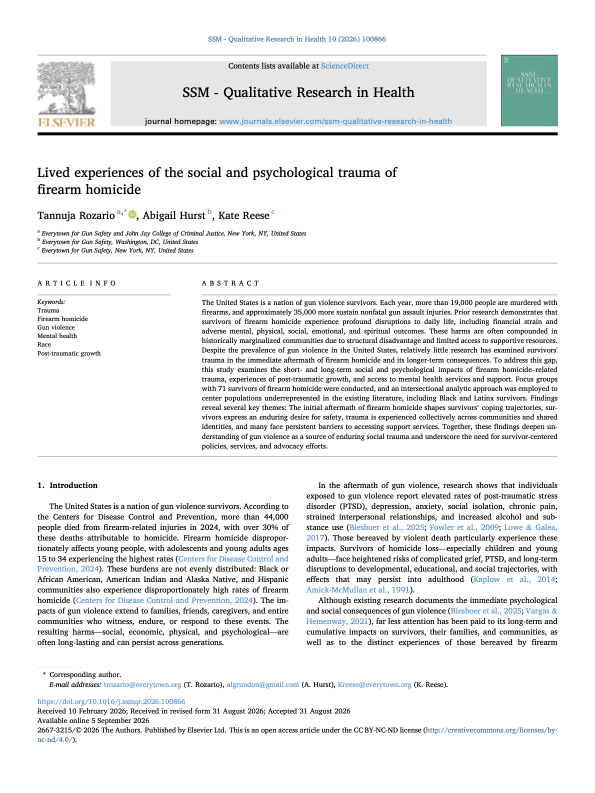
Lived experiences of the social and psychological trauma of firearm homicide

By Tannuja Rozario, Abigail Hurst and Kate Reese

The United States is a nation of gun violence survivors. Each year, more than 19,000 people are murdered with firearms, and approximately 35,000 more sustain nonfatal gun assault injuries. Prior research demonstrates that survivors of firearm homicide experience profound disruptions to daily life, including financial strain and adverse mental, physical, social, emotional, and spiritual outcomes. These harms are often compounded in historically marginalized communities due to structural disadvantage and limited access to supportive
resources. Despite the prevalence of gun violence in the United States, relatively little research has examined survivors' trauma in the immediate aftermath of firearm homicide and its longer-term consequences. To address this gap, this study examines the short- and long-term social and psycholog experiences of the social and psychological trauma of firearm homicideical impacts of firearm homicide–related trauma, experiences of post-traumatic growth, and access to mental health services and support. Focus groups with 71 survivors of firearm homicide were conducted, and an intersectional analytic approach was employed to center populations underrepresented in the existing literature, including Black and Latinx survivors.
Findings reveal several key themes: The initial aftermath of firearm homicide shapes survivors’ coping trajectories, survivors express an enduring desire for safety, trauma is experienced collectively across
communities and shared identities, and many face persistent barriers to accessing support services. Together, these findings deepen understanding of gun violence as a source of enduring social trauma
and underscore the need for survivor-centered policies, services, and advocacy efforts.