Open Access Publisher and Free Library
CRIME+CRIMINOLOGY.jpeg

CRIME

Violent-Non-Violent-Cyber-Global-Organized-Environmental-Policing-Crime Prevention-Victimization

Posts in Violence
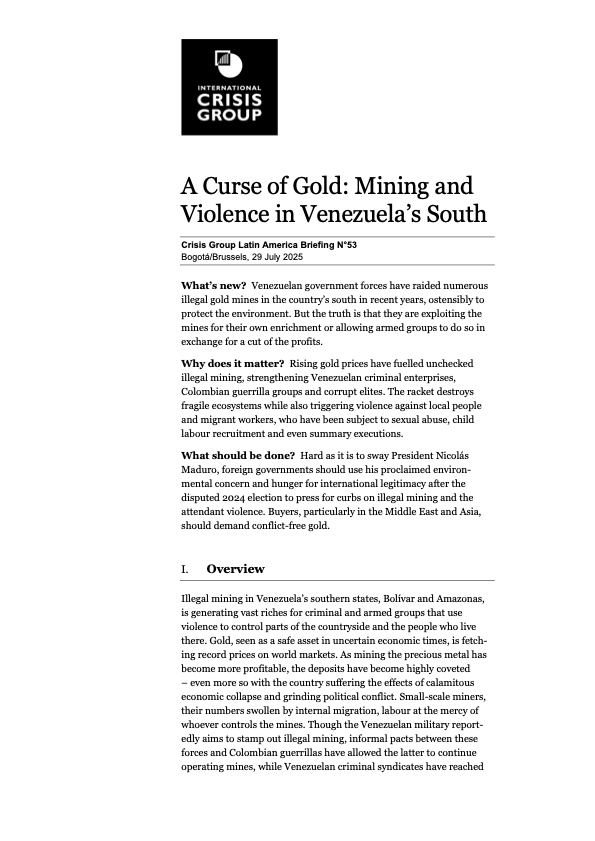
A Curse of Gold: Mining and Violence in Venezuela’s South

By The International Crisis Group

What’s new? Venezuelan government forces have raided numerous illegal gold mines in the country’s south in recent years, ostensibly to protect the environment. But the truth is that they are exploiting the mines for their own enrichment or allowing armed groups to do so in exchange for a cut of the profits.

Why does it matter? Rising gold prices have fuelled unchecked illegal mining, strengthening Venezuelan criminal enterprises, Colombian guerrilla groups and corrupt elites. The racket destroys fragile ecosystems while also triggering violence against local people and migrant workers, who have been subject to sexual abuse, child labour recruitment and even summary executions.

What should be done? Hard as it is to sway President Nicolás Maduro, foreign governments should use his proclaimed environmental concern and hunger for international legitimacy after the disputed 2024 election to press for curbs on illegal mining and the attendant violence. Buyers, particularly in the Middle East and Asia, should demand conflict-free gold.

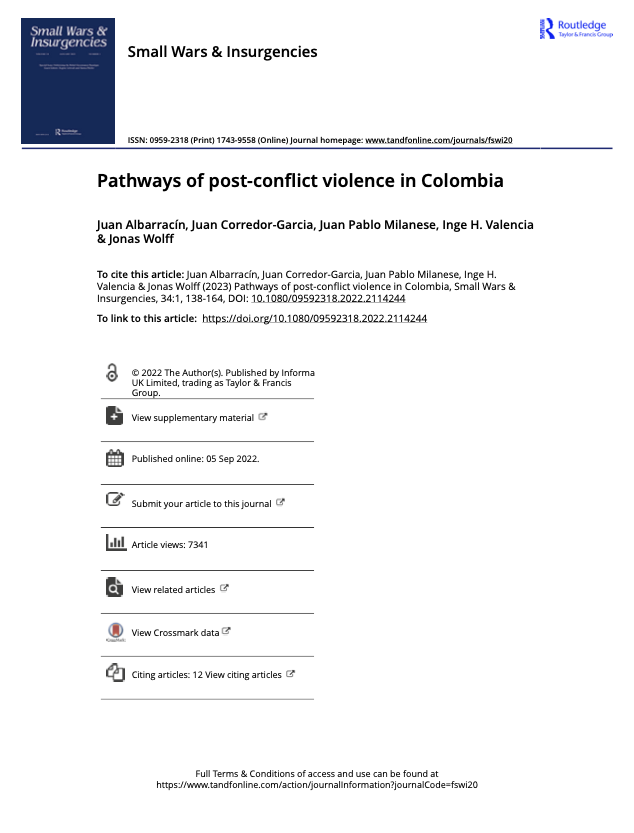
Pathways of post-conflict violence in Colombia

By Juan Albarracín, Juan Corredor-Garcia, Juan Pablo Milanese, Inge H. Valencia & Jonas Wolff

Violence in post-conflict settings is often attributed to a post-war boom in organized crime, facilitated by the demobilization of armed groups and the persisting weakness of the state. The article argues that this is only one pathway of post-conflict violence. A second causal pathway emerges from the challenges that peace processes can constitute for entrenched local political orders. By fostering political inclusion, the implementation of peace agreements may threaten subnational political elites that have used the context of armed conflict to ally with armed non-state actors. Violence is then used as a means to preserve such de facto authoritarian local orders. We start from the assumption that these two explanations are not exclusive or competing, but grasp different causal processes that may well both be at work behind the assassination of social leaders (líderes sociales) in Colombia since the 2016 peace agreement with the FARC guerrilla. We argue that this specific type of targeted violence can, in fact, be attributed to different, locally specific configurations that resemble the two pathways. The article combines fuzzy-set Qualitative Comparative Analysis with the case studies of the municipalities

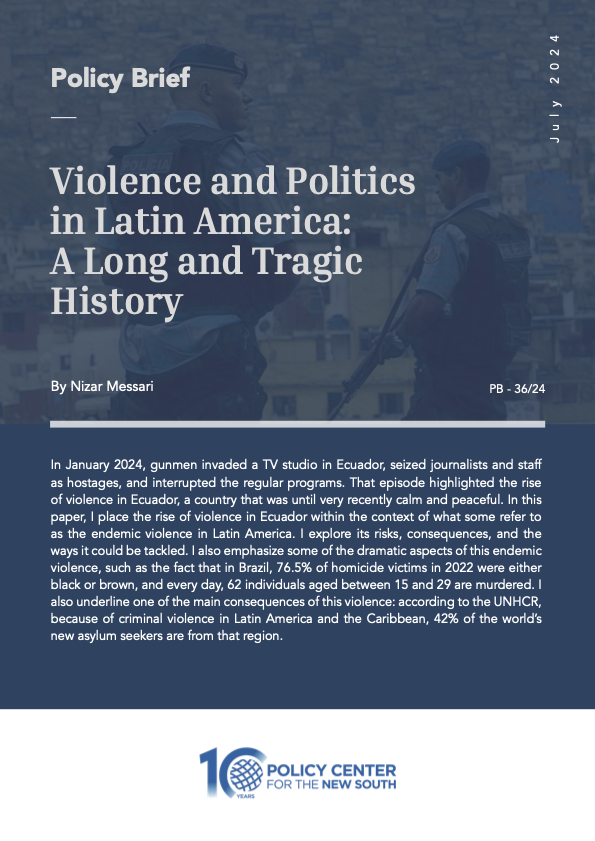
Violence and Politics in Latin America: A Long and Tragic History

By Nizar Messari  

 In January 2024, gunmen invaded a TV studio in Ecuador, seized journalists and staff as hostages, and interrupted the regular programs. That episode highlighted the rise of violence in Ecuador, a country that was until very recently calm and peaceful. In this paper, I place the rise of violence in Ecuador within the context of what some refer to as the endemic violence in Latin America. I explore its risks, consequences, and the ways it could be tackled. I also emphasize some of the dramatic aspects of this endemic violence, such as the fact that in Brazil, 76.5% of homicide victims in 2022 were either black or brown, and every day, 62 individuals aged between 15 and 29 are murdered. I also underline one of the main consequences of this violence: according to the UNHCR, because of criminal violence in Latin America and the Caribbean, 42% of the world’s new asylum seekers are from that region.

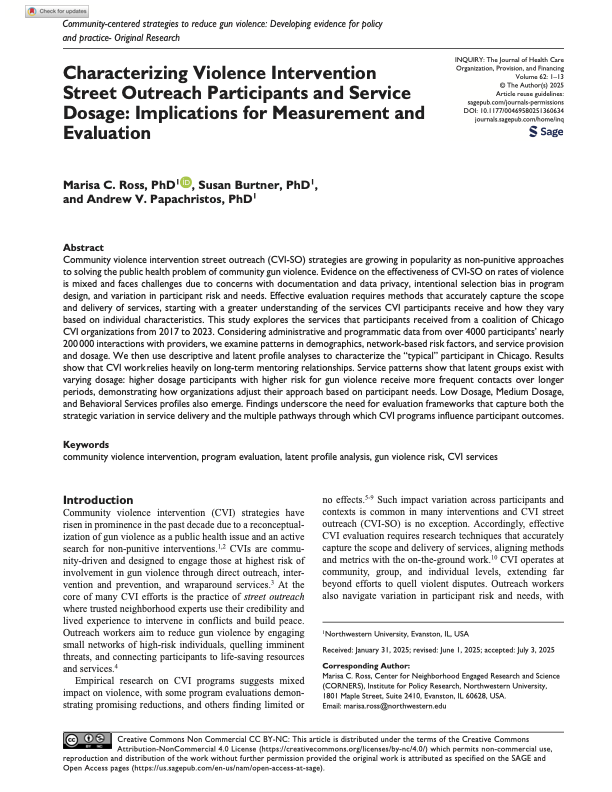
Characterizing Violence Intervention Street Outreach Participants and Service Dosage: Implications for Measurement and Evaluation

By Marisa Ross, Susan Burtner, and Andrew Papachristos

Introduction: Community violence intervention street outreach (CVI-SO) strategies are growing in popularity as non-punitive approaches to solving the public health problem of community gun violence. Evidence on the effectiveness of CVI-SO on rates of violence is mixed and faces challenges due to concerns with documentation and data privacy, intentional selection bias in program design, and variation in participant risk and needs. Effective evaluation requires methods that accurately capture the scope and delivery of services, starting with a greater understanding of the services CVI participants receive and how they vary based on individual characteristics.

Methods: This study explores the services that participants received from a coalition of Chicago CVI organizations from 2017–2023. Considering administrative and programmatic data from over 4,000 participants’ nearly 200,000 interactions with providers, the researchers examine patterns in demographics, network-based risk factors, and service provision and dosage. They then use descriptive and latent profile analyses to characterize the “typical” participant in Chicago.

Results: Results show that CVI work relies heavily on long-term mentoring relationships. Service patterns show that latent groups exist with varying dosage: higher dosage participants with higher risk for gun violence receive more frequent contacts over longer periods, demonstrating how organizations adjust their approach based on participant needs. Profiles that primarily receive behavioral or social supports-related services also emerge.

Conclusions: Findings underscore the need for evaluation frameworks that capture both the strategic variation in service delivery and the multiple pathways through which CVI programs influence participant outcomes.

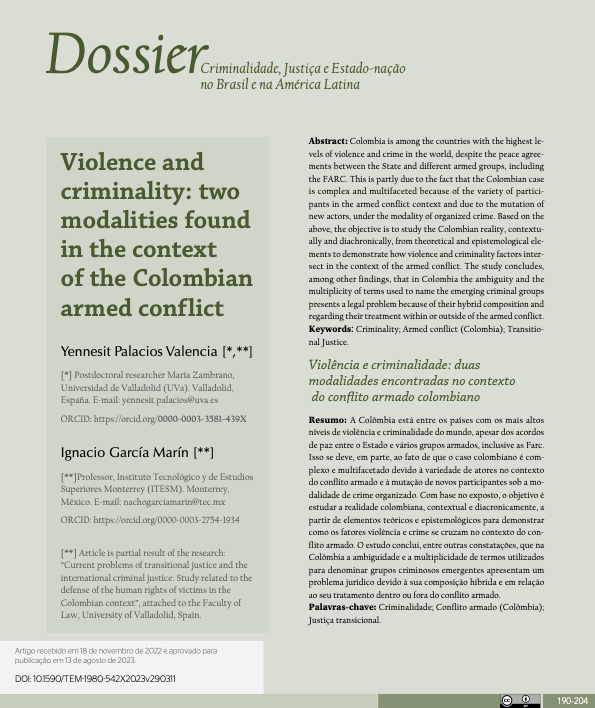
Violence and criminality: two modalities found in the context of the Colombian armed conflict 

By Yennesit Palacios Valencia and Ignacio García Marín

  Colombia is among the countries with the highest levels of violence and crime in the world, despite the peace agreements between the State and different armed groups, including the FARC. This is partly due to the fact that the Colombian case is complex and multifaceted because of the variety of participants in the armed conflict context and due to the mutation of new actors, under the modality of organized crime. Based on the above, the objective is to study the Colombian reality, contextually and diachronically, from theoretical and epistemological elements to demonstrate how violence and criminality factors intersect in the context of the armed conflict. The study concludes, among other findings, that in Colombia the ambiguity and the multiplicity of terms used to name the emerging criminal groups presents a legal problem because of their hybrid composition and regarding their treatment within or outside of the armed conflict

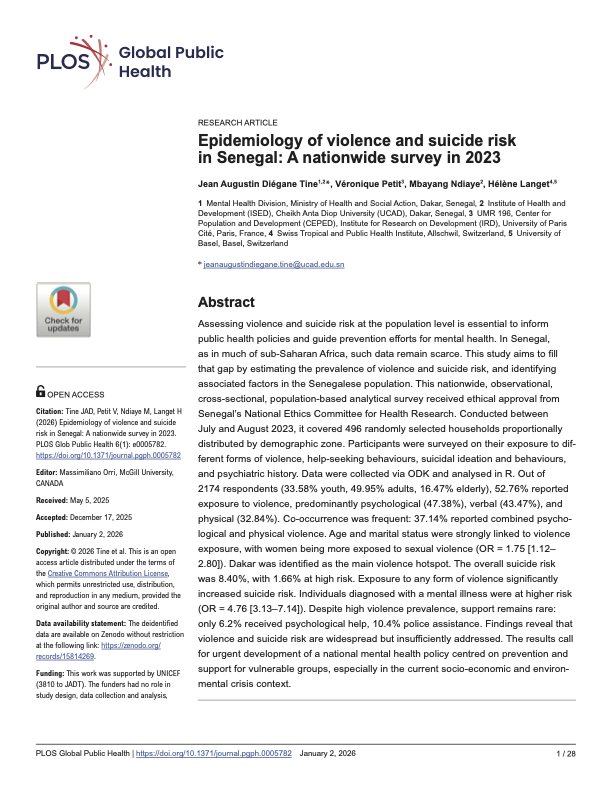
Epidemiology of violence and suicide risk in Senegal: A nationwide survey in 2023

By Jean Augustin Diégane Tine, Véronique Petit, Mbayang Ndiaye, Hélène Langet

Assessing violence and suicide risk at the population level is essential to inform public health policies and guide prevention efforts for mental health. In Senegal, as in much of sub-Saharan Africa, such data remain scarce. This study aims to fill that gap by estimating the prevalence of violence and suicide risk, and identifying associated factors in the Senegalese population. This nationwide, observational, cross-sectional, population-based analytical survey received ethical approval from Senegal’s National Ethics Committee for Health Research. Conducted between July and August 2023, it covered 496 randomly selected households proportionally distributed by demographic zone. Participants were surveyed on their exposure to different forms of violence, help-seeking behaviours, suicidal ideation and behaviours, and psychiatric history. Data were collected via ODK and analysed in R. Out of 2174 respondents (33.58% youth, 49.95% adults, 16.47% elderly), 52.76% reported exposure to violence, predominantly psychological (47.38%), verbal (43.47%), and physical (32.84%). Co-occurrence was frequent: 37.14% reported combined psychological and physical violence. Age and marital status were strongly linked to violence exposure, with women being more exposed to sexual violence (OR = 1.75 [1.12–2.80]). Dakar was identified as the main violence hotspot. The overall suicide risk was 8.40%, with 1.66% at high risk. Exposure to any form of violence significantly increased suicide risk. Individuals diagnosed with a mental illness were at higher risk (OR = 4.76 [3.13–7.14]). Despite high violence prevalence, support remains rare: only 6.2% received psychological help, 10.4% police assistance. Findings reveal that violence and suicide risk are widespread but insufficiently addressed. The results call for urgent development of a national mental health policy centred on prevention and support for vulnerable groups, especially in the current socio-economic and environmental crisis context.