Open Access Free Library
CRIME+CRIMINOLOGY.jpeg

CRIME

Violent-Non-Violent-Cyber-Global-Organized-Environmental-Policing-Crime Prevention-Victimization

Posts in Victims and Perpetrators
Big Brother Babysitter: The Carceral Logic of Family Surveillance Apps

By Elini Manis, et al.

In this report, S.T.O.P. details how family surveillance apps transfer surveillance used for probation and parole to familial contexts, enabling abusive parents and intimate partners. Courts have even opportunistically used Life360, one family surveillance app, to enforce probation. The report calls on regulators to reign in family surveillance apps based on federal and state wiretap laws, and demands developers prioritize user safety if they refuse to pull the apps entirely.

Key Findings Include:

  • Family surveillance apps like Life360 repurpose the surveillance typically used to enforce probation and parole. In fact, some courts use Life360 in lieu of apps branded as probation or parole tools.

  • Family surveillance apps frequently function as stalkerware, enabling abusers to track their targets anywhere they go. These apps can enable abusive parents, intimate partner violence, and other crimes.

  • Most family surveillance apps track more data than needed to serve their core functions, compounding safety risks for tracked individuals.

  • Short of pulling family surveillance apps entirely, developers should implement anti-abusability measures recommended by advocates for survivors of domestic abuse.

The perfect storm. An analysis of the processes that increase lethal violence in Mexico after 2006 

By Iván Flores Martínez & Matthew Phillips 

Research on ‘the War on Drugs’ in Mexico finds that military interventions increase lethal violence in the country. However, these studies fail to account for other processes that may be driving the behavior of lethal violence in the Mexican municipalities. We find confirmation that these rival processes influence the relative impact that military interventions have on lethal violence. In particular, we find that seasonality in violence, competition for scarce resources and PAN’s governance in the municipalities are associated with higher levels of lethal violence, as measured by the young male homicide rate. We argue that the literature may have overestimated the effect that military interventions have in lethal violence in municipalities and that other drivers of violence should be taken into account to accurately measure the impact that military interventions have on lethal violence.

Ransomware resilience: Strategic targets and growing trends

By Polona Car with Öykü Dilara Anaç

In 2025, ransomware – malicious software that demands a ransom – remained a major cybersecurity threat in the EU, impacting individuals as well as the public and private sectors. Recent reports confirm that attack strategies have developed into complex, multilayered software systems that enable malicious actors to evade identification and carry out decentralised attacks. Additionally, artificial intelligence has emerged as a facilitator in both spreading and combating ransomware

How crime rates in NSW compare to the rest of Australia

By Caitlin Bennett and Jackie Fitzgerald

AIM To compare crime and safety in New South Wales (NSW) with other Australian states and territories for violent and property crime. METHOD Crime data is considered from both police administrative systems and crime victimisation surveys. Police-recorded crime statistics for the year 2023 were obtained from the national collection collated and standardised by the Australian Bureau of Statistics (ABS). Victimisation surveys gather self-reported experiences of crime from a representative sample of the population. ABS crime victimisation surveys include the Crime Victimisation Survey (2021/22, 2022/23, 2023/24), the Personal Fraud Survey (2023/24), and the Personal Safety Survey (2021/22). In the case of some low prevalence offences, survey data was pooled across multiple years to improve victimisation estimates. NSW victimisation rates and recorded crime rates were compared with other states and territories, and the national average. Comparisons were produced for a range of violent and property crime offences available in the various sources. Statistical significance for the survey data was determined at the 95% confidence level. RESULTS NSW consistently records some of the lowest crime victimisation rates nationally for many violent and property offences. The specific offences for which NSW shows very low comparative crime rates are: murder, physical assault, robbery, break and enter, motor vehicle theft, malicious damage and theft from motor vehicle. Sexual assault, however, stands out as an offence of concern. NSW rates from police-recorded crime statistics and the Personal Safety Survey suggest NSW is at the higher end of the national range, though not significantly different from the national average. Rates of domestic violence and fraud in NSW appear to be comparable to the national average, with no significant differences detected. CONCLUSION Overall, the analysis demonstrates that crime rates in NSW are generally low compared to other Australian states and territories. Sexual assault rates in NSW are the main area of concern. These findings suggest that while NSW is generally safer than elsewhere in Australia, ongoing attention to sexual assault prevention and support is warranted.

Ransomware targeting individuals and small businesses: vulnerabilities and impacts

By Isabella Voce and Anthony Morgan

This study examines the experiences of 331 Australian individuals and small to medium enterprise (SME) owners who were victims of ransomware. We used survey data to understand how they were targeted and the vulnerabilities that were exploited in private and work-related settings.

Most ransomware victims had received multiple ransom messages in the past 12 months. SME owners were more likely to have received multiple messages and to have previously paid a ransom. Strong messaging should dissuade SME owners from making these payments, which increase the chances of repeat victimisation.

SME owners reported impacts on many devices. The affected devices were also more likely to have been a work-issued device or a personal device used for work. SME owners were also more likely than other victims to report that the ransomware had spread to other workplace devices, systems or email accounts. The results highlight both the human element in victimisation and the need for technological solutions to protect business owners from ransomware and its harmful effect

Links between childhood sexual abuse victimisation and adolescent offending

By Lisa Thomsen, Carleen Thompson, Amanda Robertson, Amanda Bodker, Yolonda Adams, John Rynne and James Ogilvie  

Child sexual abuse (CSA) victimisation has been linked to a greater risk of engaging in juvenile offending broadly, and sexual offending specifically, for male youth. This study used both administrative youth justice data (n=7,800 youth) and clinical information from a specialised service providing interventions to youth who perpetrate sexual offences (n=377 youth) to examine the links between CSA victimisation experiences and sexual offending. CSA victimisation was more prominent among young people who sexually offended than those with non-sexual offences. CSA typically co-occurred with other forms of maltreatment and adverse developmental experiences. Findings highlight the need for early intervention to prevent the emergence of sexual harm.

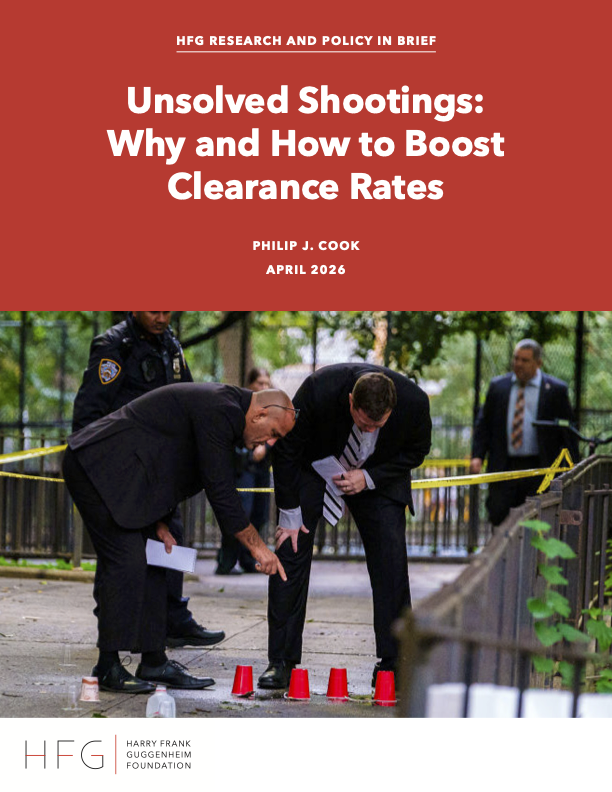
Unsolved Shootings: Why and How to Boost Clearance Rates 

By PHILIP J. COOK

Approximately 75,000 people in the United States were shot by a criminal assailant in 2024, yet most of those shootings did not result in an arrest.

In this HFG Research and Policy in Brief, Philip J. Cook, professor emeritus at Duke University, explores the gap between the minority of shootings that are solved and those that go unsolved.

“There is a strong argument for improving police performance in investigating serious crimes of violence,” Cook writes in Unsolved Shootings: Why and How to Boost Clearance Rates. “What is at stake is public safety and the basic duty of the police to serve the public.”

Cook examines the importance of arresting and prosecuting perpetrators of serious violence, the validity of “clearance rates” as a performance indicator for police departments, and what can be done by police to increase the success rate for criminal investigations—citing examples from Chicago, Denver, and other cities.

Report on Child Sexual Abuse in the Diocese of Providence

By STATE OF RHODE ISLAND, Attorney General

The sordid and shameful history of child sexual abuse in the Catholic Church spans generations and has affected communities across the globe.  Despite its small size, our state is home to one of the largest Catholic populations per capita in the country, with over 39% of Rhode Islanders—more than any other state—self-identifying as Catholic. Victims of clergy sexual abuse in Rhode Island have come from every community, every ethnic group, and from all economic and social backgrounds. They are our neighbors, friends, and family members.  Generations of Rhode Island victims, their families, and others who have suffered the impacts of this trauma deserve to know the truth of what occurred. 

Homicide in Victoria: female perpetrators of murder and manslaughter, 1860 to 1920 

By Victoria Nagy

Records from the Central Register of Female Prisoners permit a longitudinal analysis of ninety-five women convicted of murder and manslaughter in Victoria between 1860 and 1920. The data show the similarities and differences between the women convicted of these homicide offenses. An examination of the women’s socioeconomic profiles, occupations, ages, migrations, and victims reveals the links between their crimes and their punishment.

Hispanic Victims of Lethal Firearms Violence in the United States

By Terra Wiens  

  KEY FINDINGS AND RECOMMENDATIONS KEY FINDINGS ■ In 2023, more than 5,700 Hispanics were killed by guns. That year, 3,284 Hispanics died in gun homicides, 2,198 died in gun suicides, 63 died in unintentional shootings, and 202 died in other circumstances (including legal interventiona and undetermined intent). ■ More than 83,000 Hispanics were killed by guns between 2002 and 2023. During this period, 51,780 Hispanics died in gun homicides, 27,160 died in gun suicides, and 1,220 died in unintentional shootings. ■ Most Hispanic murder victims are killed with guns. In 2023, guns were used in more than three-quarters of the homicides where the victims were Hispanic. The latest data show that for homicides where the victim was Hispanic and a gun was used, 53.0 percent of these shootings involved a handgun. ■ The homicide victimization rate for Hispanics in the United States is higher than the homicide victimization rate for whites. The Hispanic homicide victimization rate in 2023 was 6.3 per 100,000. In comparison, the homicide victimization rate for whites was 2.9 per 100,000. ■ As a result of the limitations in current data collection, the total number of Hispanic victims is almost certainly higher than the reported numbers suggest. Government agencies often report data on race but not on ethnic origin. Recognizing the changing demographic landscape in the United States, it is clear that fully documenting such victimization is a crucial step in preventing it. RECOMMENDATIONS Governmental agencies that collect data on death and injury should obtain complete information on the ethnic origin of individuals in addition to their race. This will ensure complete and accurate data collection on Hispanic victims of lethal violence. ■ Individual-level ethnic origin information should be captured by all governmental agencies, regardless of department, and at all levels — local, state, and national — for all pertinent users and subjects of agency services. ■ Individual-level ethnic origin information should be self-reported and not based solely on a person’s surname or other measure. ■ All public access data and published reports issued by governmental agencies should include information on ethnic origin in addition to race. ■ The U.S. Department of Justice should issue periodic or special reports on Hispanic victimization. ■ States with a substantial proportion of Hispanic residents should issue periodic or special reports on Hispanic victimization and deaths due to all causes, including violence. Improved data collection is essential to fully understanding the scope of lethal firearms violence against Hispanics and helping develop effective measures to reduce such violence. At the same time additional efforts, both supporting current programs and activities as well as identifying new violence-reduction opportunities and approaches, should include the following: ■ Support for community-based violence intervention programs that are holistic and encourage participation by all stakeholders. ■ Educational efforts to better inform Hispanics of the risks associated with bringing a firearm into the home as measured by increased risk for homicide, suicide, and unintentional firearm deaths compared to how rarely guns are used in justifiable homicides. This is especially important in the face of current coordinated efforts by the gun industry targeting Hispanics as potential first-time gun buyers.b ■ Improved access to resources for victims and survivors of domestic violence. ■ Identification of anti-trafficking measures that could help interrupt the flow of illegal firearms into impacted communities   

Violence and Politics in Latin America: A Long and Tragic History

By Nizar Messari  

 In January 2024, gunmen invaded a TV studio in Ecuador, seized journalists and staff as hostages, and interrupted the regular programs. That episode highlighted the rise of violence in Ecuador, a country that was until very recently calm and peaceful. In this paper, I place the rise of violence in Ecuador within the context of what some refer to as the endemic violence in Latin America. I explore its risks, consequences, and the ways it could be tackled. I also emphasize some of the dramatic aspects of this endemic violence, such as the fact that in Brazil, 76.5% of homicide victims in 2022 were either black or brown, and every day, 62 individuals aged between 15 and 29 are murdered. I also underline one of the main consequences of this violence: according to the UNHCR, because of criminal violence in Latin America and the Caribbean, 42% of the world’s new asylum seekers are from that region.

Homicide Victims and Perpetrators.

Socio-economic status, demographic background and criminal history.

By Lisa Westfelt

This study focuses on aspects that have not yet been examined in Swedish research: the socio-economic status and demographic background of victims and perpetrators at the time homicides are committed, as well as the victims and perpetrators’ criminal histories.

English summary of Brå report 2025:5 Stockholm: The Swedish National Council for Crime Prevention (Brå), 2025. 14p.