Open Access Free Library
CRIME+CRIMINOLOGY.jpeg

CRIME

Violent-Non-Violent-Cyber-Global-Organized-Environmental-Policing-Crime Prevention-Victimization

Posts in Healthcare
Integrated care for people who use alcohol and/or other drugs: A case study analysis of the current landscape in England

By William D. Phillips, Jessica Dawney, Emily Hutton, Avery Adams, Lucy Strang, Katherine I. Morley, Nicola Kalk, Jennifer Bostock, Andrew Jones, Tom Ling, Tim Millar, Joanne Neale, John Strang, Jon Sussex, Jennifer Newbould

This study examined how treatment and recovery services are integrated with physical and mental health services following additional funding from England's drug strategy. Findings show wide variation in the extent and type of integration across local areas. While some progress has been made, more needs to be done to strengthen collaboration and achieve effective, person-centred care.

Key Findings

There is substantial variation in what services are offering across different local areas

  • While certain activities - such as embedding treatment and recovery staff in broader health services to encourage inward referrals - are relatively consistent across local areas, other initiatives are more localised. This is driven by variations in the stage of development of different services, differences in resourcing and local context, and the varying strength of existing relationships and connections.

We identify five models of integration for treatment and recovery services and an optimal example of an integrated care pathway.

  • We conceptualise the following models to help policymakers think about how to monitor, evaluate and communicate about service integration going forward:

  • Model 1 - single point of access

  • Model 2 - embedded workers

  • Model 3 - joint planned care

  • Model 4 - leveraging external support

  • Model 5 - building in-house expertise

  • .

  • Many treatment and recovery services are struggling to meet even basic needs due to high caseloads. Limited, short-term and inconsistent funding compounds these problems, making long-term planning and integration very difficult. Stigma, especially within mental health services, also remains a major barrier.

Recommendations

Central government should:

  • Facilitate the dissemination and implementation of the co-occurring mental health and substance use delivery framework

  • Identify priority interventions for service integration

  • Explore ring fenced, longer-term funding for integrating services

  • Examine ways in which integration efforts could be measured and monitored.

ICPs should:

  • Consider establishing a dedicated role for treatment and recovery services.

Treatment and recovery services should:

  • Provide basic mental health training to screen for and deliver mental health interventions

  • Strengthen relationships with other health services.

ICPs and treatment and recovery services should:

  • Ensure training on substance use is implemented across all healthcare settings, prioritising mental health services.
Implementation of the Treatment and Recovery Portfolio of the 'From Harm to Hope' drug strategy in England: Results from a process evaluation

By Sarah Parkinson, Jessica Dawney, Fifi Olumogba, Fin Oades, Jennifer Newbould, Katherine I. Morley, Jennifer Bostock, Andrew Jones, Nicola Kalk, Tom Ling, Tim Millar, Joanne Neale, John Strang, Jon Sussex, Lucy Strang

We conducted a mixed-methods process evaluation of the first three years of implementation of the Treatment and Recovery Portfolio of the UK government's 10-year drug strategy, From Harm to Hope. We found that the Portfolio brought welcomed funding into the treatment and recovery sector after an extended period of disinvestment. The Portfolio has largely been implemented as planned, despite challenges related to funding uncertainty and some delays. Stakeholders involved in local implementation agreed with the Portfolio's priorities, highlighting the positive focus on boosting capacity within the sector, supporting collaboration between treatment and recovery and other parts of the system, and incorporating lived experience and recovery into treatment. However, the Portfolio has not yet achieved its aim of creating a world-class treatment system or a whole-system approach to alcohol and/or other drugs. The treatment and recovery sector has been negatively impacted by years of disinvestment, which has diminished the workforce's and the system's capacity and capabilities. These long-standing challenges cannot be quickly reversed with funding injections alone, and were under-estimated by the UK government when initially implementing the Portfolio. Addressing these issues requires long-term investment, improved training and professional development standards, and action within the health and social care system that makes it easier to collaborate with treatment and recovery services. Increasing the number of people in treatment without addressing these fundamental challenges.

Key Findings

  • Ring-fenced funding provided through the Portfolio was welcomed. However, uncertainty regarding long-term funding and restrictions on carrying funding from one year to the next were reported to impede long-term planning.

  • Central government departments largely implemented the Portfolio as planned. However, there were several significant delays, including the plans to integrate with physical and mental health services.

  • Many local stakeholders were satisfied with the level of flexibility they had in delivering the Portfolio, and commented positively on planning processes with OHID. However, they viewed reporting and reprofiling requirements of the Portfolio as onerous, and national targets set by DHSC as unrealistic.

  • Local stakeholders largely agreed with the Portfolio's priorities of boosting capacity, supporting collaboration with other parts of the system, and incorporating lived experience and recovery into treatment. However, they also identified gaps, including a perceived lack of focus on alcohol and prescription drugs.

  • The Portfolio's aims of creating a world-class treatment system and whole-system approach to alcohol and other drugs have not yet been achieved. The central government underestimated the scale of the challenges faced after years of disinvestment, which has diminished capacity and capabilities within the system. Long-standing challenges cannot be quickly reversed with funding injections alone.

  • Study participants expressed concern that the quality of services may decrease due to the push to increase numbers in treatment without adequate improvements to maintain a minimum standard of care. Achieving a world-class system will require balancing numbers in treatment with the need to ensure that each person receives good-quality care..

The short-term impacts of the decriminalization of illegal drug possession on clients dispensed opioid agonist treatment medications

By Sami Aftab Abdul , Huan Jiang , .Cayley Russell  , Tara Elton-Marshall ,  et al.

Background

British Columbia, Canada implemented a three-year pilot program on January 31, 2023 decriminalizing personal possession of select illegal drugs. The policy aimed to increase access to health and social services. This analysis evaluated the short-term impacts of decriminalization on clients dispensed opioid agonist treatment (OAT) medications and visits to supervised consumption and overdose prevention services (SCS/OPS).

Methods

Population-based data from 2015 to 2023 were sourced (Pre-decriminalization: Jan 2015–Jan 2023; Post-decriminalization Feb 2023–Dec 2023). Generalized additive models in an interrupted time series design were used to model monthly total and sex-stratified, age-standardized rates of clients and first-time clients dispensed OAT medications per 100,000 population, as well as crude rates of visits to SCS/OPS per 100,000 population. The models tested both immediate level changes (immediate effect at decriminalization) and trend changes (slope changes post-decriminalization).

Results

The models detected no association between decriminalization and changes in clients dispensed OAT medications (Immediate Change β [95 % CI]: −0.001 [−0.012, 0.011]; Trend Change β [95 % CI]: −0.004 [−0.011, 0.003]), first-time clients dispensed OAT medications (Immediate Change β [95 % CI]: 0.115 [−0.049, 0.279]; Trend Change β [95 % CI]: −0.006 [−0.048, 0.035]) or visits to SCS/OPS (Immediate Change β [95 % CI]: 0.048 [−0.100, 0.195]; Trend Change β [95 % CI]: 0.013 [−0.016, 0.043]). Findings for all outcomes remained consistent after stratifying by sex.

Conclusion

Decriminalization was not associated with changes in clients dispensed OAT medications, first-time clients dispensed OAT medications, or visits to SCS/OPS. These findings reflect only the initial eleven months following the implementation of the policy. Given the complexity of factors influencing service utilization, and the introduction of the second amendment which represents a significant rollback of the original exemption, longer-term evaluations are needed to more accurately assess whether decriminalization is contributing to its intended goals.

Journal of Substance Use and Addiction Treatment


Volume 180, January 2026, 209815

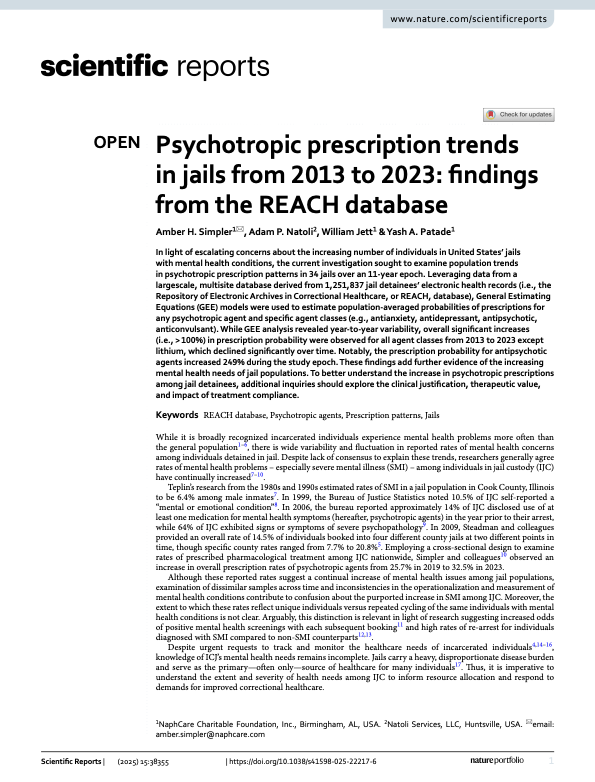
Psychotropic prescription trends in jails from 2013 to 2023: findings from the REACH database

By Amber H. Simpler, Adam P. Natoli, William Jett & Yash A. Patade 


In light of escalating concerns about the increasing number of individuals in United States' jails with mental health conditions, the current investigation sought to examine population trends in psychotropic prescription patterns in 34 jails over an 11-year epoch. Leveraging data from a largescale, multisite database derived from 1,251,837 jail detainees' electronic health records (i.e., the Repository of Electronic Archives in Correctional Healthcare, or REACH, database), General Estimating Equations (GEE) models were used to estimate population-averaged probabilities of prescriptions for any psychotropic agent and specific agent classes (e.g., antianxiety, antidepressant, antipsychotic, anticonvulsant). While GEE analysis revealed year-to-year variability, overall significant increases (i.e., > 100%) in prescription probability were observed for all agent classes from 2013 to 2023 except lithium, which declined significantly over time. Notably, the prescription probability for antipsychotic agents increased 249% during the study epoch. These findings add further evidence of the increasing mental health needs of jail populations. To better understand the increase in psychotropic prescriptions among jail detainees, additional inquiries should explore the clinical justification, therapeutic value, and impact of treatment compliance.

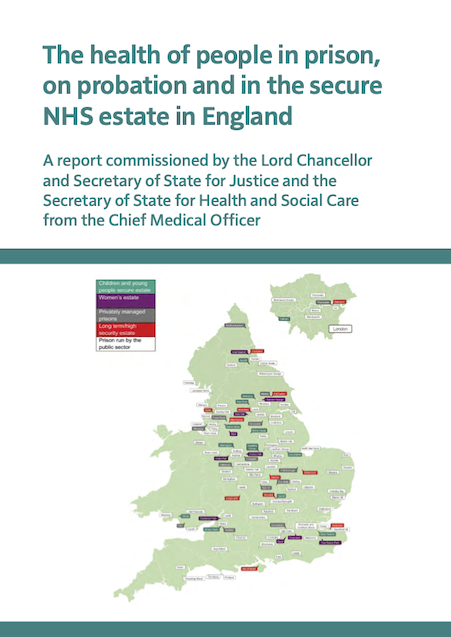
The Health Of People In Prison, On Probation And In The Secure NHS Estate In England

By Chris Whitty,

he aim of this report is to explore the health and healthcare of people in prison and on probation in England and make recommendations to improve these. It combines insights from, and individual chapters authored by: front line professionals working in prisons and the secure estate and in probation; public health professionals; commissioners and policy makers in health and justice; third sector organisations; academics and lived experience experts. These insights were gathered by extensive evidence gathering and stakeholder engagement, albeit by a small team within a defined time frame from September 2024 to July 2025. Regional health and justice teams across prison and probation were invited to share their written experiences and attend roundtables. Additional roundtables and workshops were conducted to explore specific themes such as the health needs and healthcare challenges of people on probation, health workforce and long-term conditions. We are very grateful for the time, enthusiasm and knowledgeable response from prison, probation, NHS and public health staff. Building on previous CMO visits looking at health to the secure estate (including secure mental health hospitals) we visited a further: 15 male and female prisons; 1 young offenders’ institution, 1 secure school and 1 secure children’s home; 1 secure NHS hospital and 4 probation delivery units. These covered all regions of England. During visits we discussed with frontline clinical and operational staff as well as people in prison, prison and probation officers, governors and healthcare leaders and we are very grateful for their time and expertise. In addition to lived experience identified by chapter authors and from group discussions during visits, we worked with the NHS Health and Justice Lived Experience Network and Empowering People: Inspiring Change (EP:IC) lived experience consultancy to bring together themes from existing lived experience engagement relevant to the chapters of this report, including engagement held for the 10 Year Health Plan. This was supplemented with additional lived experience focus groups held with pregnant women currently in prison, with people on probation and recently in prison on topics including the health and care needs of older adults in prison and health improvement in prison. One person with lived experience of the criminal justice system was a member of our steering group and contributed and reviewed all chapters. Lived experience contributions are incorporated throughout chapters in blue panels, practice examples (orange) and case studies (lilac) gathered from engagement are also included to illustrate findings.The development of the report was guided by 2 groups: ■ a stakeholder steering group with representation from UK Health Security Agency, Department of Health and Social Care, HM Prison and Probation Service, Ministry of Justice, NHS England and EP:IC lived experience consultancy ■ a clinical task and finish group chaired by the Royal College of General Practitioners: Secure Environments Group. Attended by front line clinicians and clinical leaders (GPs, nurses, pharmacists, psychologists, psychiatrists, midwives, obstetricians and peer support workers) working in, or with recent experience of, prisons, probation and the secure estateThe ‘children and young people’ chapter was guided by its own steering group with representation from NHS England, Youth Justice Board, Youth Custody Service and clinical advisers. The important challenges of substance misuse in prisons have been extensively explored in the recent independent review by Dame Carol Black published in 2024. For this reason we have not concentrated on this issue in this report and would point people to Dame Carol’s recommendations . Sentencing policy is obviously outside the remit of this report on health, although the implications of long and short sentences on health and healthcare is considered. Any response to the Sentencing Review by the Rt Hon David Gauke 2025 is likely to have an effect on prison and probation health and healthcare2 . While important to this population, it was outside the scope of this review to do an in depth review of social care in prisons. The ongoing independent commission into adult social care should consider the justice population.

Abnormal Man : Volume 2 - Bibliography

By Arthur MacDonald.

The narrative in Volume 1 asks many pointed questions: What does it mean to be “abnormal”? Who decides? And how have these judgments shaped modern science, education, and criminal justice?

First published in 1893, Arthur MacDonald’s Abnormal Man is one of the earliest American attempts to systematically study human difference through the emerging tools of psychology, anthropology, and criminology. Drawing on international research—from European criminal anthropology to American child-study movements—MacDonald sought to classify the physical, mental, and moral traits considered “aberrant” in his era. His work reflects the hopes and anxieties of a society confronting rapid industrialization, immigration, social change, and new scientific approaches to crime and mental health.

To the modern reader, Abnormal Man reveals both the ambition and the pitfalls of nineteenth-century science. Its pages contain pioneering observations about child development, deviance, and social responsibility, alongside early theories—now discredited—about heredity, physiognomy, and race. What emerges is a vivid and sometimes unsettling portrait of a culture striving to understand human variation without the benefit of modern psychology or ethical safeguards.

The Read-Me.org edition Volume 1 presents Abnormal Man as both a historical artifact and a gateway to critical reflection. It illustrates how scientific thought evolves, how cultural bias can shape research, and how early debates about abnormality laid the groundwork for contemporary approaches to mental health, special education, criminology, and social policy. To make such work, much of it controversial then as it is today, minimally believable, requires extensive documentation. The voluminous Bibliography of Abnormal Man reproduced here in Volume 2, contains all that Macdnald referred to within his detailed exposition. To some, his arguments may seem unsupported, or lacking in evidence. But he left no stone untuned as this amazing bibliographical documentation of all relative contemporary research

A foundational text at the crossroads of science and society, Abnormal Man invites readers to explore the origins of modern debates about deviance, diversity, and the boundaries of the “normal.”

Read-Me.Org Inc. New York-Philadelphia-Australia. 2025. 240p.

Abnormal Man : Volume 1 --Digest of Literature

By Arthur MacDonald. Introduction by Graeme R. Newman

What does it mean to be “abnormal”? Who decides? And how have these judgments shaped modern science, education, and criminal justice?

First published in 1893, Arthur MacDonald’s Abnormal Man is one of the earliest American attempts to systematically study human difference through the emerging tools of psychology, anthropology, and criminology. Drawing on international research—from European criminal anthropology to American child-study movements—MacDonald sought to classify the physical, mental, and moral traits considered “aberrant” in his era. His work reflects the hopes and anxieties of a society confronting rapid industrialization, immigration, social change, and new scientific approaches to crime and mental health.

To the modern reader, Abnormal Man reveals both the ambition and the pitfalls of nineteenth-century science. Its pages contain pioneering observations about child development, deviance, and social responsibility, alongside early theories—now discredited—about heredity, physiognomy, and race. What emerges is a vivid and sometimes unsettling portrait of a culture striving to understand human variation without the benefit of modern psychology or ethical safeguards.

This new Read-Me.org edition presents Abnormal Man as both a historical artifact and a gateway to critical reflection. It illustrates how scientific thought evolves, how cultural bias can shape research, and how early debates about abnormality laid the groundwork for contemporary approaches to mental health, special education, criminology, and social policy.

A foundational text at the crossroads of science and society, Abnormal Man invites readers to explore the origins of modern debates about deviance, diversity, and the boundaries of the “normal.”

Read-Me.Org Inc. New York-Philadelphia-Australia. 2025. p.193.

Urgent and long overdue: legal reform and drug decriminalisation in Canada

By Matthew Bonn, Chelsea Cox, Marilou Gagnon. et al.

The International Guidelines on Human Rights and Drug Policy recommend that States commit to adopting a balanced, integrated, and human rights-based approach to drug policy through a set of foundational human rights principles, obligations arising from human rights standards, and obligations arising from the human rights of particular groups. Following two years of consultation with stakeholders, including people who use drugs, NGOs, legal and human rights experts, UN technical agencies and Member States, the Guidelines “do not invent new rights. Rather, they apply existing human rights law to the legal and policy context of drug control to maximise human rights protections, including in the interpretation and implementation of the drug control conventions.” In respect of the Guidelines and its obligations under UN human rights treaties, Canada must adopt stronger and more specific commitments for a human rights-based, people centered and public health approach.3 This approach must commit to the removal of criminal penalties for simple possession and a comprehensive health-based approach to drug regulation.

Ottawa, ONT: Royal Society of Canada, 2024. 52p.

Deaths: Leading Causes for 2020

By Sally C. Curtin,  Betzaida Tejada-Vera, and Brigham A. Bastian

Objectives—This report presents final 2020 data on the 10 leading causes of death in the United States by age, race and Hispanic origin, and sex. Leading causes of infant, neonatal, and post-neonatal death are also presented. This report supplements “Deaths: Final Data for 2020,” the National Center for Health Statistics’ annual report of final mortality statistics. Methods—Data in this report are based on information from all death certificates filed in the 50 states and the District of Columbia in 2020. Causes of death classified by the International Classification of Diseases, 10th Revision (ICD–10) are ranked according to the number of deaths. Cause-of-death statistics are based on the underlying cause of death. Race and Hispanic-origin data are based on the Office of Management and Budget’s 1997 standards for reporting race and Hispanic origin. Results—In 2020, many of the 10 leading causes of death changed rank order due to the emergence of COVID-19 as a leading cause of death in the United States. The 10 leading causes of death in 2020 were, in rank order: Diseases of heart; Malignant neoplasms; COVID-19; Accidents (unintentional injuries); Cerebrovascular diseases; Chronic lower respiratory diseases; Alzheimer disease; Diabetes mellitus; Influenza and pneumonia; and Nephritis, nephrotic syndrome and nephrosis. They accounted for 74.1% of all deaths occurring in the United States. Differences in the rankings are evident by age, race and Hispanic origin, and sex. Leading causes of infant death for 2020 were, in rank order: Congenital malformations, deformations and chromosomal abnormalities; Disorders related to short gestation and low birth weight, not elsewhere classified; Sudden infant death syndrome; Accidents (unintentional injuries); Newborn affected by maternal complications of pregnancy; Newborn affected by complications of placenta, cord and membranes; Bacterial sepsis of newborn; Respiratory distress of newborn; Diseases of the circulatory system; and Neonatal hemorrhage.   

Hyattsville, MD: National Vital Statistics Reports; Centers for Disease Control and Prevention. 2023, 115pg