Open Access Publisher and Free Library
CRIME+CRIMINOLOGY.jpeg

CRIME

Violent-Non-Violent-Cyber-Global-Organized-Environmental-Policing-Crime Prevention-Victimization

Posts in Drugs
Public Opinion on Legalizing Psychedelics

By Ben Senator, Michelle Priest, Beau Kilmer

Nearly one in four U.S. adults think psilocybin “magic” mushrooms should be legal, according to a new RAND study. This level of support mirrors attitudes toward cannabis in the mid‑1990s—just before states began allowing medical use.

The study, which draws on data from the 2025 RAND Psychedelics Survey, finds that public attitudes vary greatly depending on the substance: While 23 percent of respondents support legal use of psilocybin mushrooms, only about 10 percent said the same about LSD and MDMA.

Among those who support making psilocybin use legal, 56 percent favor its use for treating mental or physical health conditions, but just 42 percent believe adults should be free to use it for any reason. And among those opposed to legalizing psilocybin, 62 percent believe it should be illegal for any reason.

The survey also asked about how legal psilocybin should be obtained: 49 percent of respondents favor supervised use in a medical facility, 28 percent support dispensary sales, and 23 percent endorse allowing adults to grow or forage for personal use.

These findings highlight the complexity of Americans' views on psychedelics, particularly psilocybin. And although it remains to be seen whether public opinion—and public policy—on psilocybin will follow a similar path as cannabis, such insights can help inform policy discussions.

China Primer: Illicit Fentanyl and China's Role

By U.S. Congressional Research Service

For over a decade, the synthetic opioid fentanyl and fentanyl-related substances have been key drivers of the U.S. opioid crisis. Countering the illicit trafficking of fentanyl and the precursor chemicals ("precursors") used to make it has been a U.S. priority. In 2015, the Drug Enforcement Administration (DEA) first identified the People's Republic of China (PRC, or China) as the main source of U.S.-bound fentanyl and fentanyl precursors. Since the PRC imposed domestic controls on fentanyl-related substances in 2019, which curtailed almost all direct shipments of fentanyl from China to the United States, many U.S. policymakers have shifted focus. Their chief concern today is the role of China—the global leader in chemical sales—as the primary source of precursors used by transnational criminal organizations (TCOs) to synthesize fentanyl and its analogues in third countries (chiefly Mexico). Congress has sought to address China's shifting role in the illicit drug trade, including through provisions in the BUST Fentanyl Act in the National Defense Authorization Act for FY2026.

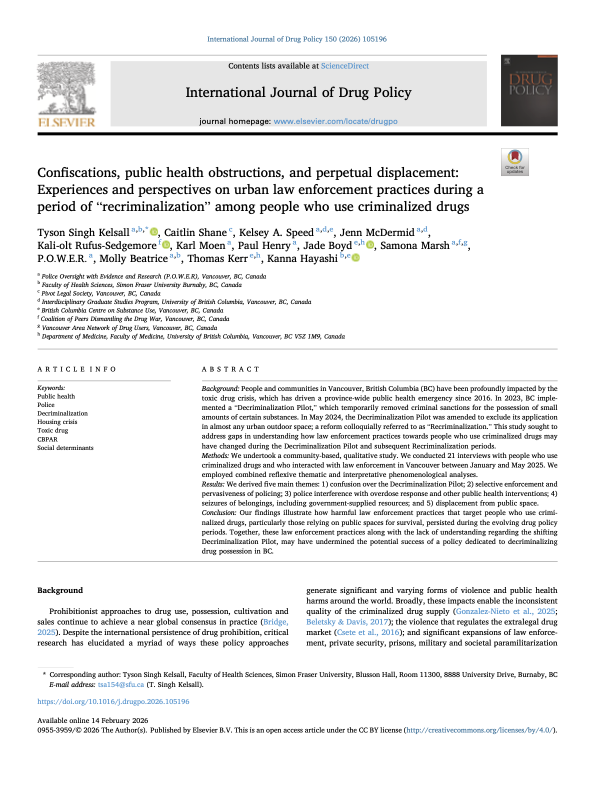
Confiscations, Public Health Obstructions, and Perpetual Displacement

By: Tyson Singh Kelsall, Caitlin Shane, Kelsey A. Speed, et al.

People and communities in Vancouver, British Columbia (BC) have been profoundly impacted by the toxic drug crisis, which has driven a province-wide public health emergency since 2016. In 2023, BC implemented a “Decriminalization Pilot,” which temporarily removed criminal sanctions for the possession of small amounts of certain substances. In May 2024, the Decriminalization Pilot was amended to exclude its application in almost any urban outdoor space; a reform colloquially referred to as “Recriminalization.” This study sought to address gaps in understanding how law enforcement practices towards people who use criminalized drugs may have changed during the Decriminalization Pilot and subsequent Recriminalization periods.

Methods

We undertook a community-based, qualitative study. We conducted 21 interviews with people who use criminalized drugs and who interacted with law enforcement in Vancouver between January and May 2025. We employed combined reflexive thematic and interpretative phenomenological analyses.

Results

We derived five main themes: 1) confusion over the Decriminalization Pilot; 2) selective enforcement and pervasiveness of policing; 3) police interference with overdose response and other public health interventions; 4) seizures of belongings, including government-supplied resources; and 5) displacement from public space.

Conclusion

Our findings illustrate how harmful law enforcement practices that target people who use criminalized drugs, particularly those relying on public spaces for survival, persisted during the evolving drug policy periods. Together, these law enforcement practices along with the lack of understanding regarding the shifting Decriminalization Pilot, may have undermined the potential success of a policy dedicated to decriminalizing drug possession in BC

The Costs Of Tackling Drug Harms In Prisons

By the U.K. Ministry of Justice and Department of Health & Social Care

1 In April 2025, approximately 40,000 people in prisons in England and Wales (50%) had an identified drug problem. Misuse of illicit drugs by people in prison creates or exacerbates risks to their health, well-being and personal safety. Between December 2022 and December 2024, the Prisons and Probation Ombudsman investigated 833 deaths, of which 136 (16%) were drug-related. Conveyance, supply and use of illicit drugs also increase risks to the safety and stability of the prison regime. Availability of drugs inside prisons creates an illicit economy that can fuel debt, which can lead to assault, extortion or self-harm. Prisoners who are using illicit drugs often reoffend after leaving prison. 2 Effective interventions require HM Prison and Probation Service (HMPPS) and health service providers, commissioned for prisons in England by NHS England (NHSE), to work closely together. • HMPPS is primarily responsible for action to detect illicit drugs and prevent their conveyance into prisons, and it also seeks to reduce demand for drugs through initiatives to encourage positive behaviour changes. • Health service providers deliver drug treatment and recovery services inside prisons. • The overall prison environment can support prisoners by providing a rehabilitative culture; education and other purposeful activities; building relationships; delivering a safe regime; and facilitating access to health interventions, including addressing mental health needs. Focus of our report 3 This report focuses on how the prison and health services are using public funds to tackle drug harms in prisons. It examines: • how well the Ministry of Justice (MoJ), HMPPS, Department of Health & Social Care (DHSC), NHSE and wider government understand the scale and nature of drug harms in prisons (Part One); • the funding available for HMPPS and NHSE to tackle drug harms in prisons, and how resources are prioritised (Part Two); and • how effectively resources have been used and how well the prison and health services work together (Part Three).4 The report focuses only on illicit drug harms in prisons. We do not cover national and international work by the police and others to counter criminal activity supplying drugs to prisons, nor do we review interventions for people on community orders or the continuity of drug treatment services for prison leavers. ‘Substance misuse’ is a broader term often used in healthcare, which includes misuse of alcohol and diversion of prescription medicines, as well as illicit drugs. We touch on these broader issues where relevant, but they are not the focus of our report. While HMPPS is responsible for prisons in England and Wales, healthcare in Wales is a devolved function provided by NHS Wales, and therefore falls outside the scope of this report

Street Drug Analysis: Factors Affecting the Detection and Identification of Emerging Substances

By The United States Government Accountability Office

Agencies at the federal, state, and local levels have facilities capable of analyzing emerging street drugs—psychoactive substances newly circulating in the drug market. For example, the Drug Enforcement Administration and U.S. Customs and Border Protection have forensic laboratories that can analyze seized drugs and identify emerging substances. Current laboratory-based technologies can detect and identify emerging street drugs when appropriate methods (protocols) and reference standards are available. Portable technologies can detect drugs at the point of seizure but face accuracy challenges due, in part, to user error. Technology manufacturers told GAO they are developing more lay-friendly user interfaces and operational methods.

From fiscal year 2019 through 2024, the Departments of Justice and Health and Human Services awarded a combined total of about $12.5 million in grants for the development of new methods and technologies for analyzing emerging street drugs. New methods and technologies may make laboratory processes more consistent, among other enhancements. Method development can be done on faster timelines than technology development.

While new methods and technologies could enhance some capabilities, forensic scientists face key challenges with analyzing emerging street drugs, including:

  • Lack of resources. Laboratories GAO spoke to consistently referenced insufficient staffing and time.

  • Unstandardized reporting. According to stakeholders, varying reporting requirements at thestate and local levels can lead to gaps in data.

  • Limited information sharing. Law enforcement may not always share up-to-date information about emerging drugs with medical examiners and hospitals.

If these challenges could be addressed, laboratories could be in a better position to meet the nation’s needs for emerging drug analysis. However, GAO is not making recommendations to address these challenges because they are primarily faced by state and local laboratories.

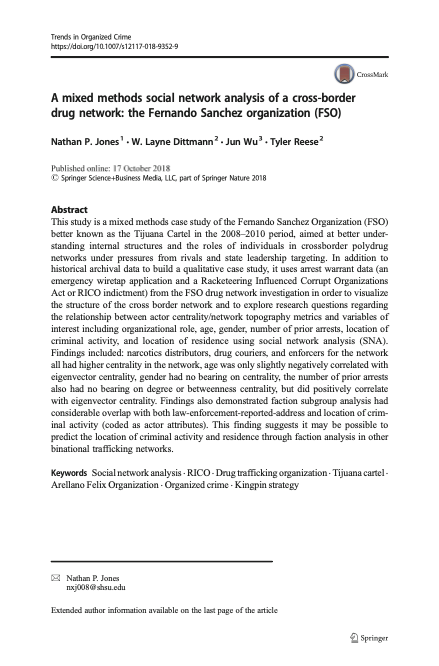
A Mixed Methods Social Network Analysis Of A Cross-Border Drug Network: The Fernando Sanchez organization (FSO)

By: Nathan P. Jones1 & W. Layne Dittmann2 & Jun Wu3 & Tyler Reese2

This study is a mixed methods case study of the Fernando Sanchez Organization (FSO) better known as the Tijuana Cartel in the 2008–2010 period, aimed at better understanding internal structures and the roles of individuals in crossborder polydrug networks under pressures from rivals and state leadership targeting. In addition to historical archival data to build a qualitative case study, it uses arrest warrant data (an emergency wiretap application and a Racketeering Influenced Corrupt Organizations Act or RICO indictment) from the FSO drug network investigation in order to visualize the structure of the cross border network and to explore research questions regarding the relationship between actor centrality/network topography metrics and variables of interest including organizational role, age, gender, number of prior arrests, location of criminal activity, and location of residence using social network analysis (SNA). Findings included: narcotics distributors, drug couriers, and enforcers for the network all had higher centrality in the network, age was only slightly negatively correlated with eigenvector centrality, gender had no bearing on centrality, the number of prior arrests also had no bearing on degree or betweenness centrality, but did positively correlate with eigenvector centrality. Findings also demonstrated faction subgroup analysis had considerable overlap with both law-enforcement-reported-address and location of criminal activity (coded as actor attributes). This finding suggests it may be possible to predict the location of criminal activity and residence through faction analysis in other binational trafficking networks.

The UNGASS Decade In Review: Gaps, Achievements and Paths For Reform

By The International Drug Policy Consortium

The 2016 UN General Assembly Special Session (UNGASS) on drugs was a watershed moment in global drug policy. It created a rare opportunity to reconsider the prevailing international paradigm on drugs and to chart a new direction.

The UNGASS process was notable for the unprecedented involvement of civil society, affected communities, UN entities and human rights experts. It helped place public health, human rights and communities closer to the centre of drug policy-making, and paved the way for better alignment between the UN drug control regime and the wider UN system. The process also generated valuable momentum for new debates and advocacy at the national level.

However, the UNGASS ultimately fell short of introducing genuine reform of the norms and institutions underpinning the international drug control system.

This report examines progress made since the 2016 UNGASS to assess the role of the global drug control regime in shaping change. It draws on UN data and reporting, academic research, contributions from civil society and community organisations, and a dedicated civil society survey conducted among IDPC members and partners.

Key conclusions

The report concludes with four forward-looking findings:

  • Civil society and community organisations play a critical role in drug policy, yet continue to be sidelined, underfunded, and increasingly exposed to threats and attacks.

  • The UN drug control treaties require urgent modernisation in order to respond to new realities and remain fit for purpose.

  • A drug control system oriented towards human rights, health and development requires a thorough reconfiguration of the existing architecture, including strong and systematic inter-agency cooperation across the UN system.

  • Regular discussion of drug policy at the UN is essential, but the agenda and working methods of the Commission on Narcotic Drugs (CND) must change to enable meaningful progress.

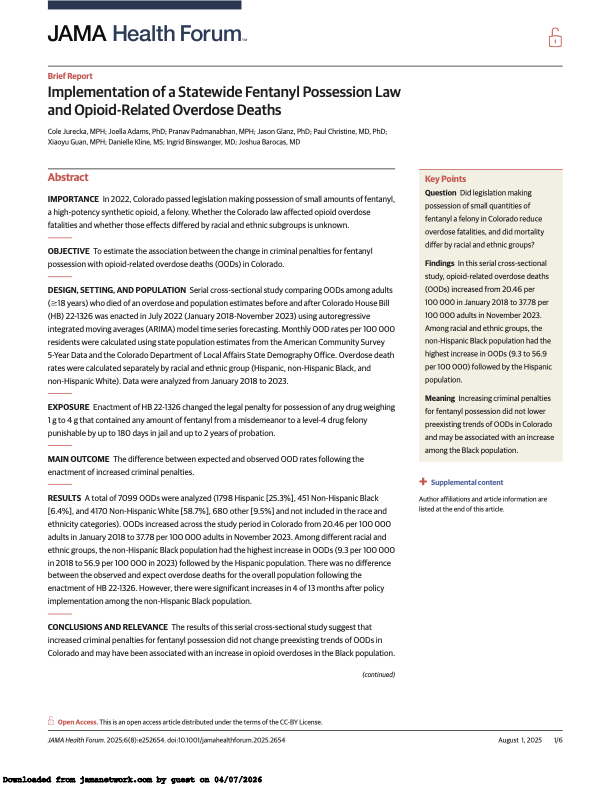
Implementation of a Statewide Fentanyl Possession Law and Opioid-Related Overdose Deaths 

By Cole Jurecka; Joella Adams; Pranav Padmanabhan; Jason Glanz; Paul Christine; Xiaoyu Guan; Danielle Kline; Ingrid Binswanger; Joshua Barocas

In 2022, Colorado passed legislation making possession of small amounts of fentanyl, a high-potency synthetic opioid, a felony. Whether the Colorado law affected opioid overdose fatalities and whether those effects differed by racial and ethnic subgroups is unknown. OBJECTIVE To estimate the association between the change in criminal penalties for fentanyl possession with opioid-related overdose deaths (OODs) in Colorado. DESIGN, SETTING, AND POPULATION Serial cross-sectional study comparing OODs among adults (18 years) who died of an overdose and population estimates before and after Colorado House Bill (HB) 22-1326 was enacted in July 2022 (January 2018-November 2023) using autoregressive integrated moving averages (ARIMA) model time series forecasting. Monthly OOD rates per 100 000 residents were calculated using state population estimates from the American Community Survey 5-Year Data and the Colorado Department of Local Affairs State Demography Office. Overdose death rates were calculated separately by racial and ethnic group (Hispanic, non-Hispanic Black, and non-Hispanic White). Data were analyzed from January 2018 to 2023. EXPOSURE Enactment of HB 22-1326 changed the legal penalty for possession of any drug weighing 1 g to 4 g that contained any amount of fentanyl from a misdemeanor to a level-4 drug felony punishable by up to 180 days in jail and up to 2 years of probation. MAIN OUTCOME The difference between expected and observed OOD rates following the enactment of increased criminal penalties. RESULTS A total of 7099 OODs were analyzed (1798 Hispanic [25.3%], 451 Non-Hispanic Black [6.4%], and 4170 Non-Hispanic White [58.7%], 680 other [9.5%] and not included in the race and ethnicity categories). OODs increased across the study period in Colorado from 20.46 per 100 000 adults in January 2018 to 37.78 per 100 000 adults in November 2023. Among different racial and ethnic groups, the non-Hispanic Black population had the highest increase in OODs (9.3 per 100 000 in 2018 to 56.9 per 100 000 in 2023) followed by the Hispanic population. There was no difference between the observed and expect overdose deaths for the overall population following the enactment of HB 22-1326. However, there were significant increases in 4 of 13 months after policy implementation among the non-Hispanic Black population CONCLUSIONS AND RELEVANCE The results of this serial cross-sectional study suggest that increased criminal penalties for fentanyl possession did not change preexisting trends of OODs in Colorado and may have been associated with an increase in opioid overdoses in the Black population.

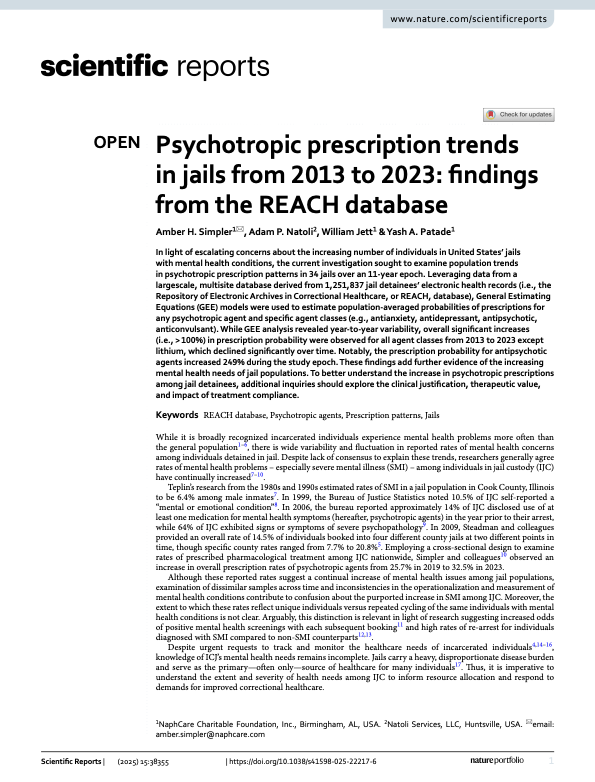
Psychotropic prescription trends in jails from 2013 to 2023: findings from the REACH database

By Amber H. Simpler, Adam P. Natoli, William Jett & Yash A. Patade 


In light of escalating concerns about the increasing number of individuals in United States' jails with mental health conditions, the current investigation sought to examine population trends in psychotropic prescription patterns in 34 jails over an 11-year epoch. Leveraging data from a largescale, multisite database derived from 1,251,837 jail detainees' electronic health records (i.e., the Repository of Electronic Archives in Correctional Healthcare, or REACH, database), General Estimating Equations (GEE) models were used to estimate population-averaged probabilities of prescriptions for any psychotropic agent and specific agent classes (e.g., antianxiety, antidepressant, antipsychotic, anticonvulsant). While GEE analysis revealed year-to-year variability, overall significant increases (i.e., > 100%) in prescription probability were observed for all agent classes from 2013 to 2023 except lithium, which declined significantly over time. Notably, the prescription probability for antipsychotic agents increased 249% during the study epoch. These findings add further evidence of the increasing mental health needs of jail populations. To better understand the increase in psychotropic prescriptions among jail detainees, additional inquiries should explore the clinical justification, therapeutic value, and impact of treatment compliance.

A Systematic Review of Substance Misuse Treatment Processes and Outcomes as Implemented in Prisons for Men in the UK

By Kim Barnett, Noor Butt, Rosie Allen, Pauline Goodlad, Anne Krayer, Adam O'Neill, et al.

Background: With a rising prison population, a substantial portion of whom are identified as substance misusers, it is important to understand the availability of treatment pathways, their successes and areas for improvement. Given the likelyimportance of national factors in criminal justice and substance use service provision, we chose to focus on one country.Aim: To review substance misuse treatment and outcomes for such treatments as implemented in British prisons for men.Methods: We conducted a mixed‐methods systematic review, searching Ovid MEDLINE, Ovid Embase, APA PsycINFO,CINAHL Plus, Sociology Collection, Web of Science Core Collection and Social Science Premium Collection between 1 January2000 and 5 June 2024. Included were empirical, peer‐reviewed studies of processes and outcomes of UK male prison‐basedsubstance misuse programmes. Primary outcomes included changes in substance use, withdrawal symptoms and experiencesof interventions, whereas secondary outcomes encompassed quality of life, locus of control and mental health. Because of studydesign heterogeneity, meta‐analysis was not possible. Analysis followed JBI methodology with a convergent synthesis.Results: Fourteen studies were included: 8 qualitative, 5 quantitative studies of which 3 were randomised control trials (RCTs)and 1 mixed‐methods study, with a combined sample of 4037 participants engaged in opioid substitute treatment (OST) and/orpsychosocial interventions. Four key themes emerged: the power of purposeful activity, strengthening support systems, bridgingpatient needs with treatment plans and, for those in opiate programmes, experiences and engagement with opioid substitutiontreatments.Conclusions: Participants articulated diverse treatment needs, highlighting the necessity of individualised and tailoredreduction or maintenance plans. Treatment requires a comprehensive approach with the aim of facilitating effective socialintegration.

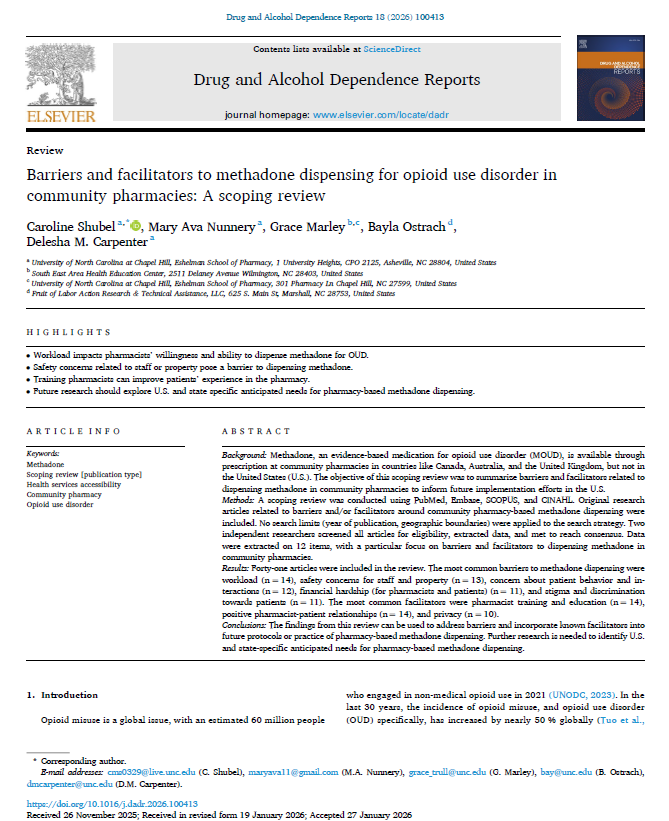
Barriers and facilitators to methadone dispensing for opioid use disorder in community pharmacies: A scoping review

By Caroline Shubel , Mary Ava Nunnery , Grace Marley, Bayla Ostrach , Delesha M. Carpenter

Background: Methadone, an evidence-based medication for opioid use disorder (MOUD), is available through prescription at community pharmacies in countries like Canada, Australia, and the United Kingdom, but not in the United States (U.S.). The objective of this scoping review was to summarize barriers and facilitators related to dispensing methadone in community pharmacies to inform future implementation efforts in the U.S. Methods: A scoping review was conducted using PubMed, Embase, SCOPUS, and CINAHL. Original research articles related to barriers and/or facilitators around community pharmacy-based methadone dispensing were included. No search limits (year of publication, geographic boundaries) were applied to the search strategy. Two independent researchers screened all articles for eligibility, extracted data, and met to reach consensus. Data were extracted on 12 items, with a particular focus on barriers and facilitators to dispensing methadone in community pharmacies. Results: Forty-one articles were included in the review. The most common barriers to methadone dispensing were workload (n = 14), safety concerns for staff and property (n = 13), concern about patient behavior and interactions (n = 12), financial hardship (for pharmacists and patients) (n = 11), and stigma and discrimination towards patients (n = 11). The most common facilitators were pharmacist training and education (n = 14), positive pharmacist-patient relationships (n = 14), and privacy (n = 10). Conclusions: The findings from this review can be used to address barriers and incorporate known facilitators into future protocols or practice of pharmacy-based methadone dispensing. Further research is needed to identify U.S. and state-specific anticipated needs for pharmacy-based methadone dispensing

:Drug Alcohol Depend Rep. 2026 Jan 29;18:100413. doi: 10.1016/j.dadr.2026.100413. PMID: 41695144; PMCID: PMC12906019

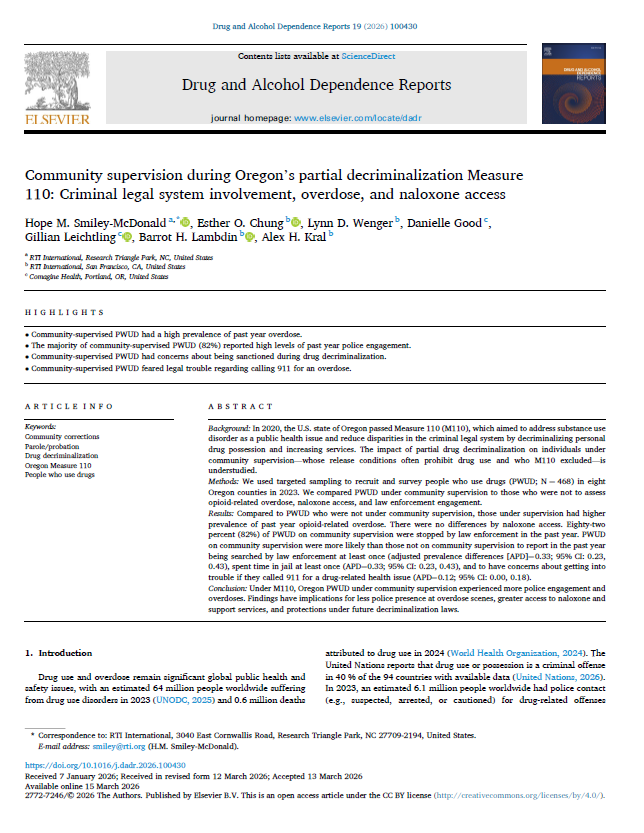
Community supervision during Oregon’s partial decriminalization Measure 110: Criminal legal system involvement, overdose, and naloxone access

Bt Hope M. Smiley-McDonald,  Esther O. Chung , Lynn D. Wenger, Danielle Good , Gillian Leichtling c, Barrot H. Lambdin , Alex H. Kral 

Background

In 2020, the U.S. state of Oregon passed Measure 110 (M110), which aimed to address substance use disorder as a public health issue and reduce disparities in the criminal legal system by decriminalizing personal drug possession and increasing services. The impact of partial drug decriminalization on individuals under community supervision—whose release conditions often prohibit drug use and who M110 excluded—is understudied.

Methods

We used targeted sampling to recruit and survey people who use drugs (PWUD; N=468) in eight Oregon counties in 2023. We compared PWUD under community supervision to those who were not to assess opioid-related overdose, naloxone access, and law enforcement engagement.

Results

Compared to PWUD who were not under community supervision, those under supervision had higher prevalence of past year opioid-related overdose. There were no differences by naloxone access. Eighty-two percent (82%) of PWUD on community supervision were stopped by law enforcement in the past year. PWUD on community supervision were more likely than those not on community supervision to report in the past year being searched by law enforcement at least once (adjusted prevalence differences [APD]=0.33; 95% CI: 0.23, 0.43), spent time in jail at least once (APD=0.33; 95% CI: 0.23, 0.43), and to have concerns about getting into trouble if they called 911 for a drug-related health problem (APD=0.12; 95% CI: 0.00, 0.18).

Conclusion

Under M110, Oregon PWUD experienced more police engagement and overdoses. Findings have implications for less police presence at overdose scenes, greater access to naloxone and support services, and protections under future decriminalization laws.

Drug and Alcohol Dependence Reports

Available online 15 March 2026, 100430

In Press, Journal Pre-proof

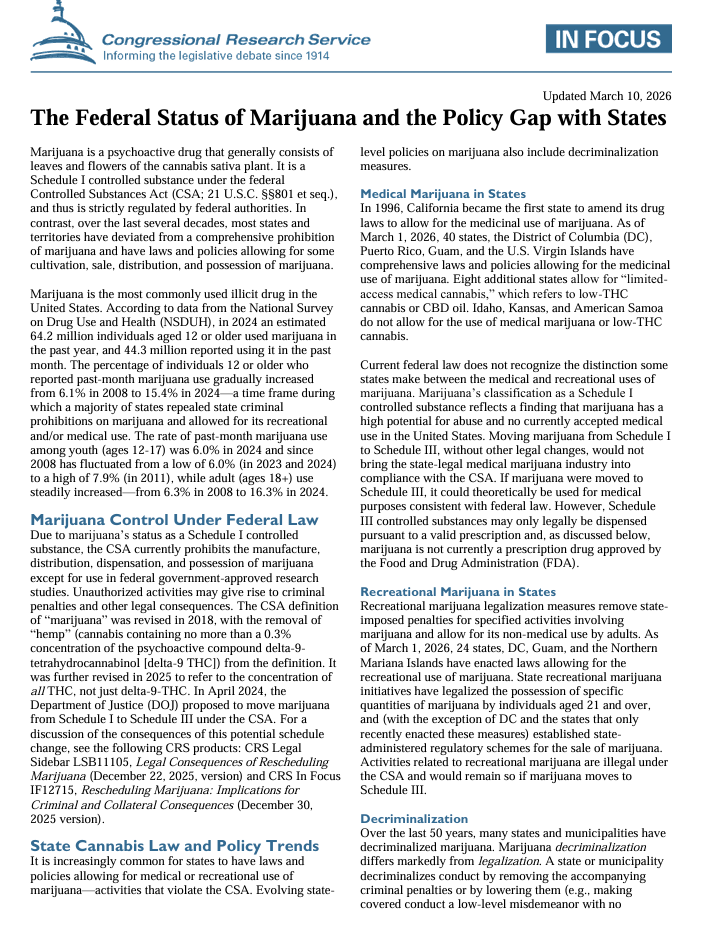
The Federal Status of Marijuana and the Policy Gap with States

By Lisa N. Sacco, Joanna R. Lampe, Hassan Z. Sheikh

Marijuana is a psychoactive drug that generally consists of leaves and flowers of the cannabis sativa plant. It is a Schedule I controlled substance under the federal Controlled Substances Act (CSA; 21 U.S.C. §§801 et seq.), and thus is strictly regulated by federal authorities. In contrast, over the last several decades, most states and territories have deviated from a comprehensive prohibition of marijuana and have laws and policies allowing for some cultivation, sale, distribution, and possession of marijuana.


Marijuana is the most commonly used illicit drug in the United States. According to data from the National Survey on Drug Use and Health (NSDUH), in 2024 an estimated 64.2 million individuals aged 12 or older used marijuana in the past year, and 44.3 million reported using it in the past month. The percentage of individuals 12 or older who reported past-month marijuana use gradually increased from 6.1% in 2008 to 15.4% in 2024—a time frame during which a majority of states repealed state criminal prohibitions on marijuana and allowed for its recreational and/or medical use. The rate of past-month marijuana use among youth (ages 12-17) was 6.0% in 2024 and since 2008 has fluctuated from a low of 6.0% (in 2023 and 2024) to a high of 7.9% (in 2011), while adult (ages 18+) use steadily increased—from 6.3% in 2008 to 16.3% in 2024.


Washington, DC: Congressional Research Service; March 10, 2026.

Entering the Void: Chinese illicit networks in Mexico

By Barbara Kelemen | Ján Slobodník

This CEIAS paper aims to shed light on cooperation between Chinese businesses and Mexican criminal groups. It specifically analyzes cases related to drug trafficking and the exploitation of natural resources in three states in Mexico. The topic is particularly relevant for countries in Latin America that have been expanding their commercial ties with China. This research suggests that the lack of state supervision in some of these countries could allow alternative structures—such as criminal groups and Chinese organized networks—to thrive and fill the security and economic void if not regulated properly.

Summary

Mexico’s macroeconomic stability and abundant natural resources have made the country into an attractive destination for Chinese businesses.

The country still suffers from a lack of internal security, most of it stemming from the Mexican Drug War, an ongoing multilateral low-intensity conflict between the Mexican government and a large number of criminal organizations.

In some of Mexico’s states, pervasive violence and instability have resulted in a power vacuum. With the government being unable to guarantee security, non-state actors such as criminal organizations and/or civilian militias seize the opportunity to establish their own rule.

When foreign companies operate in such troubled areas, they inevitably run into problems caused by Mexico’s security issues.

Within this trend of foreign companies operating in Mexico, some level of tacit cooperation has been observed between Chinese businesses and non-state actors. This cooperation is often an outcome of localized security vacuums that are exploited by alternative security providers, such as criminal organizations, that can fill them and provide operational safety for local businesses.

A growing body of research has identified the existence of Chinese illicit networks and their involvement in the trafficking of people, narcotics, and contraband goods, as well as money laundering and illegal arms trade in Mexico.

Concealed under the guise of legal commercial activity, networks of Mexican criminal organizations and their Chinese business partners exploit the dire security situation in some areas of Mexico.

Despite attempts by the Chinese and the Mexican governments to regulate certain sectors that contribute to the existence of the illicit networks in Mexico, there are still substantial opportunities that are ripe for exploitation by the criminal group-legitimate business partnerships

Assessment Of The Abuse and Dependence Potential Of New Psychoactive Substances: Synthetic Opioids

By The Laboratory and Scientific Services
United Nations Office on Drugs and Crime; 

The scientific evaluation of substances for inclusion in international and most national legislations requires an assessment of a range of chemical, pharmacological, and toxicological properties of a substance. Also, for many of the NPS that have emerged, quality comparable scientific data on these properties are either scarce or do not exist. The aim of these UNODC guidelines is to support Member States in the generation of quality scientific data on key pharmacological properties used in the scientific evaluation of substances, specifically the determination of the abuse and dependence potential of NPS. Given the continued emergence of highly potent synthetic opioids in recent years, this guideline will focus on synthetic opioids and future volumes will contain information on other groups of NPS.

Vienna: UNODC< 2025. 58p.

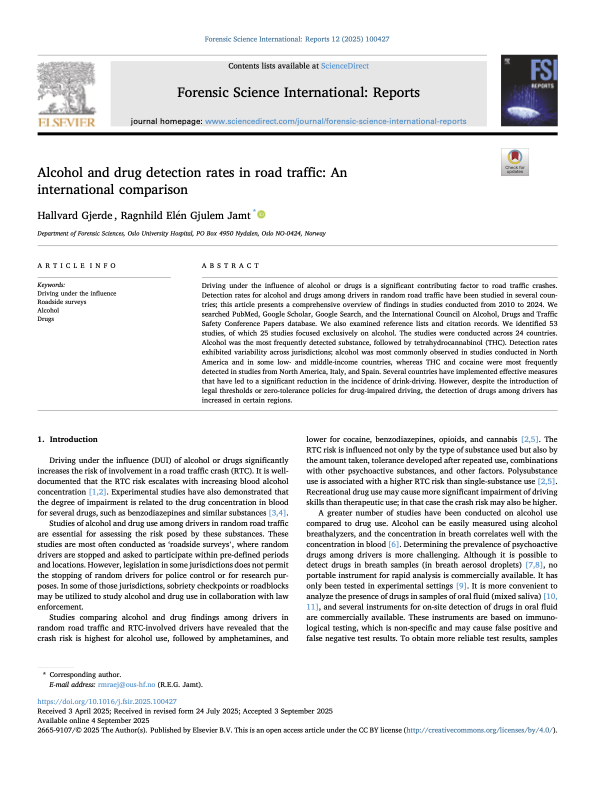
Alcohol and drug detection rates in road traffic: An international comparison

By Hallvard Gjerde, Ragnhild Elén Gjulem Jamt

Driving under the influence of alcohol or drugs is a significant contributing factor to road traffic crashes. Detection rates for alcohol and drugs among drivers in random road traffic have been studied in several countries; this article presents a comprehensive overview of findings in studies conducted from 2010 to 2024. We searched PubMed, Google Scholar, Google Search, and the International Council on Alcohol, Drugs and Traffic Safety Conference Papers database. We also examined reference lists and citation records. We identified 53 studies, of which 25 studies focused exclusively on alcohol. The studies were conducted across 24 countries. Alcohol was the most frequently detected substance, followed by tetrahydrocannabinol (THC). Detection rates exhibited variability across jurisdictions; alcohol was most commonly observed in studies conducted in North America and in some low- and middle-income countries, whereas THC and cocaine were most frequently detected in studies from North America, Italy, and Spain. Several countries have implemented effective measures that have led to a significant reduction in the incidence of drink-driving. However, despite the introduction of legal thresholds or zero-tolerance policies for drug-impaired driving, the detection of drugs among drivers has increased in certain regions.

Forensic Science International: Reports. Dec. 2025

Unregulated Fentanyl in North America

By CECILIA FARFÁN-MÉNDEZ | JASON ELIGH 

More than 1.1 million people in the United States have died from opioid overdoses since 2000. In Canada, over 50,000 lives have been lost to opioid-related overdoses since 2016. Meanwhile, in Mexico, homicide—mostly committed with illegally trafficked firearms—is the leading cause of death among men aged 15 to 44. These overlapping crises reveal that the harms associated with synthetic opioids are not confined to one country but span all of North America.

This policy brief sheds light on how illicitly manufactured fentanyl (IMF) is produced and distributed within and across Mexico, the US, and Canada. The report reveals a complex and highly integrated system of production, tablet pressing, trafficking, and consumption. Far from being a product trafficked into North America, IMF is increasingly produced on its soil.nized Crime trilateral perspective

Illicit Synthetic Drugs: Trafficking Methods, Money Laundering Practices, and Coordination Efforts

By Michael E. Clements, Triana McNeil et al


What GAO Found Mexican transnational criminal organizations are a major supplier of the top two illicit synthetic drugs involved in overdose deaths in the U.S.—fentanyl and methamphetamine. To supply these drugs to U.S. users, these organizations • source and purchase precursor chemicals primarily from China, using payment methods such as electronic funds transfers and virtual currency; • produce or oversee the production of fentanyl and methamphetamine in clandestine labs in Mexico; and • smuggle the drugs across the U.S.-Mexico border and supply them to U.S.- based drug trafficking groups. Local drug trafficking groups sell these drugs to users through e-commerce platforms, online marketplaces, mobile applications, and social media using payment methods such as cash, peer-to-peer payment applications, and virtual currency, according to Financial Crimes Enforcement Network (FinCEN) and Drug Enforcement Administration (DEA) reports. Transnational criminal organizations launder the illicit proceeds from synthetic drug sales using methods such as • bulk cash smuggling (moving physical currency across international borders), • funnel accounts (bank accounts that collect deposits from members of the criminal network in multiple locations), • trade-based money laundering (using goods in trade transactions to disguise the movement of illicit funds), • virtual currency (exchanging bulk cash for virtual currency), and • Chinese money laundering networks. Chinese money laundering networks are largely decentralized and use both underground-banking mechanisms (which bypass formal banking channels) and other laundering methods within banking systems to convert, move, and obscure illicit proceeds for a fee. Mexican transnational criminal organizations are increasingly using these networks in part because their laundering schemes have lower costs than other organizations, according to law enforcement officials. To combat drug trafficking and related money laundering, federal agencies coordinate and share information with each other and with state, local, and international partners through task forces, working and advisory groups, colocation, and other information-sharing channels. These mechanisms help agencies share resources and expertise, prevent overlapping investigations, and combine unique authorities. In addition, starting on January 20, 2025, the administration began instituting a variety of new policies, including some aimed at combating the flow of synthetic drugs into the U.S. For example, ExecutiveOrder 14159 requires the Departments of Justice and Homeland Security to jointly establish Homeland Security Task Forces in all 50 states to end the presence of cartels and transnational criminal organizations in the U.S. Agencies reported that it is too early to assess the full impact of these policies.

Washington, DC: United States Government Accountability Office; 67pp; 2025. 67p.

Abnormal Man : Volume 2 - Bibliography

By Arthur MacDonald.

The narrative in Volume 1 asks many pointed questions: What does it mean to be “abnormal”? Who decides? And how have these judgments shaped modern science, education, and criminal justice?

First published in 1893, Arthur MacDonald’s Abnormal Man is one of the earliest American attempts to systematically study human difference through the emerging tools of psychology, anthropology, and criminology. Drawing on international research—from European criminal anthropology to American child-study movements—MacDonald sought to classify the physical, mental, and moral traits considered “aberrant” in his era. His work reflects the hopes and anxieties of a society confronting rapid industrialization, immigration, social change, and new scientific approaches to crime and mental health.

To the modern reader, Abnormal Man reveals both the ambition and the pitfalls of nineteenth-century science. Its pages contain pioneering observations about child development, deviance, and social responsibility, alongside early theories—now discredited—about heredity, physiognomy, and race. What emerges is a vivid and sometimes unsettling portrait of a culture striving to understand human variation without the benefit of modern psychology or ethical safeguards.

The Read-Me.org edition Volume 1 presents Abnormal Man as both a historical artifact and a gateway to critical reflection. It illustrates how scientific thought evolves, how cultural bias can shape research, and how early debates about abnormality laid the groundwork for contemporary approaches to mental health, special education, criminology, and social policy. To make such work, much of it controversial then as it is today, minimally believable, requires extensive documentation. The voluminous Bibliography of Abnormal Man reproduced here in Volume 2, contains all that Macdnald referred to within his detailed exposition. To some, his arguments may seem unsupported, or lacking in evidence. But he left no stone untuned as this amazing bibliographical documentation of all relative contemporary research

A foundational text at the crossroads of science and society, Abnormal Man invites readers to explore the origins of modern debates about deviance, diversity, and the boundaries of the “normal.”

Read-Me.Org Inc. New York-Philadelphia-Australia. 2025. 240p.

European Drug Report 2025: Trends and Developments

By European Union Drugs Agency (EUDA)

The European Drug Report 2025: Trends and Developments presents the EUDA’s latest analysis of the drug situation in Europe. Focusing on illicit drug use, related harms and drug supply, the report provides a comprehensive set of national data across these themes, as well as on specialist drug treatment and key harm reduction interventions

This report is based on information provided to the EUDA by the EU Member States, the candidate country Türkiye, and Norway, in an annual reporting process. The purpose of the current report is to provide an overview and summary of the European drug situation up to the end of 2024. All grouping, aggregates and labels therefore reflect the situation based on the available data in 2024 in respect to the composition of the European Union and the countries participating in the EUDA’s reporting exercises. However, not all data will cover the full period. Due to the time needed to compile and submit data, many of the annual national data sets included here are from the reference year January to December 2023. Analysis of trends is based only on those countries providing sufficient data to describe changes over the period specified. The reader should also be aware that monitoring patterns and trends in a hidden and stigmatised behaviour such as drug use is both practically and methodologically challenging. For this reason, multiple sources of data are used for the purposes of analysis in this report. Although considerable improvements can be noted, both nationally and in respect to what is possible to achieve in a European-level analysis, the methodological difficulties in this area must be acknowledged. Caution is therefore required in interpretation, in particular when countries are compared on any single measure. Caveats relating to the data are to be found in the online Statistical Bulletin 2025 , which contains detailed information on methodology, qualifications on analysis and comments on the limitations in the information set available. Information is also available there on the methods and data used for European-level estimates, where interpolation may be used :

PortugalEuropean Union Drugs Agency (EUDA); 2025 355p