
Open Access Publisher and Free Library
CRIME+CRIMINOLOGY.jpeg

CRIME

Violent-Non-Violent-Cyber-Global-Organized-Environmental-Policing-Crime Prevention-Victimization

Posts in Fraud
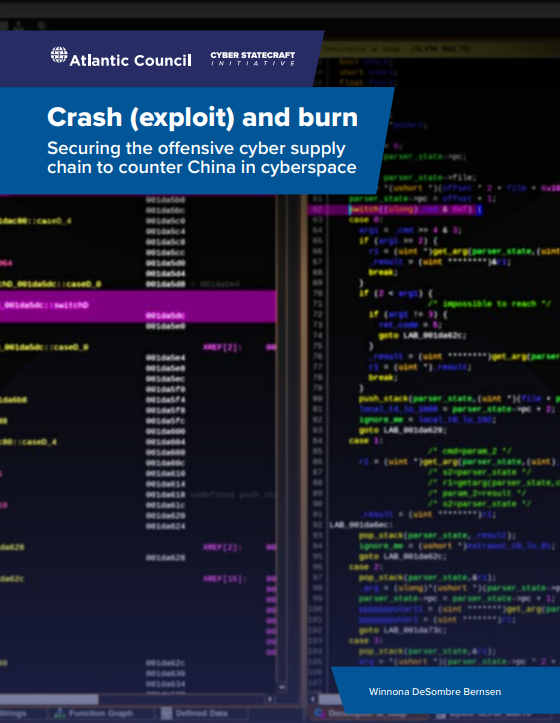
Crash (exploit) and burn: Securing the offensive cyber supply chain to counter China in cyberspace,

By Winnona DeSombre Bernsen

If the United States wants to increasingly use offensive cyber operations internationally, does it have the supply chain and acquisition capabilities to back it up—especially if its adversary is the People’s Republic of China? 

 The Cyber Statecraft Initiative’s new report from CSI nonresident fellow Winnona DeSombre Bernsen, Crash (exploit) and burn: Securing the offensive cyber supply chain to counter China in cyberspace,  is the first to conduct a comparative study within the international offensive cyber supply chain, comparing the United States’ fragmented, risk-averse acquisition model with China’s outsourced and funnel-like approach.

 Strategic competition between the United States and China has long played out in cyberspace, where offensive cyber capabilities, like zero-day vulnerabilities, are a strategic resource. Since 2016, China has been turning the zero-day marketplace in East Asia into a funnel of offensive cyber capabilities for its military and intelligence services, both to ensure it can break into the most secure Western technologies and to deny the United States from obtaining similar capabilities from the region. If the United States wishes to compete in cyberspace, it must compete against China to secure its offensive cyber supply chain.

Washington, DC: Atlantic Council, 2025. 44p

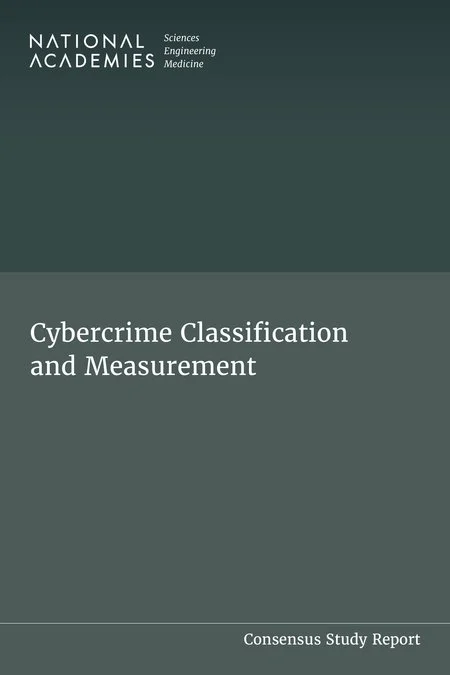
Cybercrime Classification and Measurement

By Hal S. Stern and Daniel L. Cork, Editors

Cybercrime poses serious threats and financial costs to individuals and businesses in the United States and worldwide. Reports of data breaches and ransomware attacks on governments and businesses have become common, as have incidents against individuals (e.g., identity theft, online stalking, and harassment). Concern over cybercrime has increased as the internet has become a ubiquitous part of modern life. However, comprehensive, consistent, and reliable data and metrics on cybercrime still do not exist - a consequence of a shortage of vital information resulting from the decentralized nature of relevant data collection at the national level.

Cybercrime Classification and Measurement addresses the absence credible cybercrime data and metrics. This report provides a taxonomy for the Federal Bureau of Investigation for the purpose of measuring different types of cybercrime, including both cyber-enabled and cyber-dependent crimes faced by individuals and businesses, and considers the needs for its periodic revision. This report was mandated by the 2022 Better Cybercrime Metrics Act (BCMA).

Washington, DC: The National Academies Press., 2025. 160p.

Extended editorial: preventing fraud and cybercrime in an ageing society

By Mark Button  · Vasileios Karagiannopoulos  · Julak Lee  · Joon Bae Suh  · Jeyong Jung

Introduction The nature of crime has been changing globally with technological and other societal developments fuelling a growth in fraud and cybercrime (Button and Cross 2017). The diversity and rapid evolution of a broad range of scams has led to millions across the globe becoming victims of fraud (Federal Trade Commission 2019; ONS 2023a, 2023b). A common belief often promoted in policy circles and some research is that older adults are more vulnerable to fraud (James et al. 2014). This is not so clear cut, however, as in terms of victimisation, the middle aged have been most at risk (see Fig. 1 later). This is changing and there is evidence older adults (65+) are fast becoming the one of the most at risk categories and that they also tend to lose much more than other age groups (see Table 1 later). Indeed, there are a variety of trends fuelling a potential explosion in fraud and cybercrime among older adults unless serious action is taken to reduce the risks that we will shortly explore. It is for this reason we conceived this special edition and the research project that underpins it. To set the context for this edition, it is important to examine the factors fuelling the growth in fraud and cybercrime victimisation among older age groups. We will do this using data from the UK and South Korea. The reason for the selection of these countries is simple. The funding for the project stimulating this edition came from ESRC funding aimed at developing relationships with these two countries 

  Security Journal (2025) 38:40

Cyber‑enabled imposter scams against older adults in the United States

By Lauren R. Shapiro 

This paper evaluated three cyber-enabled imposter scams against older adults using Lifestyle Routine Activity Theory. The frst section examined the motivated ofender’s tools for manipulating older adult targets (social engineering and persuasion) and explained how Artifcial Intelligence could increase exposure and susceptibility of imposter victims. The next section focused on the suitable victim by examining how heuristics and impaired cognitive, physical, and psychosocial abilities contributed to the older adult target’s susceptibility to imposter scam by interfering with the process of rational decision-making. The third section examined ways in which capable guardians, in the form of agencies and laws, protected and helped older adult targets from imposter scams. Recommendations regarding the creation of educational programs that teach older adults how to be safer online (i.e., less suitable victims) through evaluating risks, identifying potential imposter scams, and becoming efcient self-advocators were provided.   

  Security Journal (2025) 38:43

Fear of fraud amongst older adults: a hidden epidemic? 

By Mark Button  · David Shepherd  · Chloe Hawkins  · Jacki Tapley

This paper explores older adults who are largely over 75 and their experience of fraud, based upon research with the clients of a UK charity working with this age group. The researchers used a postal questionnaire yielding almost 2000 responses, supplemented with interviews with clients and key staf. The research found higher rates of fraud victimisation than national rates for this age group as well regular attempted frauds, largely through the telephone. The experience of fraud and attempted fraud has a devastating impact on some of the lives of older adults, causing fear, anxiety, and related issues, which afects their quality of life. This is the frst study to illustrate that fear of fraud is a major problem amongst older adults, particularly females living alone.  

Security Journal (2025) 38:44

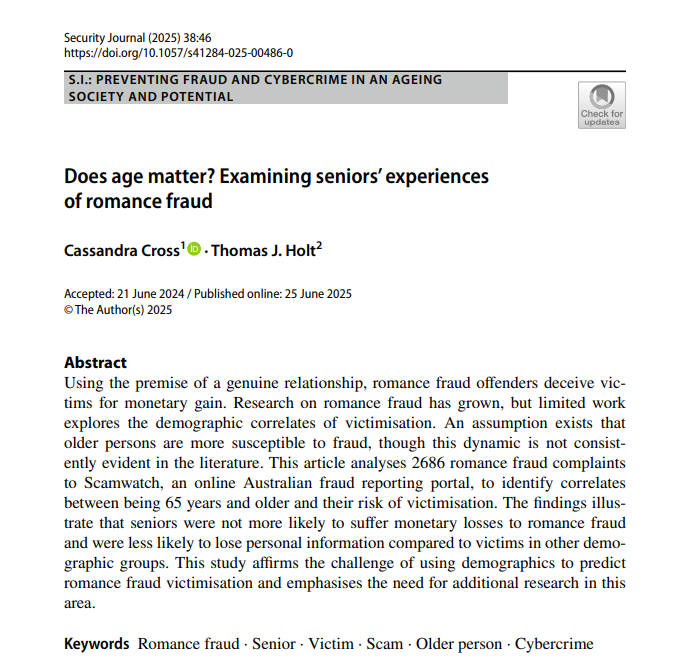
  Does age matter? Examining seniors’ experiences of romance fraud

By Cassandra Cross  · Thomas J. Holt 

Using the premise of a genuine relationship, romance fraud ofenders deceive victims for monetary gain. Research on romance fraud has grown, but limited work explores the demographic correlates of victimisation. An assumption exists that older persons are more susceptible to fraud, though this dynamic is not consistently evident in the literature. This article analyses 2686 romance fraud complaints to Scamwatch, an online Australian fraud reporting portal, to identify correlates between being 65 years and older and their risk of victimisation. The fndings illustrate that seniors were not more likely to sufer monetary losses to romance fraud and were less likely to lose personal information compared to victims in other demographic groups. This study afrms the challenge of using demographics to predict romance fraud victimisation and emphasises the need for additional research in this area 

  Security Journal (2025) 38:46

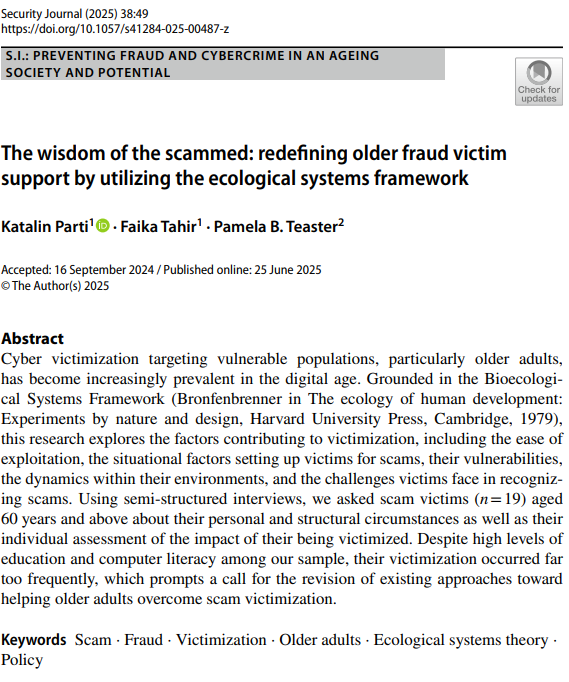
The wisdom of the scammed: redefning older fraud victim support by utilizing the ecological systems framework

By Katalin Parti  · Faika Tahir  · Pamela B. Teaster 

Cyber victimization targeting vulnerable populations, particularly older adults, has become increasingly prevalent in the digital age. Grounded in the Bioecological Systems Framework (Bronfenbrenner in The ecology of human development: Experiments by nature and design, Harvard University Press, Cambridge, 1979), this research explores the factors contributing to victimization, including the ease of exploitation, the situational factors setting up victims for scams, their vulnerabilities, the dynamics within their environments, and the challenges victims face in recognizing scams. Using semi-structured interviews, we asked scam victims (n=19) aged 60 years and above about their personal and structural circumstances as well as their individual assessment of the impact of their being victimized. Despite high levels of education and computer literacy among our sample, their victimization occurred far too frequently, which prompts a call for the revision of existing approaches toward helping older adults overcome scam victimization.  

  Security Journal (2025) 38:49

Safeguarding Singapore: Addressing the Impact of Transnational Scamming Operations in Southeast Asia

By Yen Zhi Yi
SYNOPSIS
In recent months, heightened media scrutiny has drawn attention to the proliferation of scam centres along Myanmar’s border towns and the subsequent crackdowns on them. Concurrently, Singapore has also witnessed a significant increase in scam-related incidents, with the government urging vigilance and taking precautionary measures to safeguard its citizens. Against this backdrop, it is imperative for ASEAN countries to work collaboratively to tackle this growing cross-border scourge. Doing so calls for stepped-up action at home to enhance awareness and enforcement collaboration abroad among regional partners to check this transnational security challenge.
 
S. Rajaratnam School of International Studies, NTU Singapore, 2025. 6p.

Fraud Against Individuals

By The Swedish National Council for Crime Prevention

This report focuses on how circumstances and situations that make fraud possible are targeted by fraud prevention measures. The report also includes recommendations for different crime prevention actors.