

By Beau Kilmer
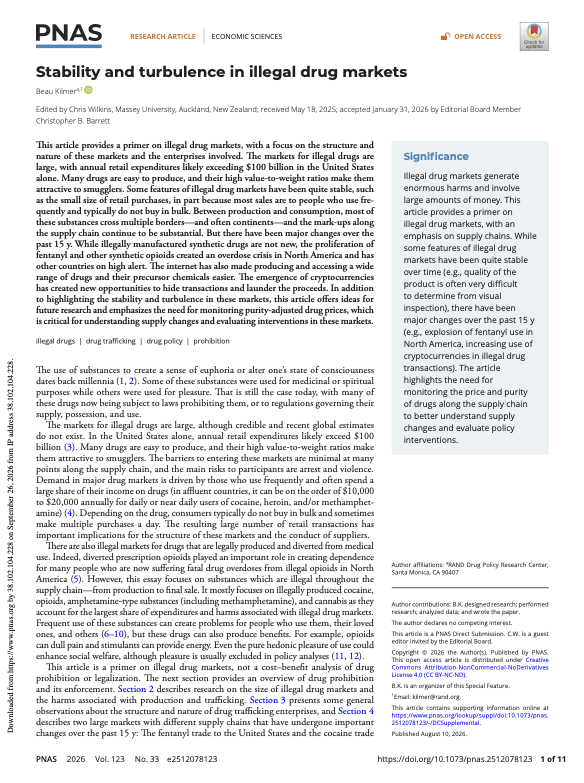
This article provides a primer on illegal drug markets, with a focus on the structure and nature of these markets and the enterprises involved. The markets for illegal drugs are large, with annual retail expenditures likely exceeding $100 billion in the United States alone. Many drugs are easy to produce, and their high value- to-weight ratios make them attractive to smugglers. Some features of illegal drug markets have been quite stable, such as the small size of retail purchases, in part because most sales are to people who use frequently and typically do not buy in bulk. Between production and consumption, most of these substances cross multiple borders—and often continents—and the mark- ups along the supply chain continue to be substantial. But there have been major changes over the past 15 y. While illegally manufactured synthetic drugs are not new, the proliferation of fentanyl and other synthetic opioids created an overdose crisis in
North America and has other countries on high alert. The internet has also made producing and accessing a wide range of drugs and their precursor chemicals easier. The emergence of cryptocurrencies has created new opportunities to hide transactions and launder the proceeds. In addition to highlighting the stability and turbulence in these markets, this article offers ideas for future research and emphasizes the need for monitoring purity-adjusted drug prices, which is critical for understanding supply changes and evaluating
interventions in these markets.
By Jay P. Kennedy
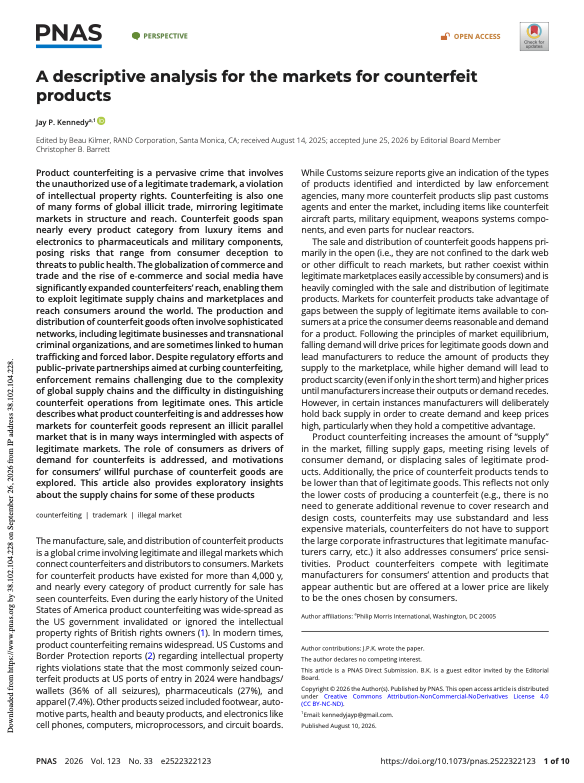
Product counterfeiting is a pervasive crime that involves the unauthorized use of a legitimate trademark, a violation of intellectual property rights. Counterfeiting is also one of many forms of global illicit trade, mirroring legitimate markets in structure and reach. Counterfeit goods span nearly every product category from luxury items and electronics to pharmaceuticals and military components, posing risks that range from consumer deception to threats to public health. The globalization of commerce and trade and the rise of e-commerce and social media have significantly expanded counterfeiters’ reach, enabling them to exploit legitimate supply chains and marketplaces and reach consumers around the world. The production and
distribution of counterfeit goods often involve sophisticated networks, including legitimate businesses and transnational criminal organizations, and are sometimes linked to human trafficking and forced labor. Despite regulatory efforts and public–private partnerships aimed at curbing counterfeiting, enforcement remains challenging due to the complexity of global supply chains and the difficulty in distinguishing counterfeit operations from legitimate ones. This article describes what product counterfeiting is and addresses how
markets for counterfeit goods represent an illicit parallel market that is in many ways intermingled with aspects of legitimate markets. The role of consumers as drivers of demand for counterfeits is addressed, and motivations for consumers’ willful purchase of counterfeit goods are explored. This article also provides exploratory insights about the supply chains for some of these products
By Joras Ferwerda
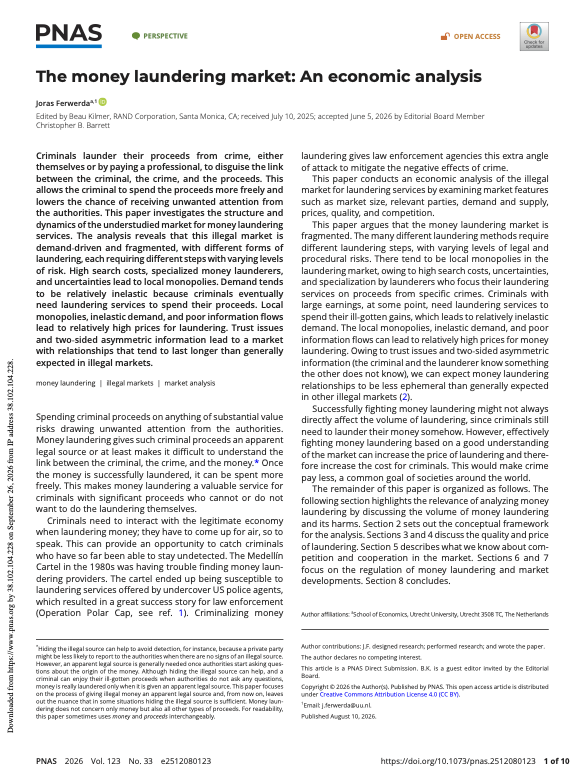
Criminals launder their proceeds from crime, either themselves or by paying a professional, to disguise the link between the criminal, the crime, and the proceeds. This allows the criminal to spend the proceeds more freely and lowers the chance of receiving unwanted attention from the authorities. This paper investigates the structure and dynamics of the understudied market for money laundering services. The analysis reveals that this illegal market is demand-driven and fragmented, with different forms of laundering, each requiring different steps with varying levels of risk. High search costs, specialized money launderers, and uncertainties lead to local monopolies. Demand tends to be relatively inelastic because criminals eventually need laundering services to spend their proceeds. Local monopolies, inelastic demand, and poor information flows
lead to relatively high prices for laundering. Trust issues and two-sided asymmetric information lead to a market with relationships that tend to last longer than generally expected in illegal markets.
By Philip J. Cook, and Rosanna Smart
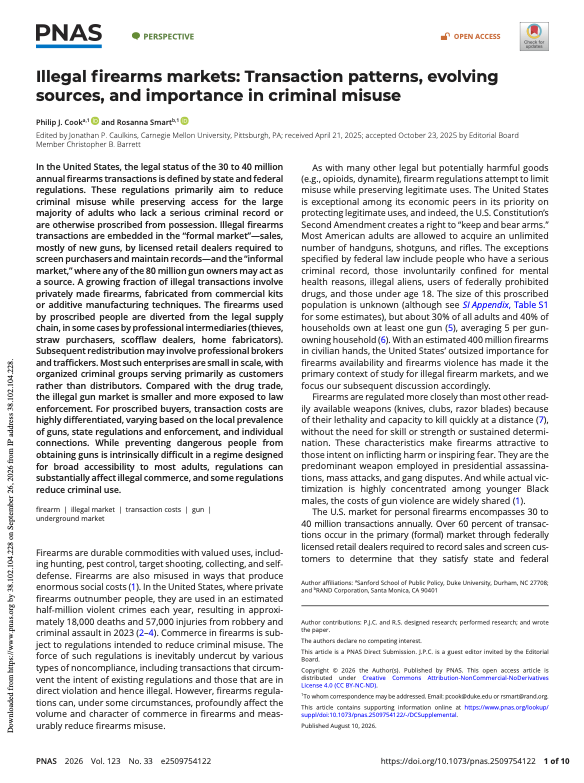
In the United States, the legal status of the 30 to 40 million annual firearms transactions is defined by state and federal regulations. These regulations primarily aim to reduce criminal misuse while preserving access for the large majority of adults who lack a serious criminal record or are otherwise proscribed from possession. Illegal firearms transactions are embedded in the “formal market”—sales, mostly of new guns, by licensed retail dealers required to screen purchasers and maintain records—and the “informal market,” where any of the 80 million gun owners may act as a source. A growing fraction of illegal transactions involve privately made firearms, fabricated from commercial kits or additive manufacturing techniques. The
firearms used by proscribed people are diverted from the legal supply chain, in some cases by professional intermediaries (thieves, straw purchasers, scofflaw dealers, home fabricators). Subsequent redistribution may involve professional brokers and traffickers. Most such enterprises are small in scale, with organized criminal groups serving primarily as customers rather than distributors. Compared with the drug trade, the illegal gun market is smaller and more exposed to law enforcement. For proscribed buyers, transaction costs are highly
differentiated, varying based on the local prevalence of guns, state regulations and enforcement, and individual connections. While preventing dangerous people from obtaining guns is intrinsically difficult in a regime designed for broad accessibility to most adults, regulations can substantially affect illegal commerce, and some regulations reduce criminal use.