
Open Access Free Library
CRIME+CRIMINOLOGY.jpeg

CRIME

Violent-Non-Violent-Cyber-Global-Organized-Environmental-Policing-Crime Prevention-Victimization

Posts in Drug markets
Drug Dealers, Robbery and Retaliation. Vulnerability, Deterrence and the Contagion of Violence

VOLKAN TOPALLI , RICHARD WRIGHT and ROBERT FORNANGO

Because of their illicit status, drug dealers robbed in the course of doing business cannot go to the police. Thus, the deterrent, compensatory and retributive benefits of formal justice are unavailable to them. Informal avenues of redress represent their only means of obtaining justice. This article, based on interviews with 20 recently robbed, active drug dealers in St Louis, Missouri, explores how such victims perceive and respond to the assault. Results indicate that direct retaliation is the preferred response because it serves three important aims: reputation maintenance, loss recovery and vengeance. When dealer/victims are unable or unwilling to retaliate they resort to less satisfactory alternatives such as robbery displacement and the resumption of selling. The implications of these findings for the spread of drug market violence are discussed.

BRIT. J. CRIMINOL.. (2002) 42, 337–351
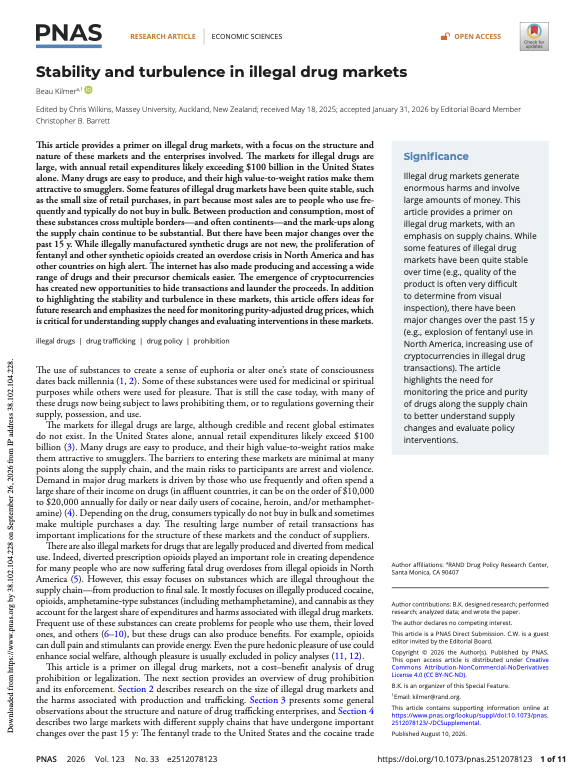
Stability and turbulence in illegal drug markets

By Beau Kilmer

This article provides a primer on illegal drug markets, with a focus on the structure and nature of these markets and the enterprises involved. The markets for illegal drugs are large, with annual retail expenditures likely exceeding $100 billion in the United States alone. Many drugs are easy to produce, and their high value- to-weight ratios make them attractive to smugglers. Some features of illegal drug markets have been quite stable, such as the small size of retail purchases, in part because most sales are to people who use frequently and typically do not buy in bulk. Between production and consumption, most of these substances cross multiple borders—and often continents—and the mark- ups along the supply chain continue to be substantial. But there have been major changes over the past 15 y. While illegally manufactured synthetic drugs are not new, the proliferation of fentanyl and other synthetic opioids created an overdose crisis in
North America and has other countries on high alert. The internet has also made producing and accessing a wide range of drugs and their precursor chemicals easier. The emergence of cryptocurrencies has created new opportunities to hide transactions and launder the proceeds. In addition to highlighting the stability and turbulence in these markets, this article offers ideas for future research and emphasizes the need for monitoring purity-adjusted drug prices, which is critical for understanding supply changes and evaluating
interventions in these markets.