Open Access Free Library
CRIME+CRIMINOLOGY.jpeg

CRIME

Violent-Non-Violent-Cyber-Global-Organized-Environmental-Policing-Crime Prevention-Victimization

Posts in Firearms
An Evaluation of the 1977 Canadian Firearm Legislation: Robbery Involving a Firearm

by Gary A. Mauser

The effect of the 1977 Canadian firearm legislation on robberies involving firearms is evaluated between 1974 and 1992 using a pooled cross-section, time series model. The results show that the 1977 legislation did not reduce robbery involving firearms, nor did it have a significant effect on the total robbery or armed robbery rates. The legislation may even have acted perversely in that it may have increased robberies with firearms. In general, these results are consistent with previous published findings but contrast with unpublished governmental studies. The implication that this legislation may have acted perversely is new and requires further investigation.

Unpublished.

A Randomized Controlled Trial of an Adapted Form of Individual Critical Incident Stress Debriefing for Victims of an Armed Robbery

Victims of an armed robbery are at great risk of psychological distress. This research is a prospective randomized controlled clinical trial of an adapted form of Critical Incident Stress Debriefing (CISD-A) with victims of an armed robbery. The specific goals are to examine whether the CISD-A is superior to the control group in both preventing the development of a posttraumatic stress disorder (PTSD) and attenuating the frequency and severity of posttraumatic stress symptoms. Following pretest, 75 participants were randomly assigned to individual debriefing or to a control group. Results revealed no differences between the CISD-A and the control group in preventing PTSD or attenuating posttraumatic symptoms 1 and 3 months later. [Brief Treatment and Crisis Intervention 6:122–129 (2006)]

Contact author: Andre´Marchand, Department of Psychology, Universite´du Que´bec a ` Montre´al, C.P. 8888, Succ. Centre-ville, Montre´al, Que´bec, Canada H3C 3P8. E-mail: marchand.andre@uqam.ca.

doi:10.1093/brief-treatment/mhj007 Advance Access publication March 24, 2006

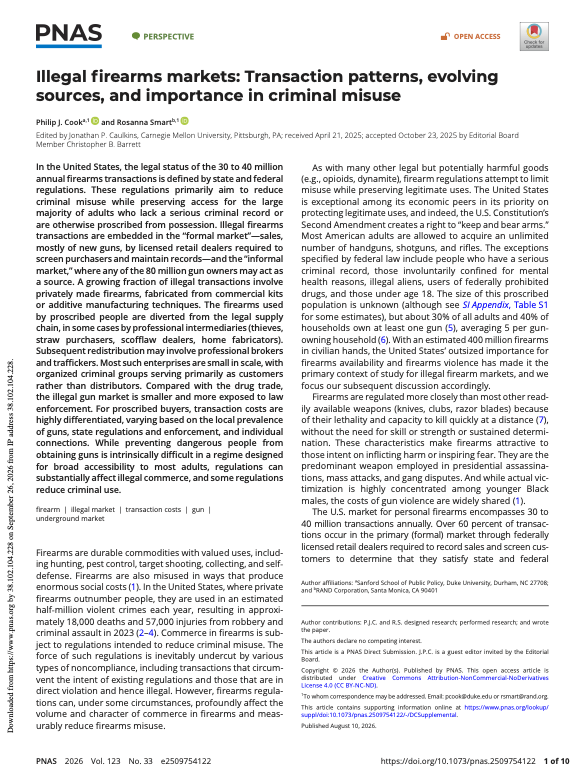
Illegal Firearms Markets. Transaction Patterns, Evolving Sources, and Importance in Criminal Misuse

By Philip J. Cook, and Rosanna Smart

In the United States, the legal status of the 30 to 40 million annual firearms transactions is defined by state and federal regulations. These regulations primarily aim to reduce criminal misuse while preserving access for the large majority of adults who lack a serious criminal record or are otherwise proscribed from possession. Illegal firearms transactions are embedded in the “formal market”—sales, mostly of new guns, by licensed retail dealers required to screen purchasers and maintain records—and the “informal market,” where any of the 80 million gun owners may act as a source. A growing fraction of illegal transactions involve privately made firearms, fabricated from commercial kits or additive manufacturing techniques. The
firearms used by proscribed people are diverted from the legal supply chain, in some cases by professional intermediaries (thieves, straw purchasers, scofflaw dealers, home fabricators). Subsequent redistribution may involve professional brokers and traffickers. Most such enterprises are small in scale, with organized criminal groups serving primarily as customers rather than distributors. Compared with the drug trade, the illegal gun market is smaller and more exposed to law enforcement. For proscribed buyers, transaction costs are highly
differentiated, varying based on the local prevalence of guns, state regulations and enforcement, and individual connections. While preventing dangerous people from obtaining guns is intrinsically difficult in a regime designed for broad accessibility to most adults, regulations can substantially affect illegal commerce, and some regulations reduce criminal use.